


The United States had not issued an official response by Friday after Iran attacked a commercial vessel in the Strait of Hormuz, in what appeared to be a violation of a U.S.-Iran memorandum of understanding intended to guarantee freedom of navigation through the strategic waterway.
According to international reports, the vessel was struck by a drone near the coast of Oman, damaging its bridge. No injuries were reported. U.S. officials told Reuters that Iran fired on the cargo ship.
Gallery
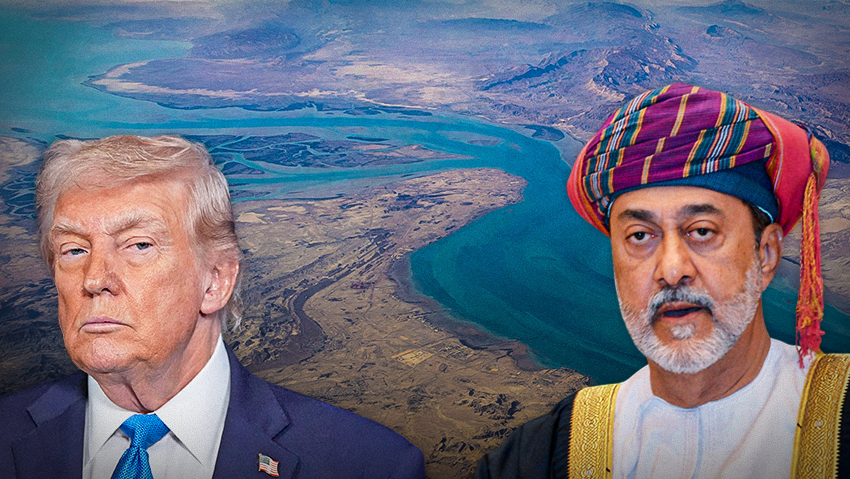
US President Donald Trump, Oman Sultan Haitham bin Tariq
(Photo: Brendan SMIALOWSKI / AFP, REUTERS/Stringer, AP, Oman News Agency)
The attack came hours after Iran's Islamic Revolutionary Guard Corps warned ships not to use shipping lanes through the Strait of Hormuz that had not been approved by Tehran. Following the incident, maritime traffic through the strait was again disrupted, despite U.S. President Donald Trump's assertion that the United States had effectively secured the waterway. The United Nations' International Maritime Organization subsequently suspended its voluntary ship evacuation initiative through the strait while it reassesses safety guarantees.
Iran portrayed the incident as a defensive response.
In a statement, the Revolutionary Guard said it viewed "the movements and presence of military aircraft belonging to Israel in the airspace of certain neighboring countries as a dangerous act and a threat to the Islamic Republic."
"If the United States fails to restrain Israel and keep it under control, the Islamic Republic will not tolerate any threat directed against it," the statement said, adding that Iran reserved the right to respond to what it called such "dangerous actions."
The Strait of Hormuz, which links the Persian Gulf to the Gulf of Oman, is one of the world's most important energy chokepoints, carrying roughly one-fifth of global oil shipments.
Many commercial vessels have recently chosen to sail through a southern corridor near Oman's coastline rather than routes favored by Iran, a development that has angered Tehran.

Oman Sultan Haitham bin Tariq and Iranian Foreign Minister Abbas Araghchi
"The route is unacceptable and extremely dangerous," the Revolutionary Guard said Thursday, warning vessels to avoid sailing outside routes recognized by Iran. It said action would be taken against ships that ignored its instructions, and the reported drone strike appeared consistent with that warning.
An Iranian official familiar with the matter told The New York Times that Oman had angered Tehran by providing alternative shipping routes, which Iran views as an attempt to undermine its control over the strategic waterway.
According to the official, Oman finds itself in a difficult position, working with Iran to establish a mechanism for managing shipping through the strait while facing U.S. pressure to reject any Iranian effort to charge transit fees and instead maintain free navigation.
Iran has argued that once the current 60-day memorandum of understanding expires, it should be allowed to collect transit fees from vessels using the strait. Iranian officials estimate such fees could generate about $40 billion annually.
The same Iranian official said Oman could not provide adequate security guarantees for commercial vessels and warned that Tehran would not tolerate interference by third parties.
Oman, which borders the Strait of Hormuz and has long served as a quiet regional mediator, has played a key role in diplomatic contacts between Iran and the United States as well as between Iran and Saudi Arabia.
Although Muscat continues to describe itself as a neutral mediator committed to regional stability, reports last month indicated it had discussed cooperating with Iran on a system to collect transit fees from ships passing through the strait, despite opposition from the Trump administration.
The disruption in the Strait of Hormuz has also benefited Oman economically.
Unlike several Gulf neighbors, Oman has largely avoided direct Iranian attacks. While disruptions to shipping through the strait have hindered oil and gas exports from Gulf states and pushed global energy prices higher, Oman has continued exporting crude through ports on the Arabian Sea that lie outside the strait.
As neighboring countries suffered heavy export losses, Oman's revenues have risen by about 13%, according to the report. The conflict has also strengthened Oman's position as a regional logistics hub, with cargo previously routed through ports in the United Arab Emirates increasingly diverted to Omani ports before being transported overland.