

President Donald Trump said Saturday that India and Pakistan agreed to a ceasefire after U.S.-mediated talks. Neither country has immediately confirmed the deal.

The announcement follows weeks of hostilities between the two nuclear-armed rivals, who have exchanged missile strikes, drone attacks, and artillery fire in their most serious confrontation in decades. Tensions have escalated since a gun massacre last month, which India blames on Pakistan.
On his Truth Social platform, Trump announced: “After a long night of talks mediated by the United States, I am pleased to announce that India and Pakistan have agreed to a FULL AND IMMEDIATE CEASEFIRE. Congratulations to both Countries on using Common Sense and Great Intelligence. Thank you for your attention to this matter!”
Brian Hughes, a spokesman for the White House’s National Security Council, echoed Trump’s sentiment on X, posting, “@POTUS is a force for peace,” alongside a link to Trump’s statement. However, no further details were provided.
Pakistan’s warnings and retaliation
Pakistan's Foreign Minister Ishaq Dar said earlier Saturday that his country would consider de-escalation if India stopped further attacks. However, he warned that any additional strikes by India would prompt a response.
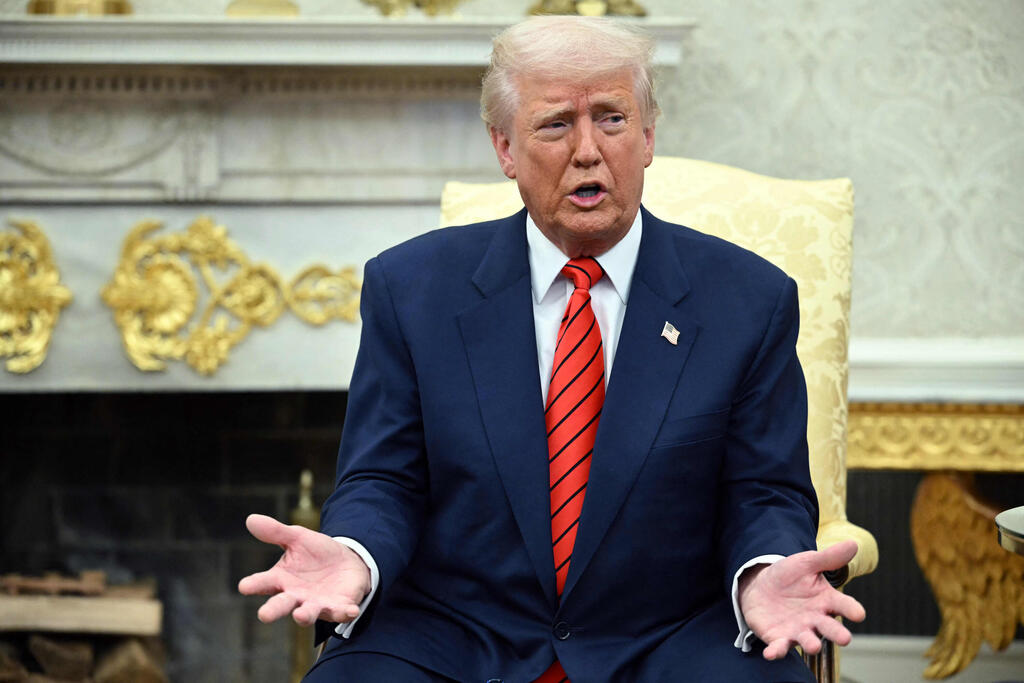
President Donald Trump
(Photo: Evelyn Hockstein / Reuters)
“We responded because our patience had reached its limit. If they stop here, we will also consider stopping,” Dar said in an interview with Pakistan's Geo News. He also noted that he conveyed this message to U.S. Secretary of State Marco Rubio, who contacted him after speaking with Indian officials.
India reported that it targeted Pakistani air bases following missile attacks from Pakistan that struck military and civilian infrastructure in Punjab state early Saturday. Pakistan claimed to have intercepted most of the missiles and conducted retaliatory strikes on Indian targets.
Secretary of State Marco Rubio spoke with his Indian counterpart, Subrahmanyam Jaishankar, and emphasized the need for both sides to identify ways to de-escalate and reestablish direct communication to avoid miscalculation, according to State Department spokesperson Tammy Bruce. The U.S. also offered support to facilitate “productive discussion.”
Rising military action in Kashmir
India’s military accused Pakistan of targeting health facilities and schools at three air bases in Indian-controlled Kashmir. “A befitting reply has been given to Pakistani actions,” said Indian Col. Sofiya Qureshi during a press briefing in New Delhi.
Wing Commander Vyomika Singh reiterated India’s commitment to “non-escalation” so long as Pakistan reciprocated. However, Singh warned that Pakistan’s ground forces were mobilizing toward forward areas, signaling a potential offensive. “Indian armed forces remain in a high state of operational readiness,” she said, adding that India’s strikes were limited to identified military targets, such as technical infrastructure and radar sites.

Indian Prime Minster Narendra Modi alongside PM Netanyahu
(Photo: GPO)
Meanwhile, Pakistan’s military claimed to have used medium-range Fateh missiles to hit an Indian missile storage facility and air bases in Pathankot and Udhampur. Army spokesman Lt. Gen. Ahmad Sharif stated that Pakistan’s air force assets remained safe despite India’s assaults.
Civilian impact and widespread tensions
The situation has been particularly dire in Indian-controlled Kashmir, where recent attacks have left buildings destroyed or severely damaged. Powerful blasts have torn off roofs, shattered windows, and riddled homes with holes.
Explosions were reported in the cities of Srinagar and Jammu, as well as the garrison town of Udhampur. Residents described hearing loud blasts throughout the night. “It looks like a war here,” said Shesh Paul Vaid, a former top police official in Jammu.
<< Get the Ynetnews app on your smartphone: Google Play: https://bit.ly/4eJ37pE | Apple App Store: https://bit.ly/3ZL7iNv >>
Mohammed Yasin, a resident near Srinagar’s airport, recounted how explosions jolted his children out of sleep. “They started crying. I heard at least two explosions,” he said.
The conflict has reached a point where analysts fear it could spiral further. Praveen Donthi, a senior analyst at the International Crisis Group, said, “It’s become a remorseless race for military one-upmanship with no apparent strategic end goals from either side. Finding an exit or off-ramp is going to be challenging.”
India and Pakistan have engaged in heavy cross-border fire for days, resulting in civilian casualties on both sides. The long-standing tensions between the two nations continue to destabilize the region, despite Trump’s announcement of a ceasefire. Whether the ceasefire will hold remains uncertain as both sides remain on high alert.