

More than 100 Israeli rioters descended overnight on the Palestinian village of Jalud near Nablus as Israeli forces attempted to return a Palestinian family to the home it had left after months of repeated harassment, according to the IDF and police. Rioters blocked roads, set tires and Palestinian property on fire and threw stones at security forces, leaving three Border Police officers lightly injured.
The Tubasi family left its home in Jalud in July after months of harassment by extremist settlers. Ahead of the family’s attempted return, messages circulated in Hilltop Youth groups calling on supporters to come to the area and prevent it.
Palestinian footage of the arson


The IDF said the operation to return the family was ultimately abandoned because of the violence.
“More than 100 Israeli rioters were present in the village, blocking roads, setting tires on fire and throwing stones at security forces,” the military said. “The rioters also set fire to Palestinian buildings in the village, torched vehicles and other property.”
Three Border Police officers were lightly injured in the clashes, and a security-force vehicle was damaged. The military said riot-control measures were used against the crowd.
Three Israeli suspects were arrested. Two, aged 15 and 17, were detained by IDF troops and transferred to police, while an 18-year-old Jerusalem resident was later arrested after police said they found balaclavas and a club inside a suspicious vehicle in the area.
Police investigators and forensic teams were expected to enter the village under IDF protection to collect evidence and testimony.
“The security establishment strongly condemns any harm to security personnel while carrying out their duties, as well as acts of vandalism and damage to property,” the IDF said. “Such incidents divert attention, undermine stability and hinder the security forces’ defensive and counterterrorism activities.”
Family says months of harassment drove them out
The Tubasi family had lived in Jalud, in the Nablus area, until leaving in July. Earlier this month, family patriarch Mahmoud Tubasi told Ynet that the family had spent nearly three months effectively trapped in its home before finally leaving.
“For almost three months we were besieged in our house, and in the end they drove us out,” he said.
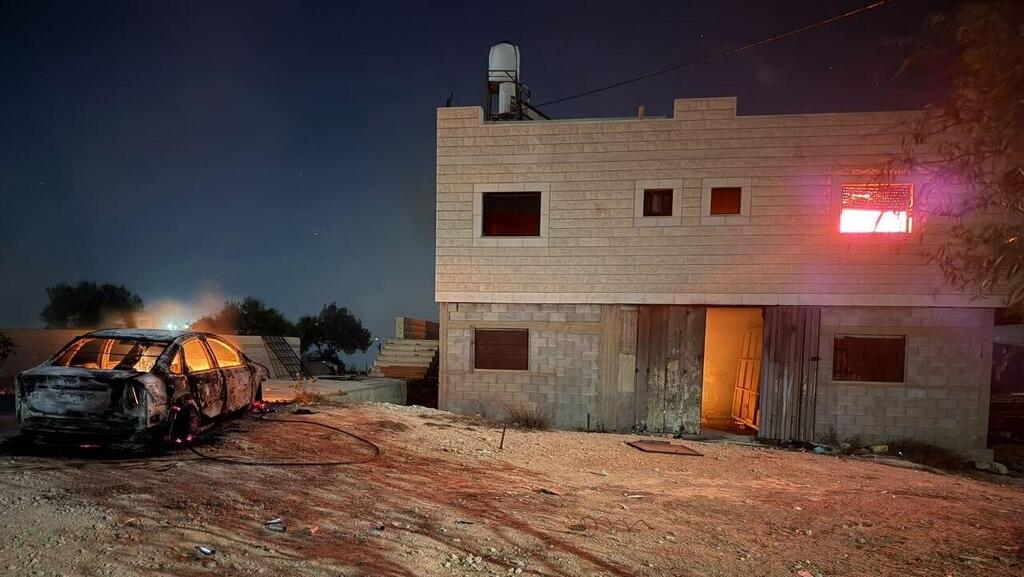
The arson attack in Jalud
Tubasi said the harassment began in early April and targeted two adjacent houses built by members of his family.
“On the night of April 3, settlers came and set fire to the doors of the houses. We woke up in panic and managed to put out the fire,” he said.
“On April 19, settlers came again and put up a sukkah next to our houses, right beside them, and from then on they didn’t leave. They threw stones at our homes day and night and played loud music at night so we couldn’t sleep.”
Tubasi said the family was also threatened with being burned “like the Dawabshe family,” referring to the Palestinian family attacked in an arson attack in the West Bank village of Duma.
He said that on April 27, settlers broke through a wall on the ground floor of one of the houses and set fire to a storage area.
“The violence continued every day and we had no life,” he said. “After two months, at the end of June, the settlers took over a house between us and the village and blocked the only road we had to reach the village with spikes and rocks. They also cut off our water and electricity.”
The family remained until July 22 before deciding to leave, Tubasi said.
“We realized it was hopeless. We had no strength left,” he said.
‘The houses of my brothers were burned’
During the overnight violence, Palestinian reports said the Tubasi family home was set on fire along with other property in Jalud. Mahmoud Tubasi later said his family’s vehicle had also been torched and that Israeli soldiers moved family members to safety.
His daughter, Mayar Abad, wrote on social media: “My father’s car was burned. My brothers’ houses were burned. God, show us the wonders of Your power against the settlers. God, take revenge on them, reward us for our disaster and replace it with something better. Give patience to our hearts.”
Vehicles set on fire by settlers in the village of al-Mughayyir
Palestinians also reported violence elsewhere in the West Bank overnight. In al-Mughayyir, northeast of Ramallah, vehicles were reportedly torched and graffiti sprayed. Palestinians in Qaryut, not far from Jalud, said a woman was injured after being attacked by extremists.
Herzog calls violence a ‘moral stain’
President Isaac Herzog condemned the Jalud violence as an extremely serious incident and called for those responsible to face the full force of the law.
“This is a moral stain, an attack on the rule of law and our most basic values as a people and a state,” Herzog said, adding that arson, stone-throwing and attacks on IDF and Border Police personnel had “no justification whatsoever.”
“The violence is deeply contradictory to the values of Judaism,” he said.
Foreign Minister Gideon Sa’ar also condemned the riot, calling it “serious and abhorrent.”
“Anyone who commits these criminal offenses and assaults Border Police fighters and IDF soldiers, and even harms them, are criminals who must be dealt with to the full severity of the law,” Sa’ar said. “They harm our values. They harm Jewish settlement. They harm Israel.”
Yashar party chairman Gadi Eisenkot described the events as “revolting” and condemned the violence, arguing that attacks involving arson, stone-throwing and assaults on security forces harmed both residents’ security and the work of the security establishment.