


Church representatives in Brussels this week publicly addressed centuries-old historical injustice toward the Jewish community, holding a special ceremony centered on an apology for a blood libel dating back to 1370.
The event took place in the presence of hundreds of participants, including Christian leaders, the Chief Rabbi of Brussels, Rabbi Albert Guigui, and other Jewish representatives. At the center of the ceremony were historic stained glass windows that depicted a false accusation that Jews desecrated the Eucharist, a claim rooted in long-standing antisemitic myths.
Gallery
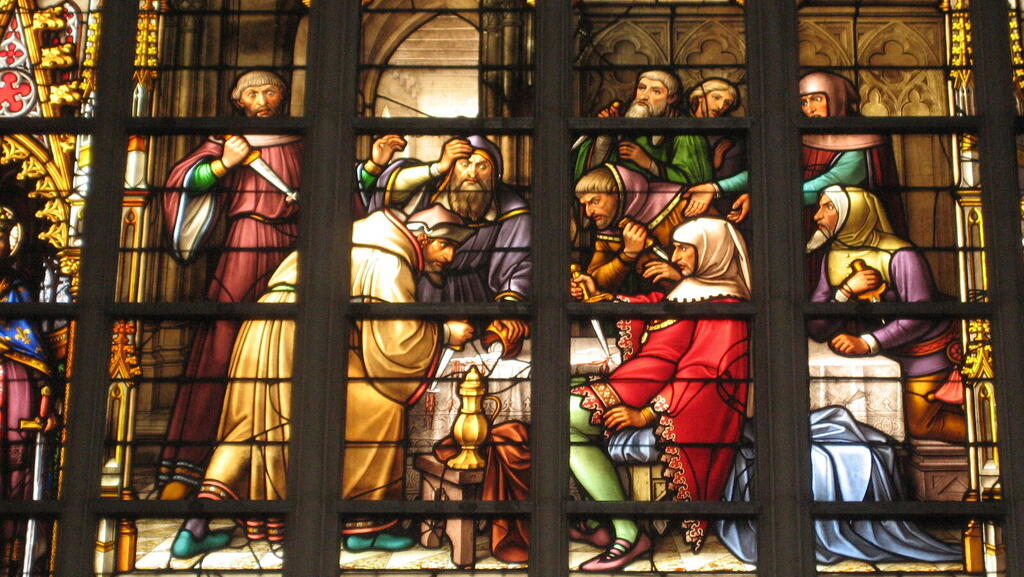
The stained glass window depicting Jews desecrating the Eucharist in a Cathedral in Brussels
(Photo: Zinneke at lb.wikipedia)
These accusations at the time led to a wave of severe violence. For centuries, these depictions remained part of the religious space without critical context or historical correction.
As part of the ceremony, the stained glass panels were removed and replaced with a new plaque in four languages — Dutch, French, English and Hebrew — containing a historical explanation alongside an official apology to the Jewish people. In its statement, the church noted that such baseless accusations, which appeared in various parts of Europe during that period, led to persecution, massacres and expulsions of Jewish communities.
The plaque reads: “We acknowledge that in the late Middle Ages, in various parts of Europe, Jewish communities were wrongly accused of desecrating the host. This slander, often fueled by fear and religious ignorance, led to persecution, massacres and unjust expulsions. This also happened in Brussels in 1370, when Jews were executed and their community was subsequently expelled from the Duchy of Brabant. In this cathedral, stained glass windows refer to these events as well as the ceremony that followed.”
It further states that “anti-Judaism stands, both theologically and socially, in contradiction to a religion that calls for truth, justice and fraternity. We ask forgiveness from the Jewish people for the suffering caused by these accusations. We renew our commitment to combating antisemitism in all its forms, deepening dialogue between Jews and Christians and passing on a clear memory to future generations based on recognition of truth and mutual respect.”
Archbishop Luc Terlinden, who signed the statement, stressed that antisemitism in all its forms contradicts the principles of Christianity and called for an open confrontation with past wrongs. “I wish to renew here our request for forgiveness from the Jewish people for the suffering caused by the events of 1370 and the anti-Judaism that followed,” he said during the ceremony.
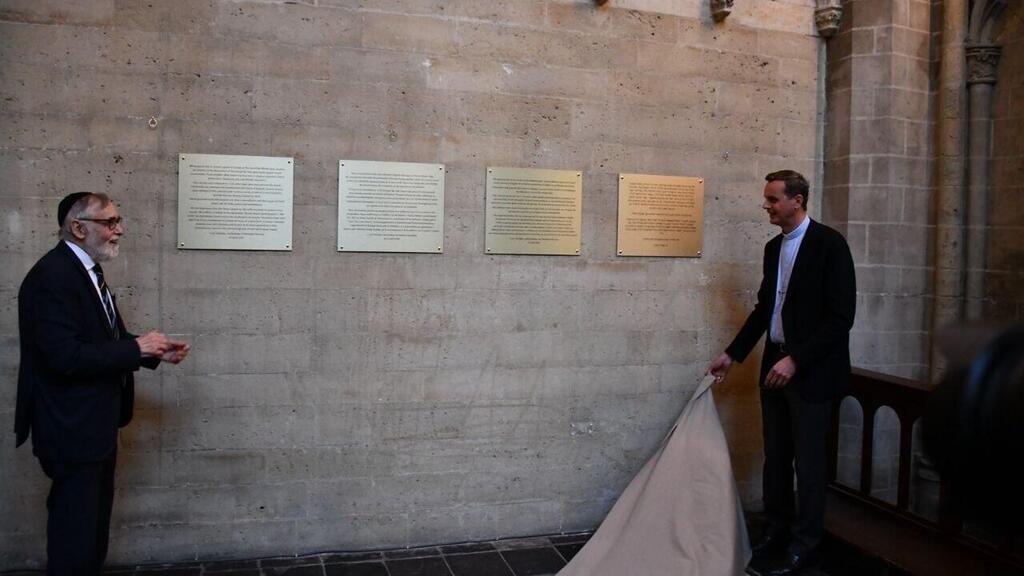
The plaques bearing the apology to the Jewish people
(Photo: Aartsbisdom Mechelen-Brussel)
According to him, the move marks a new stage in Jewish-Christian relations in three areas: a process of forgiveness and repentance, the purification of historical memory and the deepening of friendship between the communities. “Religion must never be used to justify violence or harm human dignity,” Terlinden added.
Rabbi Guigui welcomed the initiative and emphasized its significance for the Jewish community. He said it reflects a historical wound whose consequences were real — exclusion, discrimination and at times severe violence. “What matters today is how we look at these images,” he said. “They must not be erased, because they are part of history, but they must be accompanied by explanation and moral insight in order to understand the context and avoid repeating past mistakes.”
He added that the current approach changes the meaning of the stained glass windows: “They are no longer only testimony to a painful past, but also a starting point for shared reflection on truth, memory and responsibility.”
The statement also included a commitment to continue strengthening Jewish-Christian dialogue and preserving historical truth for future generations. Participants viewed the gesture as a significant step toward reconciliation between the communities, one that seeks not only to acknowledge wrongdoing but also to learn from it.