

Earth is closer to destruction than ever before as Russia, China, the United States and other nations grow “increasingly aggressive, adversarial and nationalistic,” a science-focused advocacy group said Tuesday as it moved its symbolic Doomsday Clock to 85 seconds to midnight.
Members of the Bulletin of the Atomic Scientists previewed their findings Friday and formally announced the update Tuesday.
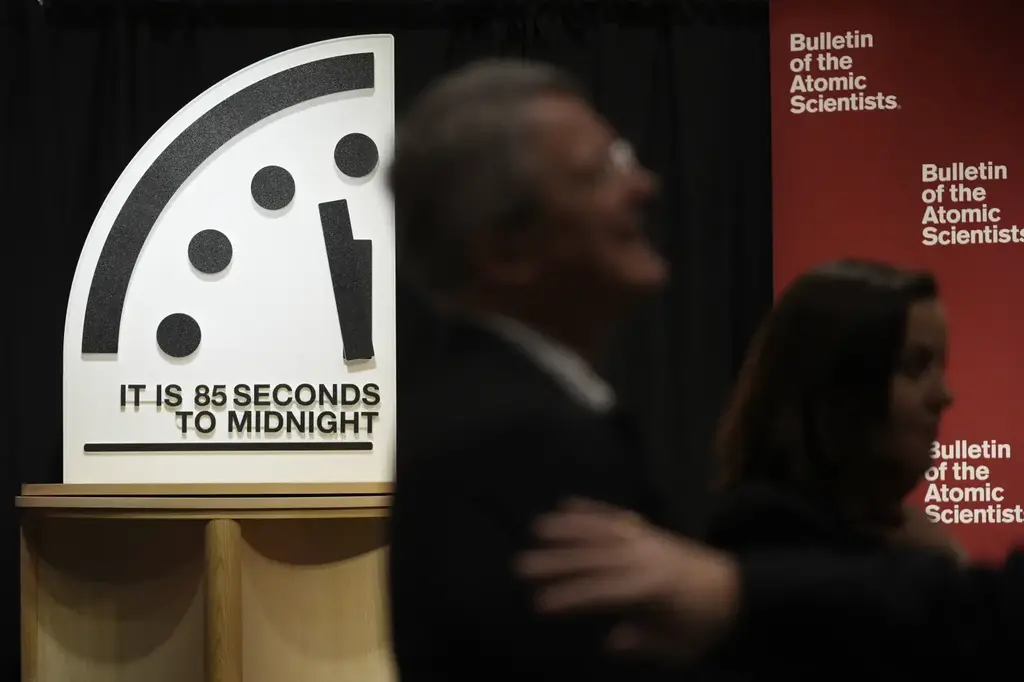
The Doomsday Clock of the Bulletin of the Atomic Scientists, set at 85 seconds to midnight, is displayed during a news conference at the Carnegie Endowment for International Peace
(Photo: AP Photo/Pablo Martinez Monsivais)
The group cited the risks of nuclear war, climate change, the potential misuse of biotechnology and the growing use of artificial intelligence without adequate safeguards in its annual assessment of how close humanity is to catastrophe.
Last year, the clock stood at 89 seconds to midnight.
Since then, the group said, “hard-won global understandings are collapsing,” fueling a winner-takes-all competition among major powers and undermining the international cooperation needed to reduce existential risks.
The scientists pointed to escalating conflicts involving nuclear-armed nations, including the war between Russia and Ukraine, fighting between India and Pakistan in May and concerns over Iran’s nuclear capabilities following U.S. and Israeli strikes last summer.
International trust and cooperation are critical, said Daniel Holz, chair of the group’s Science and Security Board.
“If the world splinters into an us-versus-them, zero-sum approach, it increases the likelihood that we all lose,” he said.
The group also highlighted droughts, heat waves and flooding linked to climate change, along with what it described as the failure of governments to adopt meaningful agreements to curb global warming. It singled out President Donald Trump’s efforts to expand fossil fuel production and scale back renewable energy initiatives.
Founded in 1947, the Bulletin created the Doomsday Clock to symbolize the likelihood of human-made catastrophe. At the end of the Cold War, the clock was set at 17 minutes to midnight. In recent years, reflecting rapid global changes, the group has shifted from counting minutes to counting seconds.
The scientists said the clock could still be turned back if world leaders and nations work together to address the most serious global threats.