

UK Prime Minister Keir Starmer’s resignation, effectively a surrender to a Labour Party revolt, has cleared the path to Downing Street for Andy Burnham, the popular mayor of Greater Manchester.
Barring surprises, Burnham, who won a landslide victory in a special election for a parliamentary seat and is seen inside Labour as the figure most capable of rescuing the party ahead of the next general election, is set to become Britain’s seventh prime minister in just a decade.
UK Prime Minister Keir Starmer’s resignation announcement
(Video: Reuters)


According to assessments in Britain, Burnham could become Labour leader without a bruising leadership fight. Such a scenario, in which he is chosen without a primary, has been described in the British media as a kind of “coronation.” For that to happen, other potential candidates who see themselves as fit for the post would have to stand aside.
One of those potential contenders was former health secretary Wes Streeting, who had previously said he intended to run for the leadership. But Monday morning, Streeting announced his support for Burnham.
“I hope everyone else gets behind Andy Burnham, he has shown what Labour can be,” Streeting said in his endorsement.
Burnham himself formally announced that he intends to put himself forward as a candidate for prime minister, while thanking Starmer. At this stage, little appears likely to block his entry into Downing Street.

Burnham, 56, has served as mayor of Greater Manchester since 2017. Polls show support for him among both Labour members and the wider public is far higher than for any other senior figure in the party. He took the first step toward the Labour leadership by triggering a special election for the Makerfield parliamentary seat near Manchester, since membership in Parliament is a prerequisite for becoming party leader.
The by-election was called after one of his allies in the party resigned to free the seat for him. On Thursday, Burnham won decisively with 55% of the vote, while his Reform UK rival trailed behind with 34%.
Makerfield was an area where Reform UK had made strong gains in local elections only a month earlier, making Burnham’s sweeping win another boost to the impression that he is the Labour figure best placed to confront Nigel Farage in the next general election.
Burnham, who is set to be sworn in Monday as a new member of Parliament, remained quiet over the weekend during the political drama. But in his victory speech in Makerfield, he already signaled where he was heading.
“Everybody knows that politics today is not working. Everybody feels that the country is not where it needs to be. Tonight may be a turning point,” he said.
He warned Labour lawmakers that this was their final chance to change course. “We have to act, there will not be another chance,” he said.
Burnham has been dubbed “the King of the North” by the British media, a reference to his past ability to confront the government in London and represent the interests of northern England, particularly during disputes over coronavirus restrictions.
He has tried to brand himself as an outsider to London’s political establishment, although in practice he has extensive experience there. He served as a member of Parliament from 2001 to 2017 and held ministerial posts under Tony Blair and Gordon Brown. He also ran twice unsuccessfully for the Labour leadership, in 2010 and 2015, losing the second time to far-left figure Jeremy Corbyn.
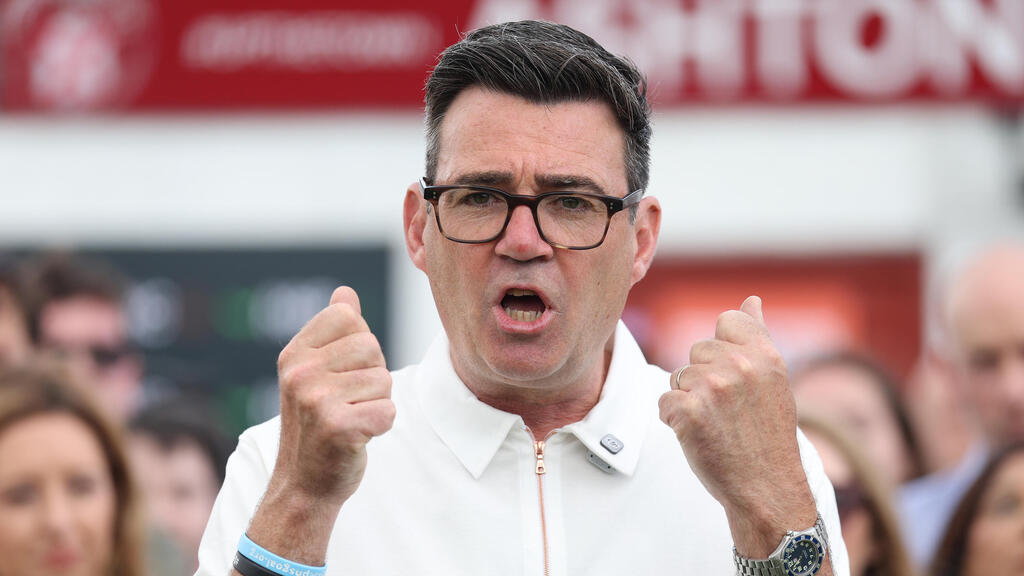
On Israel, Burnham’s record is more complex
(Photo: Ryan Jenkinson/Getty Images)
Burnham is considered part of Labour’s “soft left,” a camp positioned to the right of more radical figures such as Corbyn, who has since been expelled from the party, but to the left of figures such as Starmer, who is seen as more centrist.
During the Makerfield campaign, Burnham emphasized the fight against the cost of living and promised to promote policies to bring essential services such as water, electricity and public transportation under public ownership in order to lower prices.
He argues that he has already done so in Manchester, pointing to improvements in the city’s public transportation system. Although private companies operate the system, it is under public control and supervision, a model he has pledged to bring to the rest of Britain.
At the same time, and in an effort to avoid market turmoil, Burnham has already retreated from his criticism of the conservative fiscal rules adopted by Starmer’s government, under which it must spend less than it borrows.
On Israel, Burnham’s record is more complex.
In the previous decade, he voiced clear support for Israel. During the 2015 Labour leadership primary, he even promised that his first overseas visit, if elected, would be to Israel. He also condemned the BDS boycott movement at the time and described Israel as “a democracy with a long history of protecting minorities and advancing civil rights.”
As mayor, Burnham generally avoided commenting on foreign policy issues, but in recent years he has appeared to take a somewhat more critical stance toward Israel than Starmer.
While Starmer refused to support calls for a ceasefire immediately after the October 7 massacre, Burnham was among senior Labour figures who did call for one several weeks after Hamas’ terrorist attack, which he strongly condemned.
Burnham also pressed for recognition of a Palestinian state, saying as early as a decade ago: “It is not a gift to be given, but a right to be recognized.” He was also among senior party figures who urged Starmer to recognize a Palestinian state “without delay,” three months before Starmer did so in September last year.
Still, it remains unclear whether Burnham, as prime minister, would adopt a more confrontational policy toward Israel than Starmer, who already sharply criticized Israel over its actions in Gaza and imposed certain restrictions on arms sales to Israel.
Like Starmer, Burnham has refused to accuse Israel of “genocide.” Asked about the issue in an interview with The Guardian earlier this month, he said: “I can’t judge things on such a scale from where I am as mayor of Greater Manchester. But I am concerned about the disproportionate nature of what happened in terms of destruction, and there must be a full process of investigation and accountability.”
For the far left, such cautious criticism is not enough. MP Zarah Sultana, who defected from Labour, attacked him over his record, saying: “He joined Labour Friends of Israel, opposed BDS and described the boycott movement as ‘vindictive,’ praised Israel as a ‘democracy’ and described the Balfour Declaration as ‘British values in action.’ He is a Zionist.”