

The Knesset held a special hearing Tuesday on allegations of organized, ritual sexual abuse and the state’s response, featuring harrowing testimony from several women who said they were abused as children by family members, community figures and, in one case, a former member of parliament.
Hadar Feldman, one of the central witnesses, told lawmakers that beginning at age eight her father brought her weekly to the office of a now-deceased lawmaker in the Knesset, where she said she was sexually assaulted. “I had to drink two small glasses and lose consciousness, and he did whatever he wanted, once a week, for a year and a half,” she said.
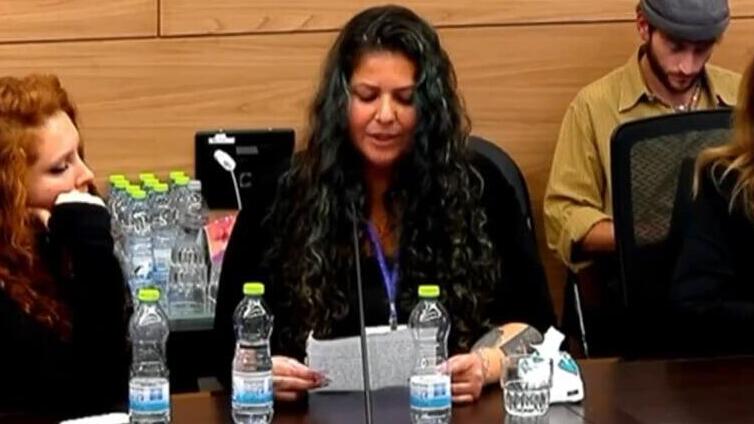
Hadar Feldman
(Photo: Knesset Channel)
Feldman testified before a joint session of the Knesset Committee on the Advancement of Women and the special committee on youth. She said she had endured years of ritual abuse. “From age seven to 21 my father sold me to anyone who wanted,” she said. “For years I was brutally raped by groups of seven and sometimes as many as 20 people. We were forced by cults into religious rituals in the name of a ‘righteous rabbi’ who carried out an ‘Akedat Yitzhak’ on us,” referencing the biblical Binding of Isaac, “where we were tortured and forced to torture one another.”
She described additional abuse that included being smeared with excrement, forced to dig her own grave and having boxes of spiders poured over her. “After every torture, every rape and every ritual, I woke up crying, not knowing why my body, my soul and my heart hurt,” she told lawmakers.
Another woman, identified as M., had her testimony read aloud. She described herself as a married professional who lives “a completely normative life,” but said she had recovered memories over the past decade of childhood abuse by relatives, a doctor, a psychiatrist and rabbis. She said she was assaulted even during late pregnancy. “I was raped in a horrific ritual in the place where I grew up,” she said, adding that she had been forced to harm a newborn to protect her fetus. “They traded me, they traded my body,” she said, calling for accountability and expanded support services for survivors.
A third woman, identified as Sh., told lawmakers she was abducted from her bed, a playground and a school bus. She said she was tied upside down, shocked with a stun gun on intimate parts of her body and forced to witness the killing of infants. “I gave a statement for more than five hours. I provided details, locations and names. I want to know that we’re being taken seriously,” she said.
A fourth survivor, identified as A., said she spent more than 100 hours with police after being summoned by the national cyber unit, known as 105, but investigators were not familiar with her case. She said she had been told that large, complex files were difficult to substantiate and that repeating her testimony could harm the case.
“This is especially infuriating,” said MK Naama Lazimi, who chairs the special youth committee. MK Mati Sarfati Harkabi, acting chair of the women’s advancement committee, said investigators “must know the file in advance.”
Sarfati Harkabi said the testimony amounted to “a mega-event that for years has been ignored, covered up and neglected,” and urged police and prosecutors to act immediately “to protect children and teens.”
A research specialist from the Knesset’s Research and Information Center, Maria Rabinovich, said a special report prepared for the hearing found no unified government definition of organized ritual abuse. Because the term does not appear in law, it is difficult for police and state prosecutors to identify relevant cases. A review of the past decade found only four police files that might qualify, with a similarly limited number at the State Attorney’s Office.
Chief Inspector Orit Danin, who heads the police sexual offenses unit, said the issue is now being overseen by the head of the Investigations and Intelligence Division and handled by Unit 105. “The matter is complex,” she said.
Naama Goldberg, director of the advocacy group Lo Omdot Mineged, said authorities lack tools to address extreme cases. “Some women want to speak but are threatened. Some live under terror,” she said.
Former deputy police chief and MK Yoav Segalovich said that resolving such cases requires “a criminal story with the name of a suspect. There is no suspect who cannot be investigated.”
Carmit Klar-Halamish, research director at the Association of Rape Crisis Centers in Israel, said the centers are receiving increasing reports of extreme abuse but systems “are not adapted to these cases.” She said some survivors fear approaching authorities, creating “a direct link between lack of treatment and children who are being harmed now.”
A representative of the State Attorney’s Office, attorney Lizo Wolfs, said the office appointed a senior prosecutor to coordinate the matter. Abigail Son Feldman of the Justice Ministry said that all the actions described are already defined as serious crimes under existing law. She added that the ministry is considering eliminating the statute of limitations for sexual offenses against minors in a broader reform.