

Oman, which is mediating between the United States and Iran, confirmed Sunday that the next round of talks, the third so far, will be held on Thursday in Geneva. Omani Foreign Minister Badr al-Busaidi expressed hope the upcoming discussions would provide “a positive push toward another step to conclude the deal.”
The talks come amid what appears to be the peak deployment of US military forces ahead of a potential strike on Iran. If no breakthrough is achieved, President Donald Trump may carry out his threats against the ayatollah regime. On Thursday, Trump set a deadline of “10 to 15 days” for an agreement, which would place the apparent cutoff at March 3. However, Trump has not yet decided how to proceed and could order a strike sooner or wait beyond that date.
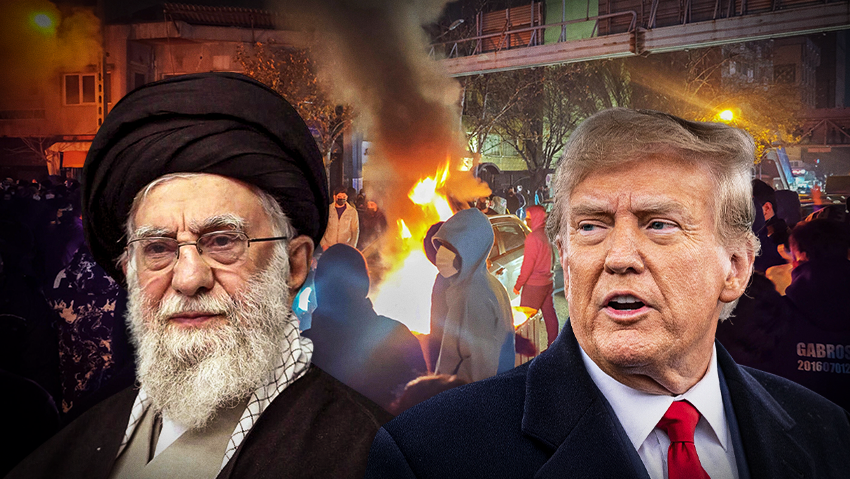
Ahead of the renewed negotiations, Prime Minister Benjamin Netanyahu convened Israel’s security Cabinet Sunday evening after holding a smaller security consultation earlier in the day. In recent weeks, Israeli officials have repeatedly voiced concern that Washington may ultimately compromise, particularly given Iran’s refusal to discuss limits on its missile program, viewed in Israel as an immediate threat, and instead settle for a narrower agreement focused solely on Iran’s nuclear program.
Those concerns may be reinforced by Trump’s recent statements, which have not mentioned Iran’s missile capabilities and instead stress only the need to prevent Tehran from acquiring nuclear weapons. Iran has declared it is prepared to accept significant limitations in the nuclear sphere but has rejected US demands for a complete ban on uranium enrichment.
Iranian and American officials have in recent days discussed the possibility of an interim nuclear agreement ahead of a comprehensive deal. US envoy Steve Witkoff, who is leading the American side, was reported by CBS over the weekend to favor separating the nuclear issue from Israel’s demand to include missile restrictions in the negotiations.
Witkoff himself expressed surprise overnight that Iran had not capitulated despite US threats and the largest American military buildup in the Middle East since the 2003 invasion of Iraq, including hundreds of aircraft, two aircraft carriers and 12 missile destroyers. In an interview with Fox News, he said Trump was “curious” why Iran had not surrendered despite the show of force.
US envoy Steve Witkoff
(Video: Fox News)


“I wouldn’t use the word frustrated because he knows he has many alternatives,” Witkoff said. “But the president is curious why they have not capitulated. Under this kind of pressure, with the amount of naval power we have there, why didn’t they say, ‘We declare we don’t want a weapon, and this is what we’re prepared to do’?”
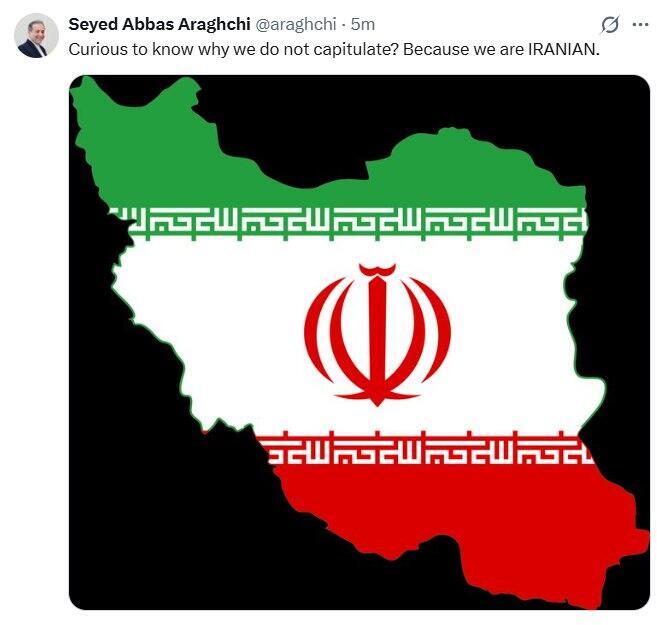
Iran’s foreign minister, Abbas Araghchi, who is negotiating opposite Witkoff, responded Sunday on X. “Curious to know why we do not capitulate? Because we are IRANIAN,” he wrote, alongside an image of Iran in the colors of its national flag.
(Photo: X)
Earlier, Araqchi told CBS that “a diplomatic solution is still possible” and said prospects for an agreement were good. He added that Tehran continues working on elements to be incorporated into a potential deal, amid a report by Axios that Washington expects an Iranian counterproposal within 48 hours.
“If the United States seeks a solution regarding Iran’s nuclear program, the only path is diplomacy,” Araqchi said. “We have proven that in the past, and I believe there is still a good chance. There is no need for military buildup, and it cannot help. It cannot pressure us.”
Student protests and fears of escalation
The negotiations and Trump’s military threats come as signs emerge of renewed social and political unrest inside the Islamic Republic.
The current tensions follow last month’s mass protests and their violent suppression by regime forces. At the time, Trump warned he would strike Iran if protesters were killed and told demonstrators that “help is on the way.” He has not fulfilled that promise but has continued to threaten military action while demanding an agreement that would at least curb Iran’s nuclear program.
Clashes between protesters and Basij at Iranian universities
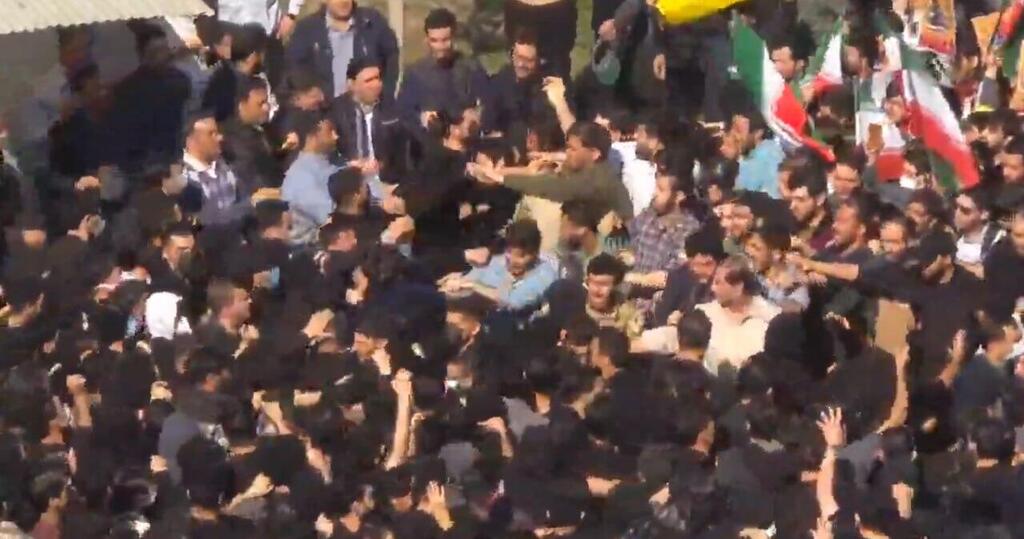
Protests in Iran
Reuters reported earlier this month, citing Iranian sources, that regime officials fear renewed unrest, particularly in the event of a US strike, which could threaten the regime’s survival.
Human rights organizations say at least 7,000 Iranians were killed in the crackdown, though the true number is widely believed to be higher. Trump claimed over the weekend that 32,000 were killed.
In recent days, chants against the regime have been heard during 40-day mourning ceremonies for those killed, a significant milestone in Shiite tradition. Since Saturday, new protests have erupted, this time led by students at universities.
Videos from Sharif University and Amir Kabir University in Tehran showed clashes between anti-regime students and members of the Basij militia who arrived to disperse them. Pro-regime students joined the confrontations. According to media outlets affiliated with the regime, one student was injured in the eye by stones thrown by others. Some footage showed objects flying through the air as pro-government demonstrators waved Islamic Republic flags.
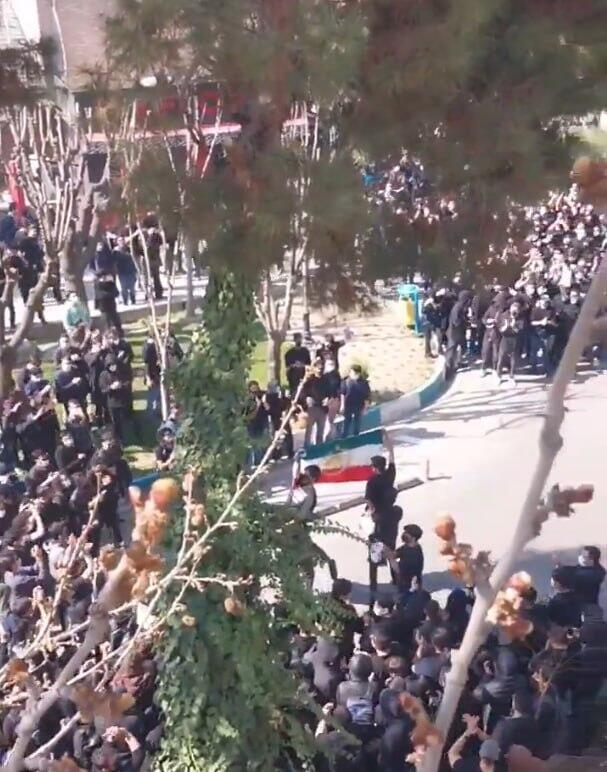
Goldie Ghamari, a Canadian human rights activist of Iranian origin, told Ynet she believes the situation will escalate. “Students are calling for the end of the terrorist Islamic Republic occupying Iran. They are waving the lion and sun flag with the crown,” she said, referring to the pre-1979 emblem associated with the ousted shah.
At Sharif University, she noted, protesters used the institution’s former name, Aryamehr, as it was known before the Islamic Revolution. “Today students called for the original name to return. This is a significant escalation, and we have not seen anything like it before,” she said.
Sima Shine, a senior researcher at the Institute for National Security Studies and former senior Mossad official, said the unrest shows that “the ground is simmering.”
“Nothing has calmed down in Iran; it has only gotten worse,” she said. “What we are seeing at universities has appeared in recent days, but we also saw it during the 40-day memorials. The universities were closed and classes were held online for a long time. Now they have reopened, so there is an opportunity.”
She cautioned that it remains unclear whether the protests will spread, given lingering fear after the high death toll. “But there is no doubt this once again proves the ground is simmering and the public is very angry at the regime,” she said.
Shine added that one of the regime’s concerns in the event of a US strike is that public unrest could erupt simultaneously. “They would have to deal with something from within and something from outside,” she said.
Regime narrative and Ramadan pressures
Iranian state-affiliated media sought Sunday to portray the campus protests as student initiatives expressing revulsion toward the United States and Israel. The Mehr news agency published images of students burning US and Israeli flags.
Shine rejected that narrative. “The protests have been going on for several days, so we clearly know they are not regime-driven,” she said. “The regime does not want to start killing again. They understand what that would do, especially with Trump threatening them and the fear of a strike. I think for now the regime is trying to contain and calm the situation.”
The renewed unrest coincides with the start of Ramadan, a significant month in Iran and across the Muslim world. While Ramadan includes elements of prayer and fasting that can have a calming effect, it also highlights Iran’s severe economic hardship. The month is marked by daily family meals to break the fast, placing additional financial strain on households already grappling with inflation and crisis.
“It’s both,” Shine said when asked whether Ramadan could inflame tensions. “We cannot truly assess from outside. This is a country of 90 million people. We see anger in areas that are more Kurdish. We have no real way of knowing whether there will be another moment when everything converges and spills into the streets. But the main point is that the ground is very unsettled, and what happened with the number of dead and the expectations surrounding Trump — all of it together is very much simmering and could erupt.”