

Hours after China stunned observers by announcing an investigation into the most senior general in its military, Zhang Youxia — long seen as one of President Xi Jinping’s closest and most loyal allies — The Wall Street Journal reported Sunday evening that he is suspected of leaking secrets about China’s nuclear weapons program to the United States and of taking bribes in exchange for promoting officers within China’s defense procurement system.
The American newspaper cited several people familiar with the matter who took part in a high-level briefing held among the Chinese military’s security leadership. According to the report, the briefing took place Saturday morning, shortly before Beijing’s dramatic announcement earlier Sunday about the investigation into Zhang. In that announcement, authorities provided no substantive details about the allegations, saying only that Zhang was suspected of violating the law and party discipline.
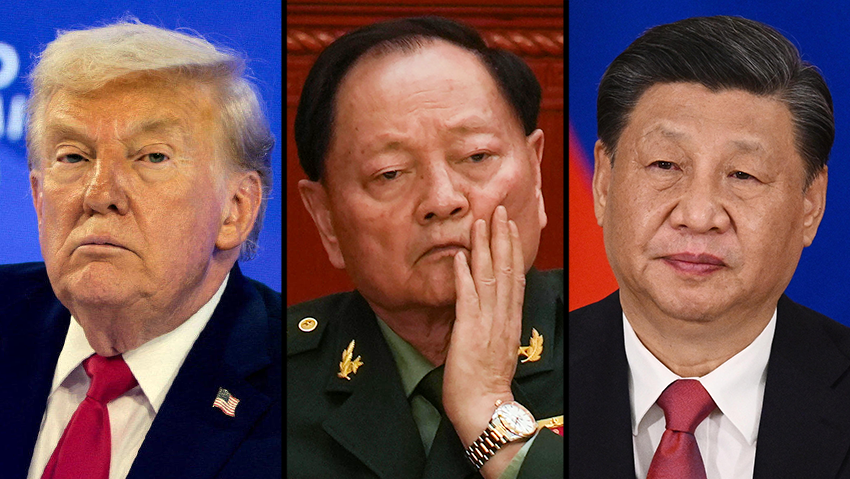
Chinese President Xi Jinping, the suspected general Zhang Youxia and US President Donald Trump
(Photo: Jonathan Ernst/Reuters, Sputnik/Vladimir Astapkovich/Kremlin via REUTERS, AP Photo/Ng Han Guan, File)
The sources said the most serious allegation against Zhang, 75, is that he leaked “technical information” to the United States about China’s nuclear weapons. Chinese authorities are also examining how he oversaw a powerful military agency responsible for the research, development and procurement of military equipment. People familiar with the weekend briefing said Zhang is alleged to have received enormous sums of money in exchange for promotions within the agency’s heavily funded procurement apparatus. At the same time, the sources said, Zhang is suspected of having promoted former Defense Minister Li Shangfu to his post in return for a substantial bribe. Li disappeared from public view in China in 2023 and was later removed as defense minister. A year later, he was expelled from the Communist Party on corruption charges.
The senior official who exposed the general — and the allegation: 'undermining the party'
Zhang serves as vice chairman of the Central Military Commission, the highest military command body in China, which is chaired by President Xi himself. That makes Zhang the most senior military figure directly beneath Xi. The investigation comes amid the detention of numerous senior figures in China’s defense establishment in recent years. Many have been accused of corruption, but analysts assess that in many cases the moves also reflect the removal of officials seen as insufficiently obedient or loyal to Xi.
The sources said Zhang is also suspected of forming “political cliques,” a term used to describe efforts to build influence networks that undermine Communist Party unity. He is also accused of abusing his authority within the influential military agency he oversaw. In addition, the sources said some of the evidence against Zhang came from Gu Jun, the former chief executive of China National Nuclear Corp., a state-owned company that oversees all aspects of China’s nuclear programs, both civilian and military. Last Monday, China announced the opening of an investigation into the former executive, again citing suspected violations of state law and party discipline.
During the briefing, the sources said, authorities revealed that the investigation into Gu was what linked Zhang to a security breach within China’s nuclear sector. They added that no details were provided about the breach itself. The sources also said authorities seized the personal phones of officers who had been promoted by Zhang and by senior General Liu Zhenli, who some of the sources said is also under investigation. Thousands of officers with ties to Zhang and Liu have now become “potential targets,” according to the sources.
The Wall Street Journal said it was unable to obtain comment from Zhang or Gu. A spokesperson for the Chinese Embassy in Washington, Liu Pengyu, did comment, saying that “the party’s decision to investigate Zhang underscores that the leadership is taking a comprehensive and uncompromising approach in its fight against corruption.”