

Rachel Levin, 4 and a half years old, left her home in the Neve Yehoshua neighborhood of Ramat Gan on February 14, 1953, wearing a red dress. Her mother had sent her to a neighbor’s house to call her father. She never returned.
Shortly after midnight that Saturday night, police trackers arrived at the Levin family home and received a brief account: the child had left hours earlier and disappeared without a trace. That was the starting point of “Operation Satan,” one of the largest search operations in the early years of the State of Israel.
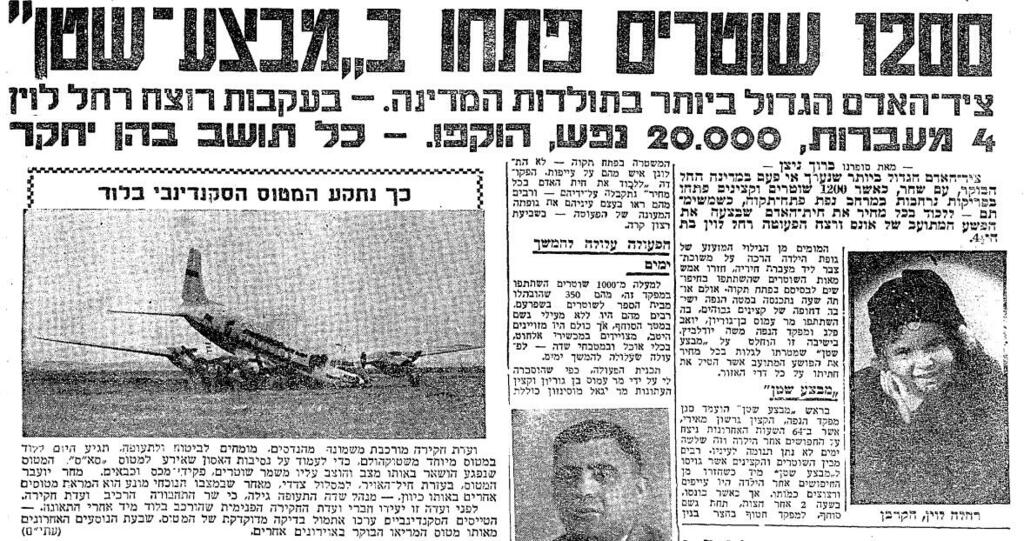
A newspaper from 1953: Operation Satan to locate missing Rachel Levin
Police squads spread out across the open fields surrounding the neighborhood. The immediate fear was that wolves and jackals roaming the area might attack a lost child. Officers fired shots into the air and sounded their horns in an effort to drive animals away during the search.
By the next morning, when Rachel had not been found, police cadets from the training school in Shfaram and soldiers from the nearby Tel Hashomer base were called in. Despite stormy weather, more than 1,000 professionals and volunteers participated in Operation Satan, including aircraft assisting in aerial searches.
About 40 hours after the search began, a breakthrough came. A pilot reported spotting a piece of red fabric caught on a prickly pear cactus near the Hiriya garbage dump. Guided by the pilot, search teams reached the site and found Rachel’s body concealed beneath cactus leaves, bearing severe signs of violence.
A police pathologist determined that the child had been raped and murdered by repeated blows to the head with a blunt object. A wrench found near the body was identified as the murder weapon. Bicycle tire tracks were also discovered at the scene.
At that moment, Operation Satan shifted from a search effort to a manhunt for a brutal killer. Investigators believed the perpetrator was likely a local resident, given the proximity between the disappearance site and the dump and the apparent familiarity with the terrain. Transit camps in the area were placed under lockdown, and residents seeking to enter or leave were subjected to thorough inspections and questioning. Because of the extreme violence, police suspected the killer was mentally unstable.
Media coverage triggered widespread public hysteria. The young state had never experienced such a violent and tragic crime, and reports of suspicious individuals flooded in from across the country.
That same evening, police received a tip about a strange man wandering near a cemetery in Sheikh Munis, today’s Ramat Aviv in Tel Aviv. Officers arrested Ben Zion Samuha, a 36-year-old immigrant from Iraq who lived nearby. He was detained after police noticed bloodstains on his clothing and light-colored hair resembling Rachel’s blond hair. Samuha was brought before a judge and remanded for two weeks, but was soon released when it became clear the blood was his own and the hair belonged to a dog.
The investigation stalled and suspects were released. Two months later, staff at a psychiatric hospital in Jerusalem contacted police to report that one of their patients, Victor Mizrahi, had confessed to murdering a girl in a red dress.
During interrogation, Mizrahi said that after his son fell seriously ill, he had been told that slaughtering a red rooster would improve the child’s condition. When his son did not recover, he concluded that sacrificing another child in place of his own was the solution. When he saw Rachel in her red dress, “just like the rooster,” he said he believed God had sent her. He offered her a ride on his bicycle, took her to Hiriya, raped her and then murdered her.
Despite claims of insanity and despite testimony from his wife that he had been home throughout the evening, Rachel disappeared. Mizrahi was convicted of rape and murder and sentenced to life imprisonment. On appeal, the Supreme Court accepted his insanity defense and transferred him from prison to compulsory psychiatric hospitalization. He was released in 1964.
Though the Rachel Levin case faded from headlines, the names Samuha and Mizrahi became part of Israeli cultural memory in the 1950s and 1960s. A crude folk song referencing Samuha, which circulated widely, particularly among paratroopers, was recorded for the radio and is preserved in the National Library of Israel. It is also cited in Yehoshua Kenaz’s novel “Infiltration.”
The podcast “Excavating Journalism” from Be.po revisits the tragedy that once shook the entire country and remains one of the most horrifying crimes in Israel’s early history.