


Israel is preparing a coordinated response to claims made in the documentary NAZA, even as officials acknowledge that most of the uproar surrounding the film has so far remained inside Israel and that key government agencies have yet to obtain a copy.
Doron Spielman, international spokesman for the National Public Diplomacy Directorate in the Prime Minister’s Office, sharply criticized directors Yuval Abraham and Rachel Szor in an interview with Ynet, accusing them of mounting what he described as a deliberate campaign against Israel. Spielman was appointed to the role in July under directorate chief Tzipi Hotovely.
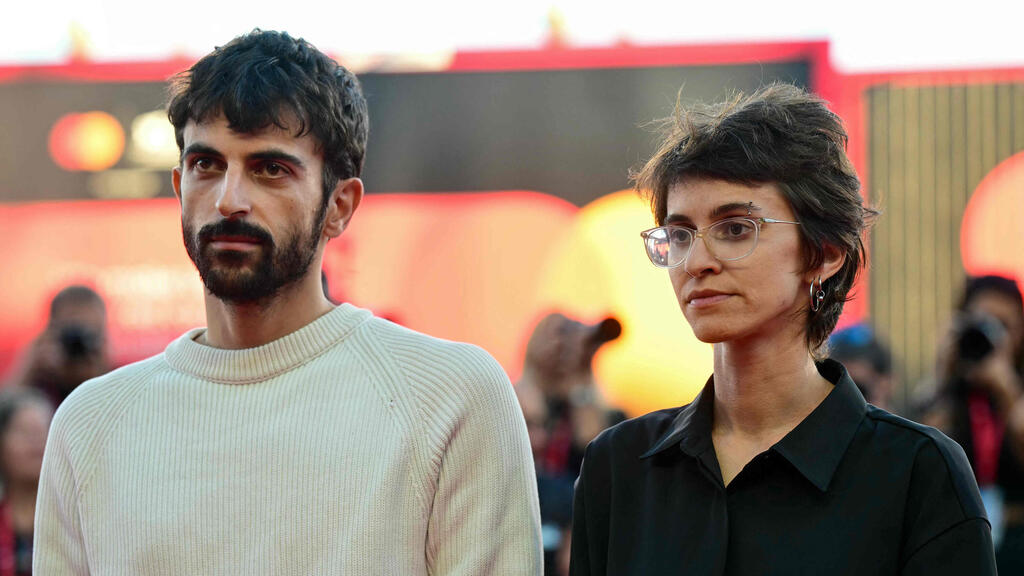
Yuval Abraham and Rachel Szor
(Photo: Stefano Rellandini / AFP)
NAZA, produced by The Guardian and directed by Abraham and Szor, features testimony from 24 anonymous Israeli military and intelligence personnel about Israel’s targeting practices in Gaza. The film won the Special Jury Prize at the Venice International Film Festival.
‘It hurts because it comes from within’
“From a communications standpoint, the film NAZA is an attempt at a targeted attack on the State of Israel,” Spielman said. “As of this moment, none of us has the film itself.”
He accused the filmmakers of deliberately launching the documentary in an environment they believed would be receptive to criticism of Israel and said Israeli officials had not been approached for a response before its release.
“They did not ask us for a response, and my approaches to The Guardian have not been answered at all,” he said.
Spielman said Israel’s public diplomacy strategy rests on two elements: speed and credibility. The absence of access to the full documentary, he said, has made the second particularly difficult.
“It is very difficult to operate credibly when you don’t know exactly what you are facing,” he said. “What do we know? Only what is in the trailer and what the winners said on stage. That is the material we have.”
“And it hurts especially because it comes from within,” he added.
Spielman compared the film with accusations made by commentators abroad about Israeli conduct in Gaza, arguing that the difference in this case was that the criticism came from Israeli filmmakers.
“There are no excuses,” he said. “That is the situation.”
Coordinating Israel’s response
Spielman said the National Public Diplomacy Directorate began coordinating with the Foreign Ministry and the IDF shortly after the film screened in Venice.
“One of the jobs of the public diplomacy directorate, which had not been functioning for several years, is to coordinate,” he said. “We aligned with the Foreign Ministry and the IDF Spokesperson’s Unit and began developing messages, both for use inside Israel and for influencers abroad.”
He said the prime minister, military chief and Foreign Ministry had all responded based on the limited material available, while he had given interviews to Sky News, AP, Reuters and NBC. Hotovely, he said, had focused largely on European media.
Despite the intensity of the controversy inside Israel, Spielman argued that the film had not yet generated comparable attention overseas.
“What surprised us is that the film caused a huge uproar inside Israel, but it didn’t reach the world in the same way,” he said. “Almost nothing is running in the United States. It dropped completely off the agenda of the main media outlets in Britain. It wasn’t in the headlines.”
“That gives us a certain advantage,” he added. “Maybe it bought us a few days before this becomes big abroad.”
The film, however, is continuing its international festival run. Its North American premiere is scheduled at the New York Film Festival on Sept. 26, with a second screening the following day.
Spielman said Israeli officials were monitoring international coverage and believed awareness of the film remained limited in the United States and relatively modest in Europe.
“Inside Israel we are burning over this, but outside it hasn’t caught on,” he said. “It could catch on, and I don’t underestimate the danger of that.”
Preparing the counter-case
Israel is now assembling material intended to rebut the documentary’s allegations if the film gains wider international attention, Spielman said.
“We have sent material to influencers, and I prepared an analysis that will go up on the Prime Minister’s Office website, a somewhat deeper analysis aimed mainly at answering the big questions,” he said.
 Doron Spielman
He said the effort involved military and intelligence officials and described coordination between the agencies as critical.
“When we go into a battle like this, that synchronization is essential,” he said.
Spielman accused the filmmakers of denying Israeli officials a meaningful opportunity to answer the claims before publication.
“They did not give us a chance to defend ourselves,” he said. “Usually, when there is an investigation, for example by The New York Times or The Guardian, they ask you questions and request a response.”
He argued that the anonymity of the film’s military and intelligence sources also made it difficult for Israel to examine their accounts.
The documentary’s anonymous testimony is central to the film, with faces and voices altered to conceal the identities of the participants. The Guardian has said the film builds on investigations previously published by The Guardian, +972 Magazine and Local Call.
Dispute over AI and civilian casualties
Spielman also challenged the documentary’s portrayal of Israel’s use of artificial intelligence in selecting and assessing targets in Gaza.
“Anyone who knows the military knows there is no such thing as an operation being carried out by AI,” he said.
“Every operation was carried out following a human decision. AI only improves a person’s ability to make a decision regarding collateral damage.”
Spielman said Israel uses technological systems to provide decision-makers with information about civilians near potential targets, arguing that their purpose is to help reduce civilian harm.
“The filmmakers took one of the most ethical things we have, an AI system that gives you information about the population so you can try to hit the enemy with the least possible harm to civilians, and turned it around,” he said.
“In the film, they say we have information about where civilians are, that the pilots press ‘go’ and that they are responsible for murder. That is completely distorted.”
NAZA presents a sharply different account, alleging through anonymous military and intelligence testimony that Israeli targeting systems allowed strikes to proceed despite projected civilian casualties. The IDF has disputed key claims associated with the film, including an allegation that a strike was approved despite an estimate that as many as 500 civilians could be killed.
For now, Spielman said, Israel’s strategy is to prepare its case before the documentary reaches a substantially larger international audience.
“The film has not caught on outside yet,” he said. “But it can, and I am not minimizing the danger.”