


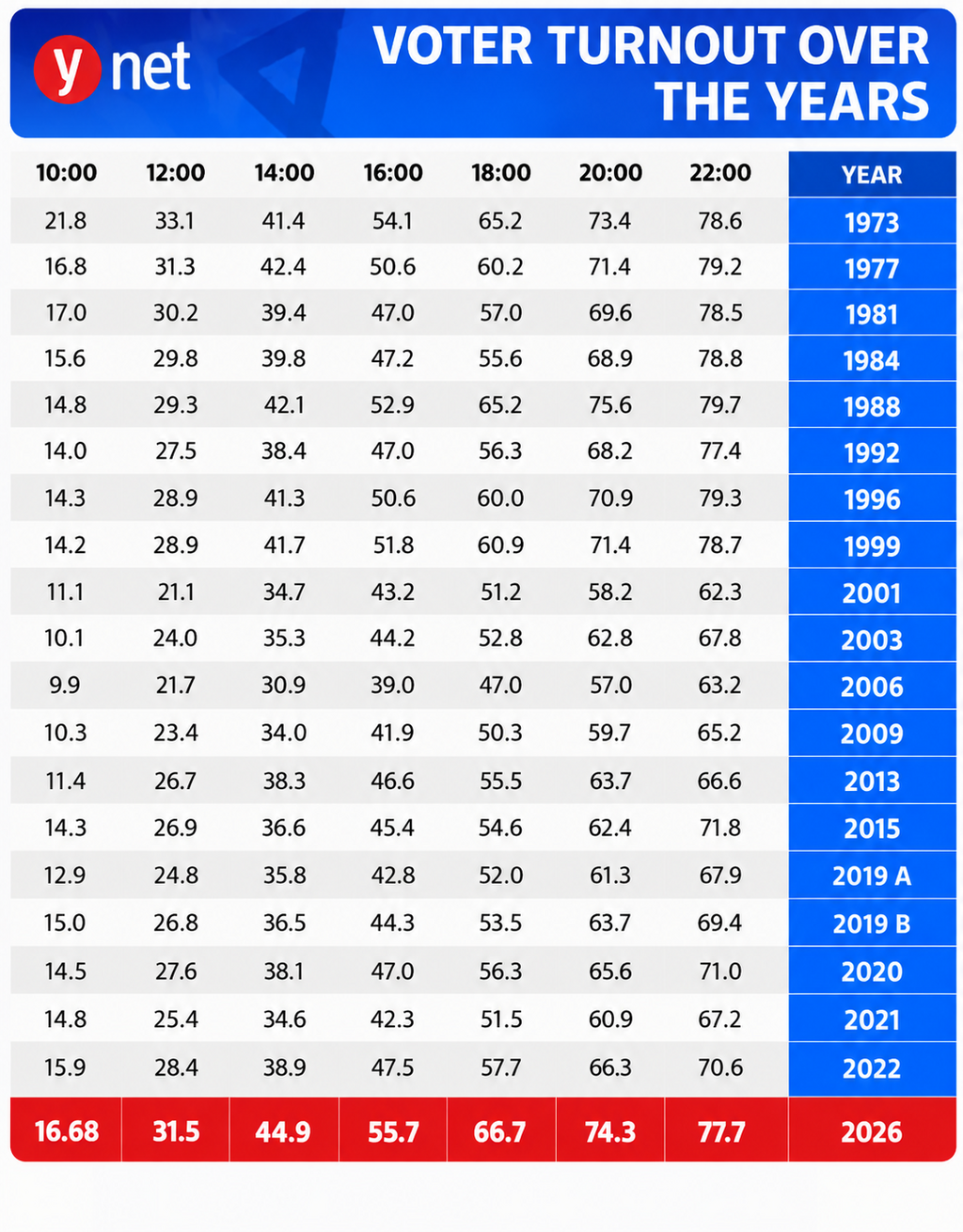
Israel recorded its highest election turnout in 25 years on Tuesday, with 77.7% of eligible voters casting ballots by the official 10 p.m. closing time, according to the Central Elections Committee. Meanwhile, updated television exit polls showed a remarkably consistent picture: 52 seats for the bloc seeking to replace Prime Minister Benjamin Netanyahu, 50 for his political allies and 18 for the Arab parties.
A total of 5,695,682 Israelis had voted by 10 p.m., an increase of approximately 7.1 percentage points compared with the same stage of the previous election in 2022. It was the highest turnout recorded at poll-closing time since 2001.
Gallery
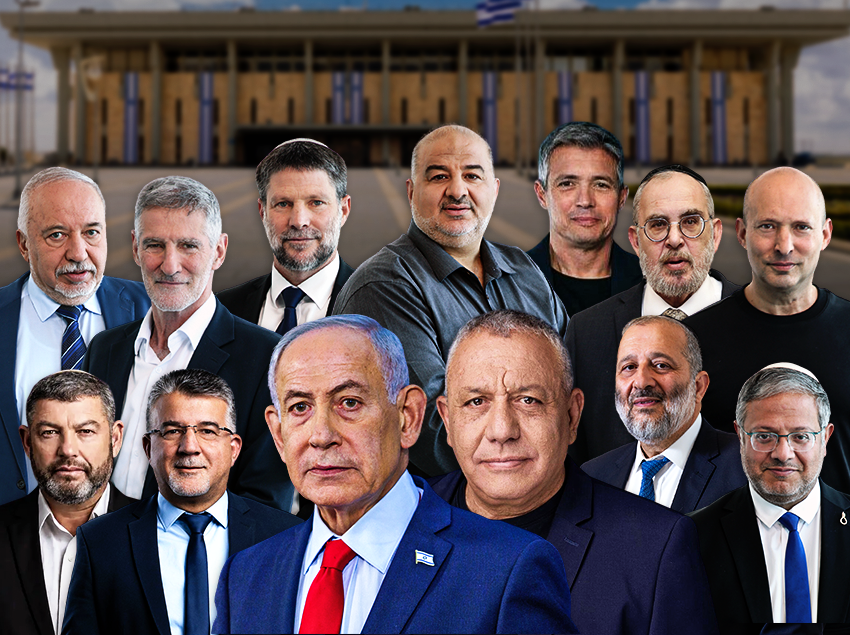
Nearly 5.7 million Israelis vote as updated exit polls show 52-50 split
(Photo: Shutterstock, Shalev Shalom, Elad Malka, Joint List Spokesperson's Office, Ryan Preuss)
The figure is not yet final. Voters who arrived at their polling stations before 10 p.m. were permitted to cast their ballots even after the official closing time, meaning the total is expected to rise further.
The high turnout was reflected across the country, with particularly strong participation in several Arab and ultra-Orthodox communities. In two small communities in the Arava region, Paran and Shaharut, the reported turnout reached 100%.
Where Israelis voted: The major cities
Among Israel's larger cities, Modi'in-Maccabim-Re'ut recorded one of the highest turnout rates at 79.2%, followed by Bnei Brak at 77%, Kfar Saba at 74.7%, Petah Tikva at 73% and Rehovot at 72.9%.
Rishon LeZion and Herzliya each recorded 71.3%, followed by Ramat Gan at 71.2%, Ra'anana at 70.8% and Lod at 70.6%.
Turnout in Jerusalem reached 65.9%, compared with 65.4% in Tel Aviv-Jaffa and 61.6% in Haifa, Israel's three largest cities.
In other major population centers, turnout stood at 69% in Holon, 68.7% in Ashkelon, 68.5% in Hadera, 67.8% in Ashdod and Beit Shemesh, and 65.8% in Be'er Sheva.
Netanya recorded 60.2%, while Bat Yam had one of the lowest turnout rates among the major cities listed, at 55.3%.
Arab communities report strong turnout
Turnout was particularly high in several Arab communities, with Sakhnin reaching 86.8% and Kafr Qasim recording 84.9%.
In the southern Bedouin city of Rahat, turnout reached 82%, while Kuseife recorded 81.2% and Hura 79.1%.
Tayibe registered 79%, Shefa-'Amr 75.9%, Umm al-Fahm 75.7% and Nazareth 72.2%.
The figures came as the updated exit polls projected a combined 18 seats for the Joint List and Ra'am, giving the Arab parties a potentially important role in the parliamentary balance.
Ultra-Orthodox communities also see high participation
High turnout was also recorded in several ultra-Orthodox communities. Rekhasim led the group with 86.9%, followed by Elad at 84% and Modi'in Illit at 83.1%.
Beitar Illit recorded 80%, while turnout reached 77% in Bnei Brak and 75.1% in Emmanuel.
These figures come as the main ultra-Orthodox parties, Shas and United Torah Judaism, remain part of the projected parliamentary bloc supporting Netanyahu.
Updated exit polls converge on 52-50 split
The latest exit poll updates from Kan 11, Channel 12 and Channel 13 all give the bloc seeking to replace Netanyahu 52 seats, compared with 50 for the prime minister's allies. The Arab parties are projected to hold the remaining 18 seats in the 120-member Knesset.
The new projections represent a slight setback for former IDF chief of staff Gadi Eisenkot's change bloc compared with the initial exit polls, which had given it 53 seats in some surveys.
In Channel 13's updated poll, Naftali Bennett's Beyahad party dropped from 14 to 13 seats, while the Joint List increased from 10 to 11. The change brought the anti-Netanyahu bloc down to 52 seats, with Netanyahu's bloc remaining at 50.
Channel 13 projects Likud as the largest party with 25 seats, followed by Eisenkot's Yashar! with 23. Bennett's Beyahad receives 13, the Joint List 11 and the Democrats nine.
Yisrael Beiteinu, Ra'am and United Torah Judaism each receive seven seats, while Otzma Yehudit, Shas and the Religious Zionism-Zehut alliance each receive six.
Kan 11's updated exit poll also shows Beyahad dropping to 13 seats and the Joint List rising to 11, producing the same overall distribution of 52 seats for the change bloc, 50 for Netanyahu's bloc and 18 for the Arab parties.
Channel 12's update showed a different movement within the change bloc: the Democrats rose to 10 seats, while Avigdor Lieberman's Yisrael Beiteinu fell to eight. Its overall bloc projection remained unchanged at 52 seats for Netanyahu's opponents against 50 for his supporters.
The updated Channel 12 poll continues to show Likud leading with 24 seats, followed by Yashar! with 22 and Beyahad with 12. The Joint List receives 11 seats.
High turnout, but no clear parliamentary majority
Despite the unusually high voter participation and the narrow lead for Netanyahu's opponents, the updated exit polls still do not point to a clear parliamentary majority for either main political bloc.
The change bloc's 52 projected seats leave it nine short of the 61 needed for an outright majority. Netanyahu's 50-seat bloc is 11 seats short.
The Arab parties' projected 18 seats could therefore play an important role in determining the next government, although disagreements among the parties seeking to replace Netanyahu remain an obstacle to forming a coalition.
The final outcome will also depend on the official count, including special double-envelope ballots cast by soldiers and other eligible voters whose votes require separate verification.
The unexpectedly high turnout could also affect parties close to the 3.25% electoral threshold, with Ofer Winter's Amcha Yisrael, the joint party led by Yoaz Hendel and Yaron Zelekha, and the Haredi Public Party all projected to fall short in the exit polls.
For now, election night has produced a clear result in one respect: voter participation has reached a level not seen in a quarter-century. Whether that translates into a decisive political outcome remains unresolved.