


President Isaac Herzog has reportedly raised the possibility of forming a unity government bringing together Prime Minister Benjamin Netanyahu and opposition leader Gadi Eisenkot after Israel's October 27 election, according to sources in Eisenkot's party who spoke to ynet. The President's Office categorically denied the report, insisting that Herzog has not discussed any future coalition arrangement with politicians.
According to candidates from Eisenkot's Yashar party who encountered Herzog at various events, the president spoke about the need for national unity if the election produces no clear winner, suggesting that cooperation between Netanyahu's Likud and Eisenkot's party could prevent another election.
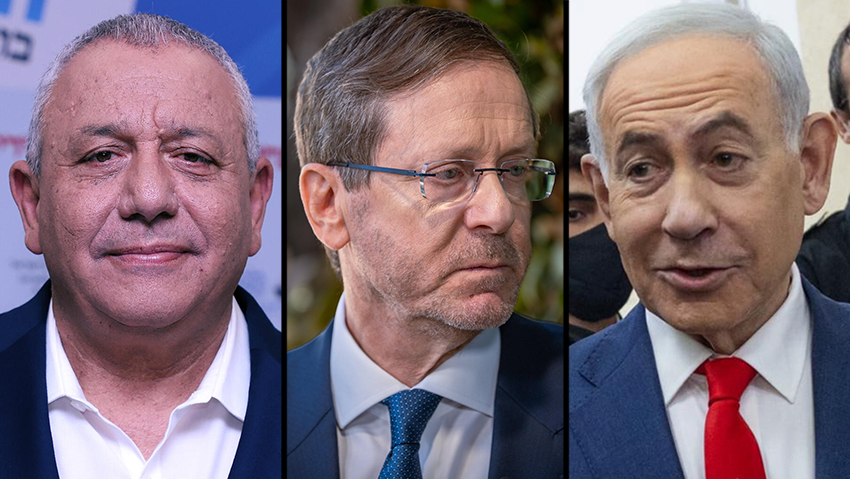
Opposition leader Gadi Eisenkot, President Isaac Herzog, and Prime Minister Benjamin Netanyahu
(Photo: Haim Goldberg/Flash90, Shalev Shalom, Ryan Preuss)
The reported proposal would bring together two political rivals whose parties are positioned on opposite sides of Israel's electoral divide, despite repeated declarations by Eisenkot and other opposition leaders that they will not join a government led by Netanyahu.
Sources familiar with the discussions told ynet that Herzog intends to use his influence after the election to encourage cooperation between the two parties, potentially applying pressure on lawmakers from Eisenkot's party if neither political bloc can assemble a governing majority.
The President's Office rejected the claims.
"We categorically deny the report," it said. "The president has not discussed a unity government with any candidate or Knesset member. At this stage, the president is not dealing with any potential government composition. All of this will be discussed during consultations at the President's Residence after the election results are received."
The office maintained that Herzog had spoken only about the importance of establishing a stable government, without expressing a preference for any particular coalition.
Eisenkot also rejected the prospect of serving alongside Netanyahu, declaring that the prime minister "cannot serve as prime minister, minister or deputy minister."
Herzog: ‘I will do everything I can to prevent another election’
The report follows remarks Herzog made earlier Monday during a special interview at the People of the Nation conference organized by ynet and Yedioth Ahronoth.
Asked about the possibility of another election if the October 27 vote ends without a clear majority, Herzog emphasized his determination to prevent Israel from returning to the polls.
"I am doing everything I can to ensure Israel has a stable government," he said.
"But I will say more than that: I really, really will do everything I can to prevent repeat elections. We need to understand that the national challenges facing us are enormous."
Herzog stressed that political leaders must first wait for the election results.
"We need to wait for the outcome and not pass judgment in advance, but we must do everything possible to avoid going back to elections again and again and again," he said.
The remarks immediately raised concerns among parties in the anti-Netanyahu bloc, whose leaders fear that the president could use his role in the government formation process to encourage cooperation with Likud.
Following an election, the president consults representatives of the parliamentary factions before assigning a lawmaker the task of forming a government.
According to the sources cited by ynet, Herzog could seek to use that political leverage to persuade lawmakers from Eisenkot's Yashar party, described as the largest faction in the opposition bloc, that a unity government is necessary if the election produces a deadlock.
Opposition leaders reject ‘fake unity’ with Netanyahu
The prospect of a coalition involving Netanyahu provoked an immediate backlash from opposition leaders.
Democrats chairman Yair Golan issued a sharply worded statement on X, rejecting any possibility of joining forces with the prime minister.
"There will be no unity government with Netanyahu," Golan wrote, warning that anyone even considering such an arrangement would be "stabbing the democratic public in the back."
Yair Lapid, the Yesh Atid chairman who is running alongside former Prime Minister Naftali Bennett as part of the Together party, also responded forcefully to Herzog's remarks.
"I very much hope President Herzog will not try to push another 'fake unity' government in which Netanyahu once again deceives his partners and brings more disasters upon Israeli citizens with the votes of people who voted to remove him from power," Lapid said.
"We will not cooperate with this," he added, calling on the other parties in the opposition bloc to announce in advance that they would refuse to join such a government.
Other parties in the anti-Netanyahu bloc, as well as Netanyahu's political allies, had not publicly responded to the reported proposal.
Opposition politicians have repeatedly ruled out participating in a government that includes Netanyahu, particularly citing his responsibility as prime minister during the failures preceding the October 7, 2023 Hamas massacre.
For most of those parties, another election would be preferable to entering a unity coalition with him.
The concern among opposition leaders is that Herzog's determination to prevent repeat elections could translate into pressure on individual lawmakers, particularly those less firmly opposed to a unity arrangement.
Eisenkot prepares for a minority government rather than another election
Despite the reported unity discussions, Eisenkot and his political allies are preparing for other scenarios after the election, including the possibility of establishing a minority government.
Eisenkot has said on several occasions that if forced to choose between leaving Netanyahu in office as caretaker prime minister and forming an alternative government supported by a Zionist parliamentary majority, he would pursue the latter option.
Members of the opposition bloc are also preparing to move quickly to replace Knesset Speaker Amir Ohana, a senior Likud lawmaker, as one of their first steps following the election.
According to previously reported plans, they intend to secure the support of at least 61 lawmakers to demand the speaker's replacement.
The strategy draws on a previous confrontation involving former Likud Knesset Speaker Yuli Edelstein, who refused to convene the legislature for a vote on replacing him during a political transition.
After the matter reached the High Court of Justice, judges ordered the Knesset to convene. Edelstein subsequently resigned rather than carry out the court's directive.
Speaking at the People of the Nation conference, Eisenkot said that one of his immediate priorities after the election would be to take control of the Knesset and its main decision-making mechanisms.
Ohana, who also attended the conference, acknowledged that his replacement would be legitimate if a parliamentary majority supported it.
"If there are 61 votes to replace me, it will be legitimate to do so," he said.
Asked whether another dispute over the speakership might reach the High Court, Ohana dismissed the possibility.
"I don't think it will get there. We are law-abiding," he said.
The approaching election therefore presents two competing strategies for the day after the vote: Herzog's stated determination to avoid another round of elections, and opposition parties' efforts to establish a government without Netanyahu, even if doing so requires a minority coalition.
Whether a unity proposal is ever formally raised will depend on the election results and the subsequent coalition consultations. For now, the President's Office insists that no such discussions have taken place.