


The Knesset Foreign Affairs and Defense Committee approved a bill Sunday that would freeze the arrests of ultra-Orthodox yeshiva students who failed to report for mandatory military service, despite a legal opinion warning that the measure would deepen inequality and face serious constitutional difficulties.
The bill was approved for its second and third readings, the final stages required for passage into law, and is expected to reach the Knesset plenum later this week. The coalition is advancing it as part of an agreement with ultra-Orthodox parties previously revealed by ynet.
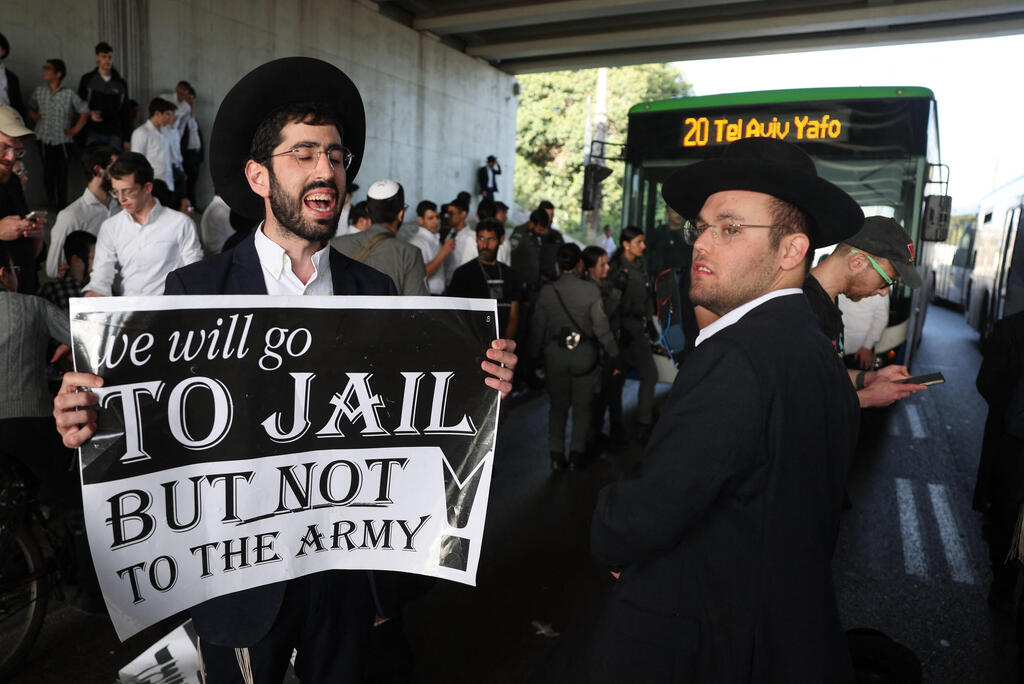
(Photo: Jack Guez/AFP)
In a sharply worded opinion, the committee’s legal adviser described the proposal as “a sectoral exemption from the obligations of the Defense Service Law, without a balancing weight on the other side of the equation.”
Israel requires most Jewish citizens to perform military service, but broad exemptions historically granted to ultra-Orthodox men studying full-time in yeshivas have become one of the country’s most contentious political and legal disputes. Those who have received draft orders but fail to report can face arrest as draft evaders.
The revised bill removes the original 90-day limit on the arrest freeze and states that the measure will remain in force until November 30. In practice, however, it could remain effective for about six months if the Knesset is dissolved before an election.
That is because Section 38 of the Basic Law: The Knesset automatically extends legislation due to expire within four months of parliament’s dissolution until three months after the next Knesset begins its term.
The updated text also removes a provision under which a yeshiva head whose students accumulated five fines could no longer grant other students protection from arrest.
Instead, the defense minister would determine which yeshivas could secure arrest immunity for their students, taking into account recommendations from the Council of Yeshivas. The Defense Ministry would rely on Education Ministry inspection mechanisms.
Another revised provision addresses yeshivas found to have students who are not genuinely engaged in Torah study. Under the current wording, students at an institution that fails an inspection could simply register at another yeshiva.
‘No balancing mechanism’
The committee’s legal adviser acknowledged that Israeli court rulings have historically allowed lawmakers to create special arrangements for full-time yeshiva students in recognition of the value placed on Torah study.
However, she said such arrangements were always required to include measures aimed at reducing inequality in military service.
That balance, she wrote, is essential if legislation granting special treatment to yeshiva students is to meet constitutional standards.
Combining a temporary freeze on criminal proceedings with effective supervision and the withdrawal of financial benefits “might perhaps, though only with great difficulty,” have addressed some of the proposal’s constitutional defects, she said.
The bill before the committee, however, creates an arrest-freeze mechanism exclusively for yeshiva students without introducing meaningful countermeasures.
“In practice, this mechanism grants a sectoral exemption from the obligations of the Defense Service Law, without placing a balancing weight on the other side of the equation,” the opinion said.
The legal adviser said even temporary legislation lasting only a few months must contain the basic principles necessary to justify unequal treatment.
“An arrangement exempting a particular group from complying with the law, without complementary mechanisms, violates the required balance,” she wrote.
She added that the current bill does not contain even the minimum measures needed to combine protection for Torah study with an effort to reduce inequality in national service.
“The further the proposed mechanism moves away from the essential principles required in a military conscription arrangement, the sharper the inequality becomes and the greater the constitutional difficulty it creates,” she concluded.