



An especially dramatic night lies ahead for Israel's party leaders and voters. Exceptionally high turnout, strong participation in liberal strongholds, a surge in voting among Arab citizens and renewed mobilization in Likud strongholds have created a complex political picture that remains difficult to predict even after the release of the television exit polls. With the exception of Channel 14 and i24NEWS, the polls give an advantage to the bloc seeking to replace Prime Minister Benjamin Netanyahu, although it remains dependent on Arab parties.
Polling stations across Israel closed at exactly 10 p.m. Tuesday, ending a dramatic election day marked by exceptionally high and unprecedented turnout. From early in the morning, it was clear that this was no ordinary election. Record participation was reported in liberal strongholds and among Israelis who returned from abroad specifically to vote, but there was also a surprising surge in areas traditionally loyal to Netanyahu. While most of the final pre-election polls had placed Likud as the second-largest party, exit polls suggest Netanyahu managed to mobilize his supporters and could emerge with the largest party in the Knesset, Israel's parliament.
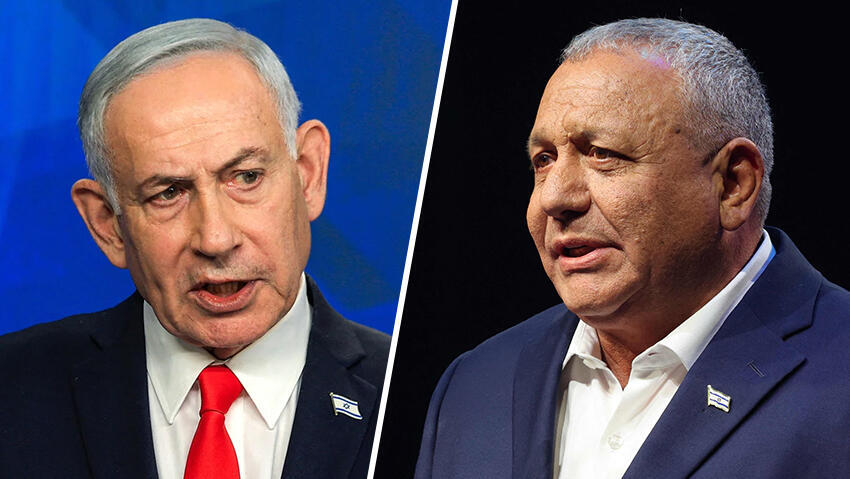
(Photo: Jack GUEZ/AFP, Ronen-Zvulun/AFP)
In that sense, Netanyahu may find himself in a stronger starting position in the battle that will begin Wednesday morning over who receives the mandate from Israel's president to form the next government. Israeli law does not require the president to give the mandate to the leader of the largest party, but rather to the candidate considered most likely to form a government, giving the president broad discretion in making that decision. Therefore, if Likud emerges as a larger party than Eisenkot's Yashar!, Netanyahu is likely to wage a fierce public campaign, using every means available to persuade the president to give him the first opportunity.
Securing the first mandate carries enormous significance for the candidates. The initial period allotted to form a government is 28 days, after which the candidate can request an additional 14 days from the president. This is a critical window for the parties, because the faction whose leader receives the first mandate also gains control of the Knesset's Arrangements Committee, a powerful body responsible for managing parliamentary affairs until permanent committees are established.
Whoever chairs the committee can advance legislative initiatives while working to replace the Knesset speaker or, in Likud's case, keep the position in the party's hands. This would allow the party to establish facts on the ground before the mandate is transferred to the opposing side or a government is formed.
Another dramatic factor is the performance of the Arab parties, whose communities have recorded a significant and unprecedented increase in voter turnout. Both the television exit polls and party officials point to a combined result that could surpass the Joint List's previous record of 15 Knesset seats. In such a scenario, both rival blocs would find themselves further from the 61 seats needed for a parliamentary majority, making it difficult for either to form a government.
Likud officials are pointing Tuesday evening to pollster Shlomo Filber's exit poll on Channel 14, which they say indicates a tie between the blocs, and are already looking toward their next objective. At the same time, they stress that the night will be tense and dramatic, and that until the very end, it will be impossible to know which bloc has gained the advantage.