

Prime Minister Benjamin Netanyahu really wants to help the man currently living in the White House in Washington DC to achieve what appears to be one of his most important goals, and he is not alone.
Many around the world, even during President Donald Trump’s first term, recommended him as a candidate for the Nobel Peace Prize. Even though they probably knew the chances of these nominations being accepted by the Norwegian committee were slim, they had a good reason: Trump is known to enjoy flattery, and the nomination letter Netanyahu presented to him on Monday night during their dinner at the White House indeed moved him.
Gallery
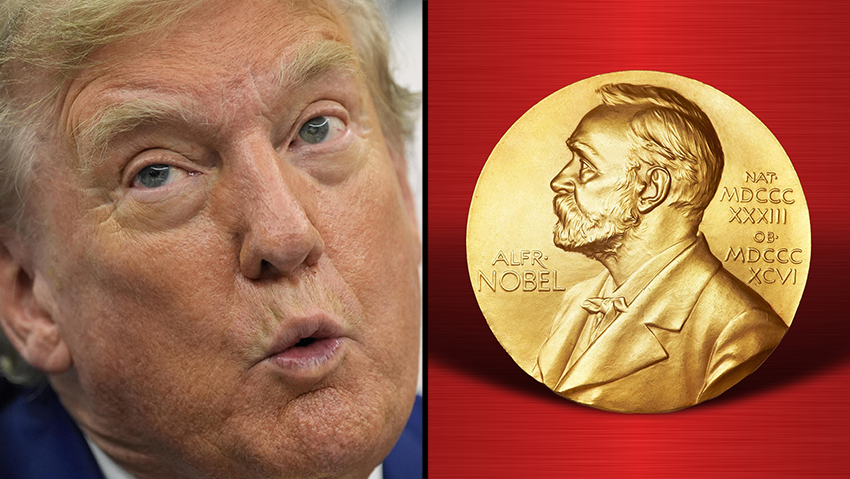
US President Donald Trump really wants to win the Nobel Peace Proze
(Photos: Shutterstock, Alex Brandon/AP)
“Wow,” Trump told Netanyahu when the prime minister announced to the press covering the start of the meeting that he had submitted a letter to the Norwegian committee, recommending the president as a peace prize candidate. “I didn’t know about this. Especially coming from you—it’s very meaningful. Thank you so much, Bibi.”
In the letter, which Netanyahu’s office released simultaneously and which was submitted to the committee on July 1, he wrote: “President Trump has shown exceptional and unwavering dedication to advancing peace, security and stability around the world.”
In his letter, Netanyahu mentioned the Abraham Accords, signed late in Trump’s first term, which normalized relations between Israel and the UAE, Bahrain and Morocco. He hinted at the possibility of expanding these accords to additional countries as part of a broader deal that might end the Gaza war and secure the hostages’ release. “In the Middle East, his efforts have brought about a dramatic transformation and created new opportunities to broaden the circle of peace and normalization,” the letter said.
The Nobel Peace Prize has been awarded since 1901 by a foundation established by dynamite inventor Alfred Nobel’s will. Unlike other Nobel categories, whose laureates are chosen by a Swedish committee, the Peace Prize is decided by a separate committee appointed by the Norwegian Parliament.
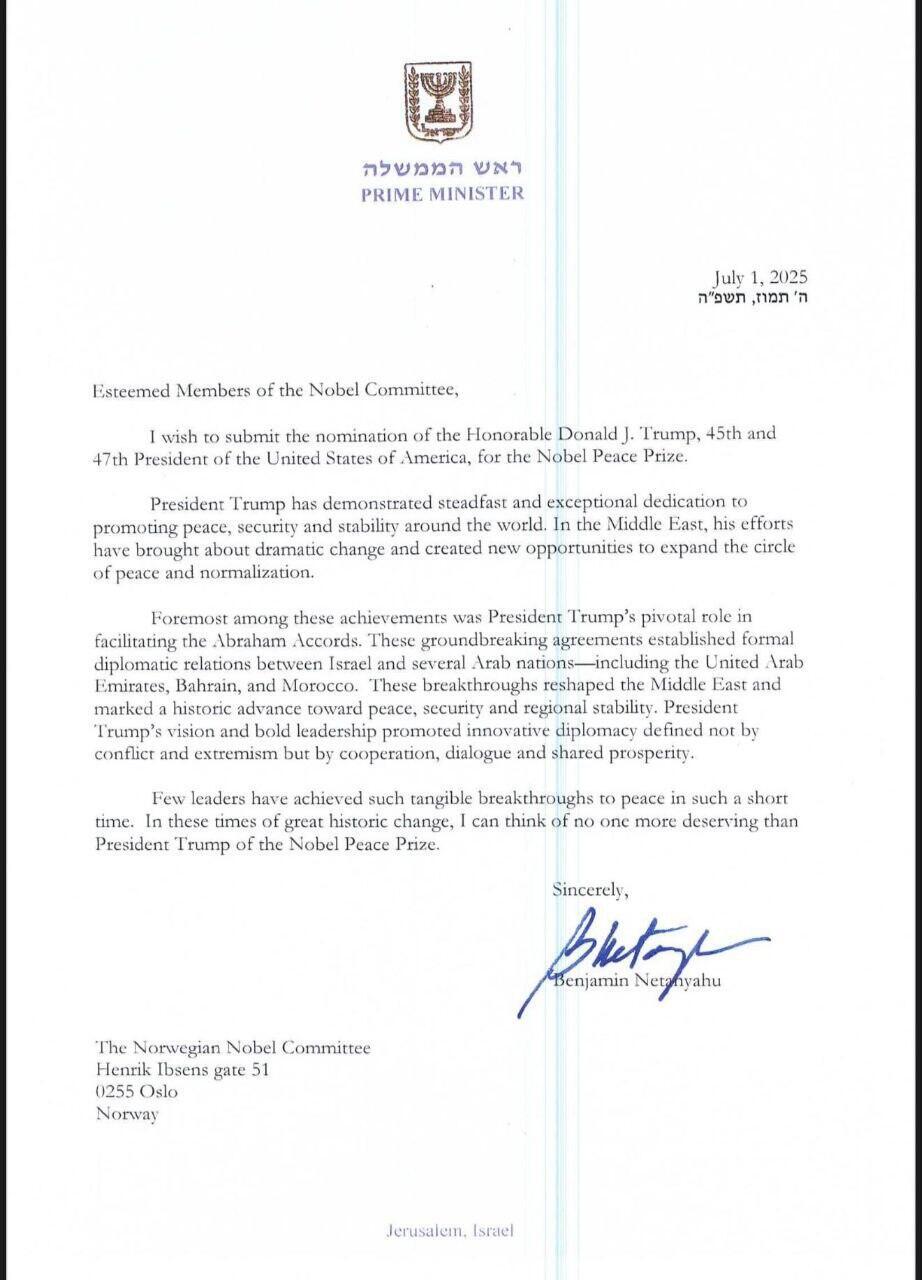
Prime Minister Benjamin Netanyahu's letter nominating President Donald Trump for the Nobel Peace Prize
Individuals and organizations may receive the prize; recent laureates include a Japanese nuclear disarmament organization, Iranian women’s rights activist Narges Mohammadi, and human rights defenders from Belarus, Russia and Ukraine. The most recent head of state to win was Sudanese Prime Minister Abiy Ahmed in 2019, who was honored for his reconciliation efforts with Eritrea. However, his country later descended into civil war.
Or maybe there won't be a winner at all?
According to the committee’s rules, the prize is awarded to someone “who has done the most or best work for fraternity between nations, for the abolition or reduction of standing armies, and for the holding and promotion of peace congresses.” In recent years, amid global conflict, there’s been speculation that the committee might choose not to award the prize—something that’s happened 19 times before, most recently in 1972.
Thousands of individuals are eligible to nominate candidates for the Peace Prize, including heads of state, parliamentarians, previous laureates and university professors. The Nobel Committee keeps candidate names confidential for 50 years and announces only the winner. But nominators themselves may disclose whom they've nominated—a right Netanyahu exercised now.
Get the Ynetnews app on your smartphone: Google Play: https://bit.ly/4eJ37pE | Apple App Store: https://bit.ly/3ZL7iNv
However, Netanyahu missed the nomination deadline this year: submissions closed in January, and this year’s laureate will be announced alongside winners in other categories in October. According to the committee, the shortlist includes 338 nominees—244 individuals and 94 organizations.
Netanyahu wasn't the first to nominate Trump. Professor Anat Beck-Alon, an Israeli law professor at Case Western Reserve University, said she nominated Trump before this year’s deadline. She wrote: “By pledging hostage releases, firmly opposing antisemitism, and encouraging historic accords that bring stability to some of the world’s most volatile regions, he again demonstrated he is a deserving candidate.”
The Ukrainian who nominated Trump—and then withdrew it
Ukrainian politician Oleksandr Merezhko said in November, amid Trump’s electoral victory, that he nominated him. But last month he announced he'd retracted his nomination, saying he had “lost all faith” in Trump’s ability to bring peace to the Russia-Ukraine war. Conversely, earlier this month, Pakistan submitted a nomination, citing Trump’s role in the India-Pakistan ceasefire—an agreement that India itself said the U.S. was not involved in. Also in June, U.S. Rep. Buddy Carter, a Republican from Georgia, nominated Trump for brokering a ceasefire in the Israel–Iran conflict (after Trump entered the conflict and struck Iranian nuclear facilities).
Still, most observers view Trump’s chances as very slim—due to his consistent emphasis on military strength as the only guarantee of peace, and because of a significant cultural and political gap between him and the Norwegian committee—though they would never admit this publicly. Even endorsements for Trump during his first term didn’t influence the committee.
“Obviously this is pathetic ass kissing and a PR stunt, but I'd imagine that the folks who award the Nobel Peace Prize aren't the biggest Netanyahu fans,” said Tommy Vitor, former spokesman for the U.S. National Security Council under Obama, commenting on Netanyahu’s gesture in a post on the X platform.
Netanyahu, however, had a strategic reason. Endorsing Trump touches a sore spot: Trump has long aspired to win the Nobel Peace Prize. His fixation began in 2009 when Barack Obama won it in his first year in office—before any real achievement. Obama’s award surprised many, even his supporters, and years later committee members expressed regret as his two-term presidency did not bring peace. Trump never forgot. In 2013, after reports that Obama told aides, referring to drone strikes, “Turns out I’m really good at killing people,” Trump (then a businessman and reality TV star) tweeted: “Can Oslo retract the award?”
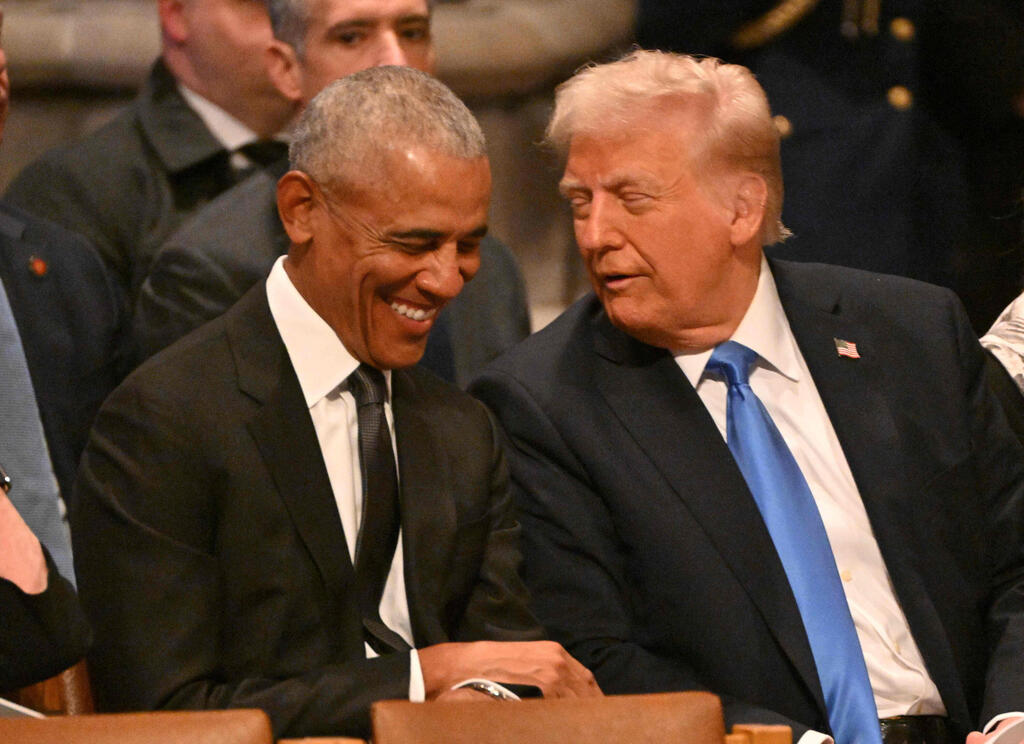
President Donald Trump is jealous of former president Barack Obama's prize
(Photo: Roberto Schmidt/AFP)
At campaign rallies last year, Trump repeated the comparison: “If my name was Obama, I’d have the Nobel in 10 seconds,” he said in October. “He got the Nobel Prize. He didn’t even know what the hell he got it for. Remember, he got elected. Well so did I. He got elected and they announced he was getting the Nobel Prize. I’m just saying there’s a lot of unfairness in this world.”
In February, during his first meeting this year with Netanyahu, Trump again expressed his frustration: “They’ll never give me the Nobel Peace Prize. Too bad. I deserved it. But they’ll never give it to me.”
In a long social media post last month—just a day before he ordered strikes on Iran—Trump elaborated, following a signed deal his administration brokered to end the Congo-Rwanda conflict:
“I won’t get a Nobel Peace Prize for this, I won’t get a Nobel Peace Prize for stopping the War between India and Pakistan, I won’t get a Nobel Peace Prize for stopping the War between Serbia and Kosovo, I won’t get a Nobel Peace Prize for keeping Peace between Egypt and Ethiopia (A massive Ethiopian built dam, stupidly financed by the United States of America, substantially reduces the water flowing into The Nile River), and I won’t get a Nobel Peace Prize for doing the Abraham Accords in the Middle East which, if all goes well, will be loaded to the brim with additional Countries signing on, and will unify the Middle East for the first time in ‘The Ages!’ No, I won’t get a Nobel Peace Prize no matter what I do, including Russia/Ukraine, and Israel/Iran, whatever those outcomes may be, but the people know, and that’s all that matters to me!”