


While public and media attention is focused mainly on the battles at the top and the major parties, recent days suggest that secondary developments among small parties operating under the political radar could, surprisingly, reshape the political map and dramatically affect the election results if they cross the electoral threshold.
In the bloc opposed to Prime Minister Benjamin Netanyahu, efforts so far have focused on trying to push Benny Gantz’s Blue and White party out of the race, since recent polls show it failing to cross the electoral threshold. Gantz, who until recently was part of the opposition bloc, refuses to commit to not sitting in a government with Netanyahu and is taking a relatively unusual line: He says he will force an end to the politics of boycotts and lead the formation of a broad unity government without the political extremes in Israel.
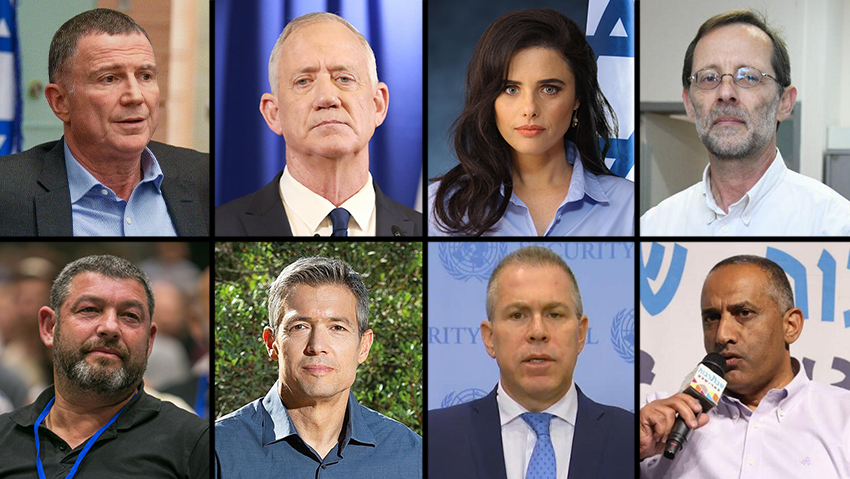
(Photo: Yair Sagi, Reuven Kapuchinsky, Dana Kopel, Rafi Kotz, Beersheba Municipality spokesperson’s office, UN, Alex Kolomoisky, Ido Erez)
But this is where Gantz’s gamble in one of the most consequential elections comes into play, as he risks wasting votes. To strengthen his hold on the electorate he is targeting, Gantz is examining possible alliances with other small parties that also are not crossing the threshold, or have failed to do so in the past, in an effort to stabilize his position.
In recent weeks, Gantz has been holding intensive negotiations with former Fire and Rescue Commissioner Dedy Simhi, whose son Guy Simhi was killed on October 7 in the battle at Re’im. Alongside Simhi, the possible addition of Yaron Zelekha, a former Finance Ministry accountant general who announced years ago that he wanted to enter politics but failed to cross the electoral threshold, was also examined. As of now, the option of adding Zelekha remains on hold, but Gantz and Simhi are applying heavy pressure on Yoaz Hendel, chairman of the reservists’ party, to join them.
The main gap complicating a three-way alliance stems from Hendel’s demand for a joint declaration with Gantz and Simhi that a government cannot be formed with the Haredi parties in their current form and that the joint party would not sit with them. Simhi opposes such a declaration and is willing instead to make a public commitment with Hendel and Gantz that they will not sit with Arab parties.
Another, less severe dispute concerns Simhi’s desire to announce that he will not provide either side with the decisive 61st Knesset seat, but will force them to form a government together. Hendel is not insisting on that line and is demanding a more general declaration: a broad national and Zionist government. Because Hendel is currently serving in active reserve duty and is not yet available to finalize an agreement, it appears the dispute between the sides will not be resolved at least until next week.
Another party drifting across the political map, though it has not yet taken firm shape, is linked to former Likud figures seeking to offer a different path from the one the party is currently pursuing. Gilad Erdan, Yuli Edelstein and Ayelet Shaked are just some of the names that could be part of such a party. Erdan, who has been constantly examining options for forming the party, recently informed the board of Israel Aerospace Industries that he is stepping down from his membership.
Missed the Knesset by 23,000 votes
On the right side of the political map is Zehut, the party led by former lawmaker Moshe Feiglin. In recent days, he has been traveling across the country and meeting with new audiences in an effort to cross the electoral threshold. In the first 2019 election, Feiglin fell about 23,000 votes short of entering the Knesset. He later joined forces with Netanyahu, and after stepping away from political life, began planning his return.
Feiglin, who recently announced the addition of right-wing activist Michael Ben-Ari, is sending messages that he is open to alliances. The realistic options for him are a merger with Bezalel Smotrich’s Religious Zionism party, Itamar Ben-Gvir’s Otzma Yehudit party, and, as part of a broader alliance, he is also not ruling out Avi Maoz’s Noam party. Also in the mix is retired Brig. Gen. Ofer Winter, who has already begun building a political infrastructure but has not made progress with it. Time is working against him and is also pushing him toward an alliance.
Political officials said the splinter parties and the picture emerging at the bottom of the polls could change the broader political landscape. If one of the parties crosses the electoral threshold or imposes its line on others, it will affect the overall results and perhaps even the identity of the next prime minister.
Either way, the players on the political field still have time to decide before the candidate lists for the 26th Knesset close. The deadline for submitting candidate lists to the Central Elections Committee is the 47th day before the election. Therefore, if the election is held Oct. 20, candidates may be submitted until Sept. 3.