


Two Israeli passengers who subdued an Omani co-pilot who tried to crash a flydubai flight to Tel Aviv said in interviews with the New York Post that members of the cabin crew confronted them and demanded that they untie him.
“They were asking us to untie the terrorist — we had no idea why,” said Tzvika Manes, one of the Israeli passengers who helped overpower the co-pilot.
The injured Indian captain receives treatment near the restrained suspect


Daniel Schlichter, a real estate businessman who was sitting in the second row near the cockpit, gave a similar account.
“They were saying to free the terrorist — we got instantly suspicious of them,” he said.
The Israelis initially restrained the co-pilot — identified as Hamam al-Hammami — using headphone cords that Schlichter collected from other passengers, then secured him with plastic zip ties. As he was being held down, Yaniv Hayun, a plumber who was among the passengers who helped regain control of the aircraft, heard al-Hammami shouting, “Kill me, kill me.” The passengers believed the outburst followed the failure of what they suspected was his attempt to carry out a jihadist attack.
Several crew members then began demanding that the passengers release him. An argument broke out, with the Israelis insisting they would not free the co-pilot under any circumstances.
“They said, ‘You are not God, you are not going to kill him,’” Manes recalled. “We didn’t want to kill him, we just wanted him not to kill us.”
Schlichter, 59, was returning from a vacation in Japan with his wife. He and Manes told the Post that the Israelis even gave the injured suspect an oxygen mask.
“We wanted him to live so he could be investigated,” Schlichter said.
A struggle over control of the situation then developed, according to the passengers. Crew members insisted that they were responsible for the aircraft and should be left alone in the area immediately outside the cockpit. The Israeli passengers, fearing at the time that other crew members might have been involved in the co-pilot’s alleged plot, ordered the stewards away from the cockpit and told them to sit farther back in the cabin.
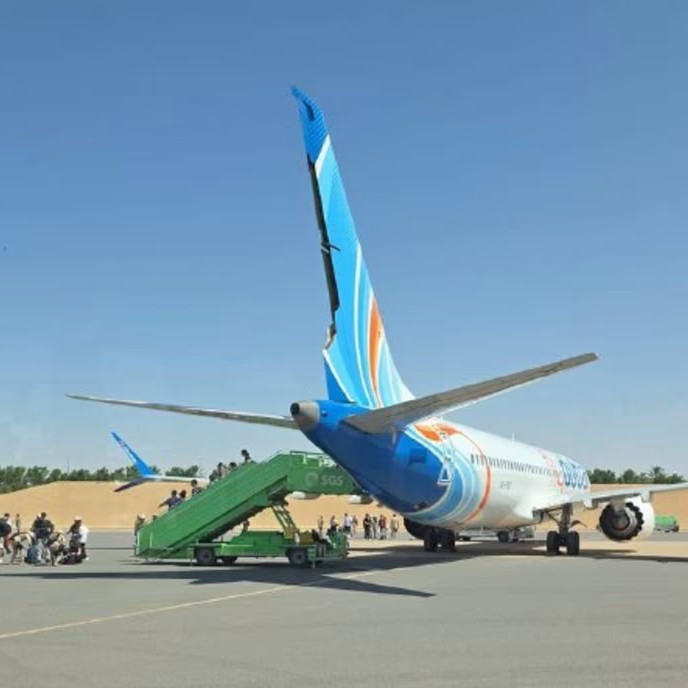
The Flydubai plane after landing in Saudi Arabia, its tail damaged during the steep descent
“We told them, ‘Now the policy is we’re in charge and you do what we say,’” Manes said. “We didn’t know what to think, we were in a suspicious mode for every steward.”
A group of passengers, including Schlichter, escorted the crew members to seats in the fifth or sixth row, away from the cockpit.
“We shouted at them and told them to sit down,” Schlichter said.
Manes said the passengers then recruited “a big guy” to guard the cockpit and prevent anyone from entering.
According to Schlichter, once the crew members were seated, they “began to understand that this was a special case” and started tending to traumatized passengers, providing blankets and water. The crew members have not been accused of conspiring with the Omani co-pilot.
Asked by the Post about the crew’s conduct, flydubai said it could not comment on a matter under investigation.
“We remain fully committed to supporting the ongoing investigation and are in close coordination with the relevant government authorities and regulators,” the airline said in a statement.
The investigation so far indicates that al-Hammami attacked Indian captain Smit Machchhar with an emergency ax kept in the cockpit for use in breaking aircraft windows. Despite being wounded, Machchhar managed to crawl to the cockpit door and open it, allowing Hayun to overpower al-Hammami and help stabilize the aircraft.
Al-Hammami was later transferred from Saudi Arabia, where the plane made an emergency landing, to the United Arab Emirates. Emirati authorities have since described the alleged attempt to crash the aircraft as a “terrorist act” for the first time, as the investigation continues.
Authorities currently believe al-Hammami acted alone, and no reports have emerged indicating that he was acting on behalf of a terrorist organization or state.