


A ceremonial groundbreaking for the long‑awaited Dan Region metro project was held Thursday afternoon at the Segula Junction in Petah Tikva, with Prime Minister Benjamin Netanyahu hailing the milestone as a turning point for Israel’s public transit future.
“Everyone laughed at the metro project,” Netanyahu said at the event. “There are commentators who said ‘the metro is falling apart.’ Falling apart? The metro is waking up.” Several mayors, including Tel Aviv‑Jaffa’s Ron Huldai, Ramat Gan’s Carmel Shama‑Hacohen and Givatayim’s Ran Konik, were notably absent from the ceremony.
Gallery
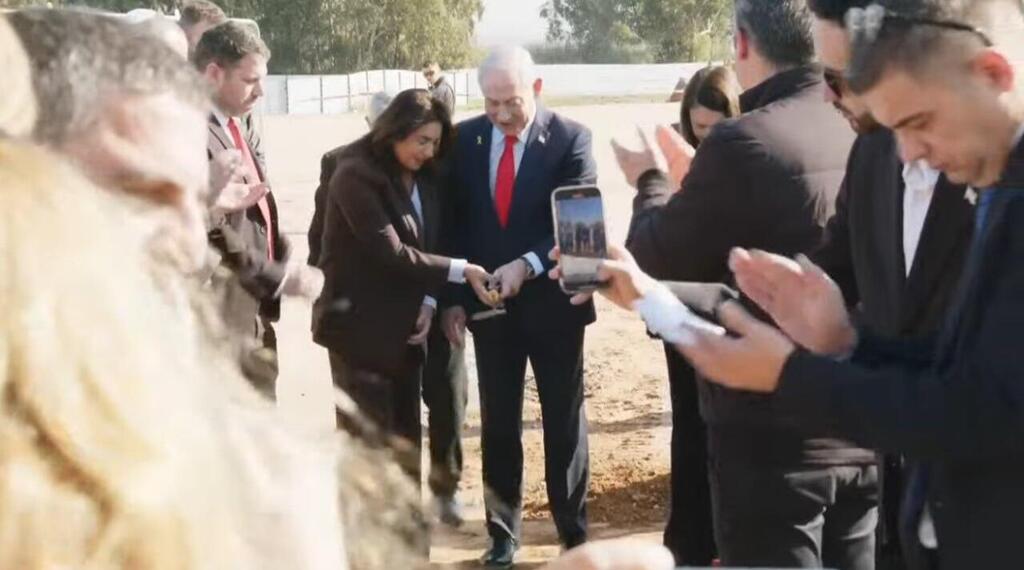
Prime Minister Benjamin Netanyahu and Transportation Minister Miri Regev at ceremonial groundbreaking for Dan Region metro project
(Photo: NTA Metropolitan Mass Transit System Ltd)
Netanyahu emphasized the scale and ambition of the effort, saying the metro would transform transportation across the densely populated Dan region. “There will be many tunnels here and there is also a very great light at the end of the tunnel. The era of the metro is coming to the Dan region,” he said.
“Ben Gurion spoke about it, others spoke about it,” Netanyahu said, referring to Israel's first prime minister. “Without dreaming there is nothing; but if you remain with the dream without execution, you are left with nothing. Dreams are one thing and reality is another, and we have brought the reality. We promised, we fulfilled and we are implementing.”
The prime minister called the cornerstone ceremony a key step toward realizing a vision that he said will “propel the country forward.” He described the metro as not just an “urban legend” but “urban history that we are creating through systematic work with massive investment and a forward‑looking perspective. A promising future, a shining future for the citizens of Israel.”
Netanyahu noted that visitors to modern capital cities abroad are familiar with extensive subway systems. “Over the years many asked me, ‘Prime Minister, when will we have something like this here?’ So your eyes see it: we are also advancing, with momentum, a mass transit system below ground and above ground. 150 kilometers underground. This is a giant project, simply giant. More than 150 billion shekels. This metro will quickly and safely connect all the municipalities in greater Dan region.”
He said the new system would bring huge benefits to residents within a few years of operation, turning the metropolitan area into “one accessible unit” and enabling people to live in central locations without being stuck in traffic.
The metro project, long debated and repeatedly delayed, represents one of the largest public infrastructure investments in Israel’s history. Netanyahu’s government has pushed ahead amid both political debate and logistical challenges as the country seeks alternatives to chronic congestion and growing urban populations.

The Tel Aviv metro
(Illustration: NTA Metropolitan Mass Transit System Ltd)
Transportation Minister Miri Regev also spoke at the ceremony, saying she had made a strategic decision to advance the metro only as part of a broader national transportation plan.
“I admit it — my ultimate vision was a railway from Kiryat Shmona to Eilat, and yes, we will have such a railway,” Regev said. “I decided that the metro would move forward only as part of a plan to connect the entire State of Israel. In the end, an airport needs a train, and a train needs bicycle paths leading to it.”
Regev rejected criticism that she had delayed the metro for political reasons or harmed Israel’s economy. “That’s not new,” she said. “I was prepared to absorb all the criticism in order to give Israel’s citizens connectivity and mobility.”
She also reiterated her opposition to congestion taxes, saying it should not be implemented before comprehensive public transportation links are in place. “As long as there is no connectivity, there will be no congestion tax,” Regev said, calling on Netanyahu to halt the plan.
Despite political differences with Tel Aviv Mayor Huldai, Regev praised his approach to transportation projects. “We disagree on many things — he’s even taking me to court now over the issue of tefillin,” she said. “But on one thing I salute him: before elections, the city is completely torn up — whether for the light rail or the metro — because he knows that in three years we won’t need cars in Tel Aviv.”
Behind the ribbon-cutting ceremony and celebratory remarks, however, the government body tasked with managing the metro project is facing a deep crisis.
The Metro Authority, responsible for overseeing, coordinating and regulating the project, is currently without a chairperson and staffed by just five employees, despite being charged with managing the largest and most expensive infrastructure project ever undertaken in Israel.
The metro’s total cost is estimated at between 150 billion and 200 billion shekels. Once completed, it is expected to serve about 2 million passengers a day, connect more than 20 local authorities and fundamentally transform public transportation across the Tel Aviv metropolitan area.
The project’s original completion target was 2032, but after repeated delays it is now not expected to be finished before 2040. Even that distant deadline could slip further if the Metro Authority is unable to fulfill its role.
NTA Metropolitan Mass Transit System Ltd., the state-owned company responsible for construction, planning and excavation, cannot supervise itself, remove regulatory obstacles involving other government ministries or manage oversight. NTA is also simultaneously operating two major light rail projects, creating a significant managerial burden.
Without a functioning Metro Authority, officials warn, a dangerous vacuum has emerged — with no single body responsible for decision-making, timetable enforcement or safeguarding the broader public interest.