

The plenum of the Knesset convenes Monday for the opening ceremony of the winter session following a three‑month recess. This marks the fourth session of the 25th Knesset, and the big question looming is whether the Knesset will dissolve and head to elections even before the next summer session begins.
The ceremony is opened by Speaker Amir Ohana, followed by speeches from President Isaac Herzog, Prime Minister Benjamin Netanyahu and Opposition Leader Yair Lapid.
At the start of the session, Ohana referred to the incoming Supreme Court President Yitzhak Amit as simply Supreme Court judge, sparking an uproar in the plenum. Knesset member Gilad Kariv of the opposition party The Democrats yelled: “Zero, isn’t the incitement enough for you? Wasn’t 7 October enough? You bring disgrace to this house.”
Ohana, as chair of the session, called Kariv to a first summons. Other opposition Knesset members were expelled and some left by protest.
Gallery
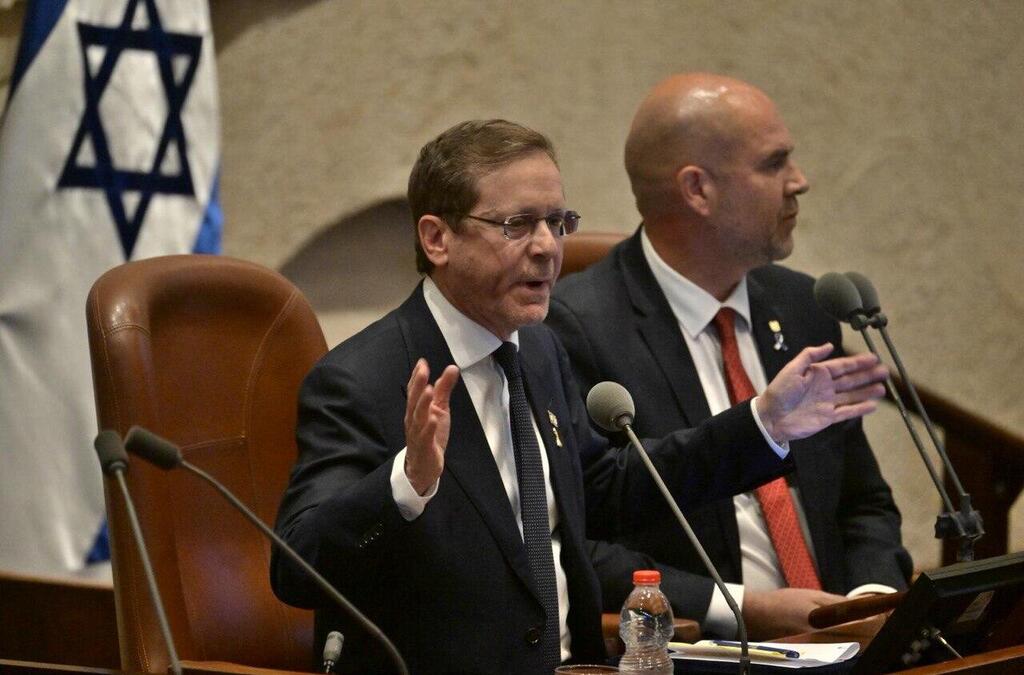
President Isaac Herzog addressign the opening of the Knesset's winter session
(Photo: Amos Ben Gershon, GPO)
Ohana — who returned to his lapel the hostage pin removed at Trump’s Knesset visit — opened the winter session with a sharp critique of the justice system, charging it with “trampling the Knesset and harming democracy.” He warned: “When the Basic Law: Reasonableness is struck down by the High Court during wartime, that is a severe precedent, adding: “It is not the public representatives who are cancelled — it is the sovereign, the people who went to the ballot box.”
Ohana argued the judicial system is operating “without checks and balances” and that the Government Legal Counsel’s Office is expanding its powers “in an unprecedented manner.”
“There is no longer anywhere in the democratic world an authority whose power is infinite and unlimited — because ‘everything is justiciable’ — and only it has the final word, except the Israeli judicial system.”
He stressed that the effect is not only legal but societal: “There is not one grain of unity in striking down a Basic Law in wartime — and one softened so much to try to dispel the fears. This move signals a wound to Israeli democracy, to the Knesset, to elected public officials — and more gravely, to the public that elected them.”
That said, he called for a fresh start in inter‑branch relations. “We can and must work together on repairing the relationships between the branches,” he said.
Herzog honors Amit, calls for respectful discourse
President Herzog opened his remarks by addressing Justice Amit as “Supreme Court President” and was greeted with applause. He announced he would skip his pre‑written speech to address the recent incident involving Ohana.

incoming Supreme Court President Yitzhak Amit
(Photo: Alex Kolomoisky)
“I had a long and programmatic speech prepared, but this is a very important moment in our lives and the heart bleeds. There is a difference between a principled debate — which is legitimate — and lack of courtesy, harm to human dignity, harm to other authorities and to Israeli judges.”
Herzog declared: “I will stand up for the judges of Israel. When we today bury two heroic soldiers, when the body of another fallen hostage returns today, we cannot ignore where we are dragging ourselves as a nation.”
He stressed that he would not accept “basic disrespect,” and called for a return to a dignified civic discourse: “The people of Israel, instead of dealing with what matters most, are busy with the question of whether the Supreme Court President will be invited and under what title. Supreme Court President — I welcome you.”
He was also met with shouted insults from coalition members.
Herzog appealed for calm and for fundamental issues to be addressed. “It is time to sit and talk, establish clear rules, and stop breaking codes and traditions that have lasted decades,” he said
He concluded with a warning that Israel is entering a particularly sensitive election year: “It is possible to behave with restraint and responsibility, and it is possible to tear each other’s eyes out — at a time when our soldiers are in Gaza and their families are on the home front. I promise that we will attempt to reach unity.”
Netanyahu centers hostages, warns mission unfinished
Netanyahu took the floor immediately after Herzog, and referred indirectly to the dispute over Ohana’s designation of Amit: “I expected to hear a response as well,” he said. “And I say — Yitzhak Amit is president of the Supreme Court. That is a fact.” He added: “But I said and I add — I am Prime Minister of Israel, those are the Ministers of Israel, and that is a fact. And this is the Speaker of the Knesset, and those are the MKs of Israel — and that too is a fact.”
Turning to the issue of the hostages, he emphasized the national commitment. “We are committed to bringing everyone home, until the last one. These are not empty words — we said it when we spoke of the hostages alive in Gaza; some did not believe. I believed. My colleagues believed. And our soldiers did the work and brought them back,” he said.
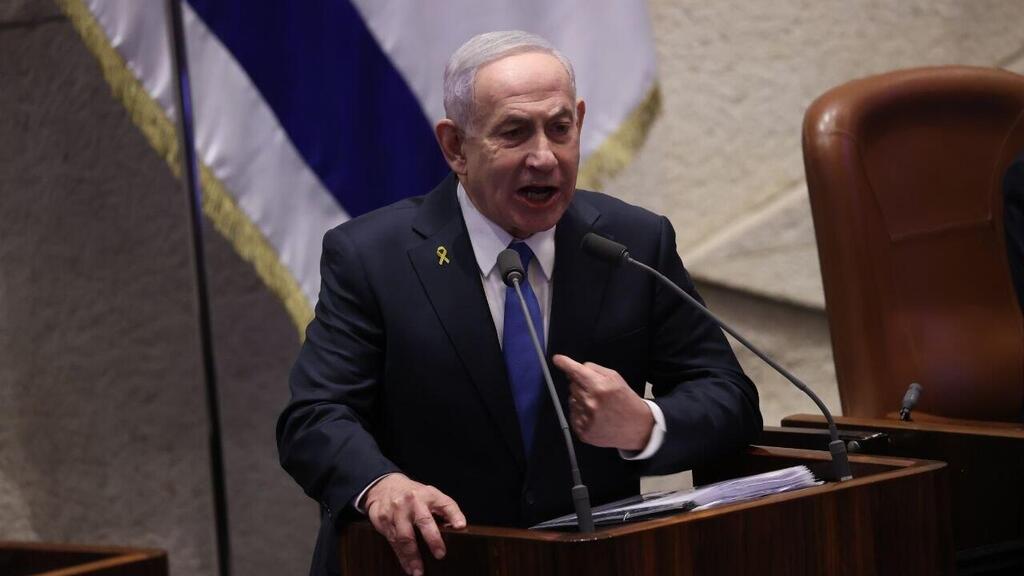
Prime Minister Benjamin Netanyahu addresses teh Knesset plenum at the opening ceremony of the winter session
(Photo: Alex Kolomoisky)
Netanyahu called the past year a defining moment. “We rose from the terrible collapse of October 7, we returned a hair‑raising war, and we reached from the Gaza Strip to the skies of Tehran," he said.
He noted that so far 293 hostages have been returned to Israel, including 20 alive and 12 fallen in the past week — but added: “The mission is not yet completed.”
He read out the names of 16 fallen hostage‑soldiers still in Gaza. When he mispronounced the name of fallen captive Sgt. Itay Chen as “Eitan," opposition lawmakers called him out, and he replied sarcastically: “Good that you correct me.”
He responded angrily to the opposition's calls, demanding that things be set straight. "At no point, not six months ago, not a year ago, not a year and a half ago, at no point was Hamas ready for the outline we have now achieved," he said, claiming that military pressure and the entry into Gaza forced the organization to give in. He warned that if it had given in to demands to stop the war, we would have faced "a crushing victory by Hamas" and explained that an early end would have left Yahwa Sinwar, Hezbollah and the Iranian axis very strong. "Hamas would have stood its ground," Netanyahu attacked.
According to him, "Iran would continue to produce tens of thousands of ballistic missiles at an accelerated pace and within a few months it would develop atomic bombs with the aim of destroying us, including you and everyone, Jews, Arabs, right-wingers, leftists. Everyone would go up into the sky in atomic smoke."
Netanyahu referred to Hamas's violation of the ceasefire agreement and the deaths of soldiers, Major Yaniv Kula, 26, and Sergeant Itai Yavetz, 21 , in an incident that occurred in Rafah. "We attacked Hamas with 153 tons of bombs. We attacked dozens of targets throughout the length and breadth of the Strip, we eliminated many terrorists, including senior commanders. I made it clear from the beginning - a ceasefire is not a license for Hamas to threaten us. Hamas' military-governmental force will be eliminated."
He called for lowering the flames and managing the dispute in a state-like manner, and also called for "unity": "We know what terrible destruction gratuitous hatred has caused to the history of our people. It is time to lower the height of the flames. In a democracy, it is possible to reach decisions by a majority and a minority, it is also possible to reach compromises, it is possible and necessary to discuss disputes, but to do so in a matter-of-fact manner, certainly not with violence, certainly not with murder threats against elected officials, certainly not with murder threats against the prime minister and his family members, and also against the families of ministers." He also clarified: "We are going to pass the 2026 budget soon."
Netanyahu referred to the draft exemption law that is expected to be introduced in the upcoming session, and presented it as a historic move: "We will overcome the challenges, we will realize the opportunities. In the current session, we will submit for Knesset approval a draft law that will result in the draft of 10,000 yeshiva students within two years. This is a real revolution, something that has not happened since the establishment of the state."
The prime minister noted that young people who are not Haredi must also contribute, and he particularly complimented the Haredi Hasmonean Brigade, which fought in Gaza. "I visited them, I saw them. They eliminated dozens of terrorists. These brave fighters enlisted as Haredi and will be discharged as Haredi." His remarks were met with applause from the entire plenary session - except for the Haredi Knesset members, who seemed surprised.
Lapid: 'This Knesset is not yours, it belongs to the people of Israel'
Opposition leader Yair Lapid took the floor to speak after Netanyahu, and angrily began his remarks with a call aimed directly at the Knesset Speaker: "MK Ohana, this Knesset is not yours. It belongs to the people of Israel." Lapid added: "This is the first place since the Great Sanhedrin of the people of Israel that can elect leadership - and you are disrespecting it like this. Do not disrespect the memory of the fallen in this building." He told Ohana that he was "the chairman of only half the Knesset, he is the chairman of that side and that's the end of it."
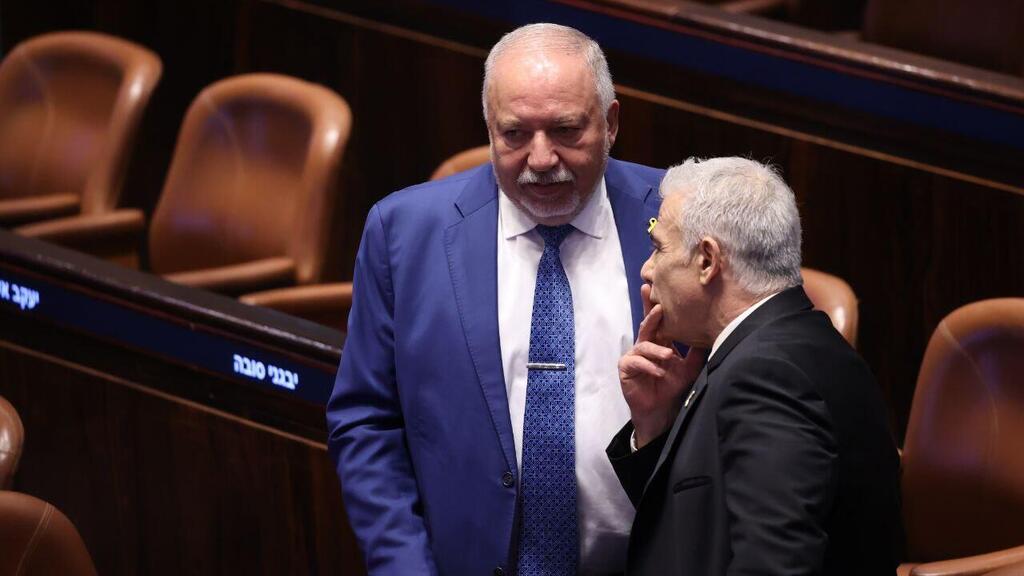
Opposition Leader Yair Lapid and Avigdor Liberman on the Knesset floor
(Photo: Alex Kolomoisky)
Later, he turned to Benjamin Netanyahu and responded sharply to his words: "Mr. Prime Minister, I listened very attentively to your speech and wondered in what reality it was taking place. You said that we bombed Iran - who was the prime minister when Iran gained power? You said that Hezbollah had accumulated 150,000 missiles - who was the prime minister at that time?
Winter session opens amid crises: cease‑fire, coalition tensions and draft law
The session opens against the backdrop of the hostages deal, the fragile cease‑fire with Hamas and concerns of coalition instability, particularly from government ministers Itamar Ben‑Gvir and Bezalel Smotrich, over the fact that Hamas has not yet been disarmed.
Ben‑Gvir demanded at the start of his faction meeting that the first law submitted this session be the death penalty for terrorists, warning: “The excuses are over. If within three weeks the law is not brought to a vote in the Knesset plenum, Otzma Yehudit will not be bound by coalition votes.”
The National Security Minister added: “The main war objective is the destruction of Hamas. Not extracting a price from it, but extracting its very existence. I call on the prime minister — it’s time to pull yourself together, it’s time to return to intense full‑force combat, to conquer, to crush — until this objective is achieved.”
Another looming crisis for the coalition is the draft‑exemption law, whose draft version is expected Monday from the Foreign & Defense Committee chairman Boaz Bismuth. The bill proposes new exemptions for ultra‑Orthodox citizens and is being closely watched by their parties, which are weighing rejoining the coalition, but are waiting to see if legislative progress secures a “victory.”
For Netanyahu, the session opens with a significant dilemma: on one hand he wants to capitalize on his popularity after the hostages deal and returning all living captives in order to head to elections; on the other hand he is trying to halt the ongoing trial against him within this term. Last week, Justice Minister Yariv Levin announced a law would be advanced allowing him and National Security Minister Israel Katz to cancel hearings in Netanyahu’s trial.
Also notable is that Supreme Court President Yitzhak Amit — who was not formally invited today by Speaker Ohana to the traditional photo session with the president, prime minister and opposition leader — was invited only “as a regular judge.”