

U.S. President Donald Trump is pushing to hold another meeting with North Korean leader Kim Jong Un as early as this fall, in an effort to revive the unusual personal diplomacy he pursued with him during his first term.
The Wall Street Journal reported overnight between Tuesday and Wednesday, citing U.S. officials, that Trump has already privately discussed the possibility of holding a face-to-face meeting with Kim during his next visit to Asia, which could take place in November around the APEC summit in Shenzhen, China.
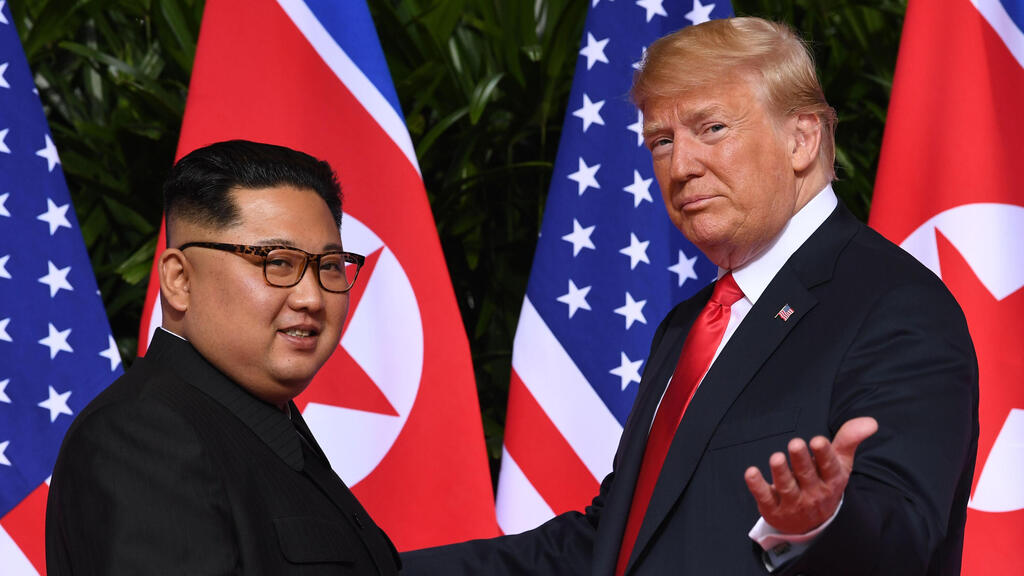
Trump and Kim at their first meeting in 2018
(Photo: AFP)
Formal preparations for a summit have not yet begun, but Trump’s desire to hold another meeting is clear, according to the Journal. A White House official told the newspaper that the two leaders would meet “at the right time.” North Korea’s delegation to the United Nations did not respond to a request for comment, and Trump himself said Monday that Kim had already responded to his outreach efforts, but did not elaborate on what the response included or how the communication between them took place.
This is not the first time since returning to the White House that Trump has tried to arrange such a meeting. According to the Journal, during a previous trip to Asia he tried to advance a meeting on short notice and even publicly asked that a message be passed to Kim saying he wanted to talk. U.S. officials told the newspaper that Pyongyang quietly signaled at the time that it was open to the idea, but logistical difficulties prevented the meeting from taking place.
The renewed contacts now carry greater significance following an unusual step Trump has already taken to reduce tensions with Pyongyang: an order to significantly scale back the major annual military exercise held by the U.S. and South Korea. On Wednesday morning, South Korea’s military announced that the Ulchi Freedom Shield exercise, which began August 17 and was supposed to continue until August 27, would end as early as Friday, August 21. In other words, the exercise was shortened from 11 days to just five.
According to South Korean media reports, the two allies will complete the defensive portion of the exercise this week, but its second stage, which includes, among other things, counterattack scenarios, will be canceled or postponed. Some field training is also expected to be canceled or delayed. A Pentagon official confirmed that the U.S. military is significantly scaling back the exercise in accordance with the president’s order.
But the way the decision was made caused embarrassment in Seoul. South Korean Foreign Minister Cho Hyun revealed overnight in a parliamentary hearing that not only was the South Korean government surprised by Trump’s order, but so were officials in the U.S. administration itself. According to him, when Trump suddenly ordered the exercise scaled back, officials in both countries had not known about it in advance.
Trump’s order was published hours before the exercise began Monday. The American president claimed that the drills were “expensive” and sent Pyongyang a hostile and inappropriate message. He explicitly linked his decision to his “very good relationship” with Kim, and claimed that North Korea under his presidency is not threatening and acts “respectfully.” He also used the announcement to settle accounts with Seoul over its refusal to join U.S. actions against Iran.
In South Korea, despite the surprise, officials are trying to see the possible rapprochement between Trump and Kim as an opportunity. The national security adviser to President Lee Ja Meyung said this week that Seoul hopes the personal relationship between the two leaders will lead to the renewal of meaningful dialogue between Washington and Pyongyang, which could advance stability on the Korean Peninsula. At the same time, Lee emphasized that the joint exercises are defensive only and are not intended to prepare an attack on the North.
North Korea, for its part, is still not publicly signaling that it is impressed by the gesture. The state news agency KCNA again condemned the exercises overnight, called the U.S. and South Korea “warmongers” and said Pyongyang would continue exercising its right to self-defense in the face of military threats against it. Notably, the statement did not mention Trump himself, his order to cut the exercise or his renewed attempt to open a channel with Kim.
This time, Kim comes much stronger
If a fourth meeting does indeed take place, Trump is expected to meet a North Korean leader in a very different position of strength from the one he was in during their previous meetings. The two first met in Singapore in 2018, then again in Hanoi in February 2019, and for a third time in June that year in the demilitarized zone between the two Koreas. The Hanoi summit ended without an agreement after the sides failed to reach understandings on dismantling North Korea’s nuclear program and lifting sanctions. Since then, Pyongyang has significantly expanded its nuclear and missile capabilities.
According to The Wall Street Journal, independent arms control experts previously estimated that North Korea has about 60 nuclear warheads and enough fissile material for as many as 90. But Jeffrey Lewis, an expert on North Korea’s nuclear program at Stanford University, told the newspaper that those estimates are likely now very low. Given the hundreds of missile launchers Pyongyang has displayed and the growing quantities of plutonium and enriched uranium it is producing, he said, its arsenal may now already be in the low hundreds of warheads.
Its ability to hit U.S. territory has also improved. The U.S. intelligence community’s annual threat assessment said in March that North Korea continues to expand its strategic weapons programs, and a Pentagon official later warned that its nuclear forces are increasingly capable of threatening the U.S. itself, while its missile array can strike South Korea and Japan with nuclear or conventional weapons.
At the same time, Kim has strengthened ties in recent years with Washington’s other adversaries. North Korea has deepened its cooperation with Russia, sent thousands of troops to help Vladimir Putin’s army in the war in Ukraine and gained combat experience through them. It has also improved relations with China and deepened missile cooperation with Iran. All of this, according to officials and experts who spoke with the Journal, gives Kim far greater leverage ahead of any future negotiations.
Trump, by contrast, sees a personal meeting as a possible way to break the deadlock anew. According to the Journal, the president is seeking a major foreign policy achievement while the campaign against Iran has still not produced the arrangement he wants. But among experts, and also among some U.S. officials, there is great skepticism: Kim is no longer the leader he was in 2018, and giving up nuclear weapons — Trump’s central goal in the previous summits — now seems even further away.
History also provides a precedent for the current move. After the first summit with Kim in Singapore in 2018, Trump suspended a major military exercise with South Korea, which he described as expensive and provocative, and in the years that followed, additional exercises were canceled or redesigned. But the gestures did not lead to North Korean denuclearization, and when the talks collapsed, the major exercises were gradually renewed. Now Trump is returning to almost the same formula — only this time, on the other side of the table sits Kim Jong Un, armed with a much larger arsenal and a stronger alliance network.