


President Isaac Herzog's consultations with Israel's political parties over who should form the next government are set to begin Tuesday, with several key questions still unresolved. While all parties in the bloc seeking to replace Prime Minister Benjamin Netanyahu have announced they will recommend Yashar! party leader Gadi Eisenkot for prime minister, the remaining parties have yet to declare whom they will endorse.
The consultations will begin Tuesday afternoon. Herzog announced that he would start with representatives of the smaller Knesset factions, proceeding in ascending order of size, giving those parties less time to decide which candidate to support. "The aim of the decision is to encourage thinking outside the box," the President's Office said. Representatives of Religious Zionism-Zehut will be the first to arrive at 5 p.m., followed by Shas at 6:15 p.m. and Yisrael Beytenu at 7:15 p.m.
Yisrael Beytenu chairman Avigdor Liberman announced that he would join Naftali Bennett's Beyachad party and the Democrats in recommending Eisenkot, despite sharply criticizing him and saying his "selfish" campaign had "cost us seven or eight seats." By contrast, the parties in Netanyahu's bloc, whose stability is no longer as certain as it once was, have yet to officially announce whom they will recommend.
Religious Zionism-Zehut and Otzma Yehudit have no apparent path to government other than under Netanyahu, and both are widely expected to recommend him. Shas is also considered highly likely to endorse Netanyahu, although party chairman Aryeh Deri did not answer calls from the Likud leader, who issued a statement supporting him in an apparent effort to ensure he would not break ranks. United Torah Judaism, however, is a different story, with current assessments suggesting it will not recommend anyone.
Representatives of United Torah Judaism, an Ashkenazi ultra-Orthodox party, are scheduled to be the first to arrive at the President's Residence on Thursday, at 8:30 a.m. They will be followed by Otzma Yehudit at 9:45 a.m., the Democrats at 11 a.m., Ra'am at 12:15 p.m., the Joint List at 4:45 p.m. and Bennett's Beyachad faction at 6 p.m. Representatives of the two largest parties will arrive last, with Yashar! scheduled for 7:15 p.m. and Likud for 8:30 p.m.
Besides the parties in Netanyahu's bloc, the Arab parties, which secured a record 18 seats in the latest election, have also yet to officially announce whom they will recommend, if anyone. However, current assessments and previous statements suggest that both Ra'am and the Joint List will ultimately recommend Eisenkot.
The leaders of the Joint List and Ra'am held their first meeting since the election at a hotel in Nazareth, seeking to strengthen coordination and explore political cooperation in the coming period. Their recommendations to the president are expected to be coordinated.
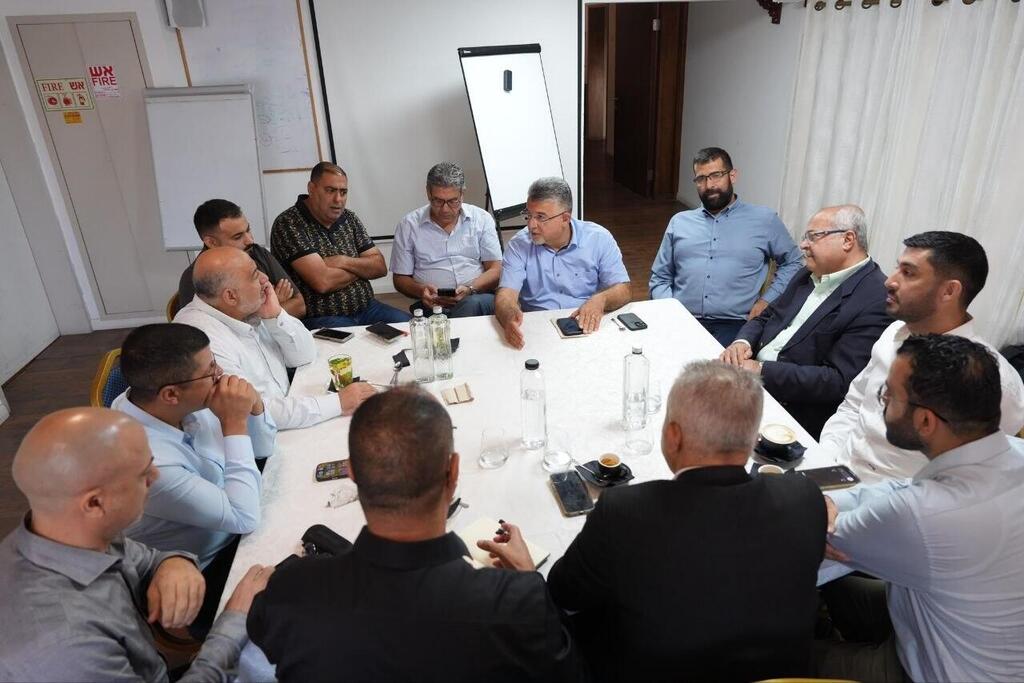
Leaders of the Joint List and Ra'am
The support of every party in the bloc seeking to replace Netanyahu gives Eisenkot 48 endorsements. If Ra'am and the Joint List join them, he will almost certainly receive the first mandate to form a government. Even if the Arab parties ultimately decide not to recommend him, Herzog could still give Eisenkot the mandate if United Torah Judaism does not endorse Netanyahu. In that case, Netanyahu would have 46 endorsements, fewer than Eisenkot. The president traditionally assigns the task of forming a government to the Knesset member he believes has the best chance of succeeding, usually the candidate with the most endorsements.
Before the consultations begin, leaders of the Eisenkot bloc are expected to meet to examine their options ahead of receiving a possible mandate to form a government. Senior figures in the bloc say their immediate plans include what they call a "takeover of the Knesset," beginning with replacing Knesset Speaker Amir Ohana, establishing the Arrangements Committee responsible for organizing parliamentary proceedings and repealing controversial legislation advanced by the coalition during the previous term.
Herzog's office said that "the president wishes to hear the positions of all factions and examine whether there are additional approaches or alternatives that could help build consensus and form a government. This reflects the belief that, at this time, it is important to exhaust all possibilities, broaden the dialogue and consider every avenue that could advance the process. The president also does not rule out another round of consultations, should that prove necessary."
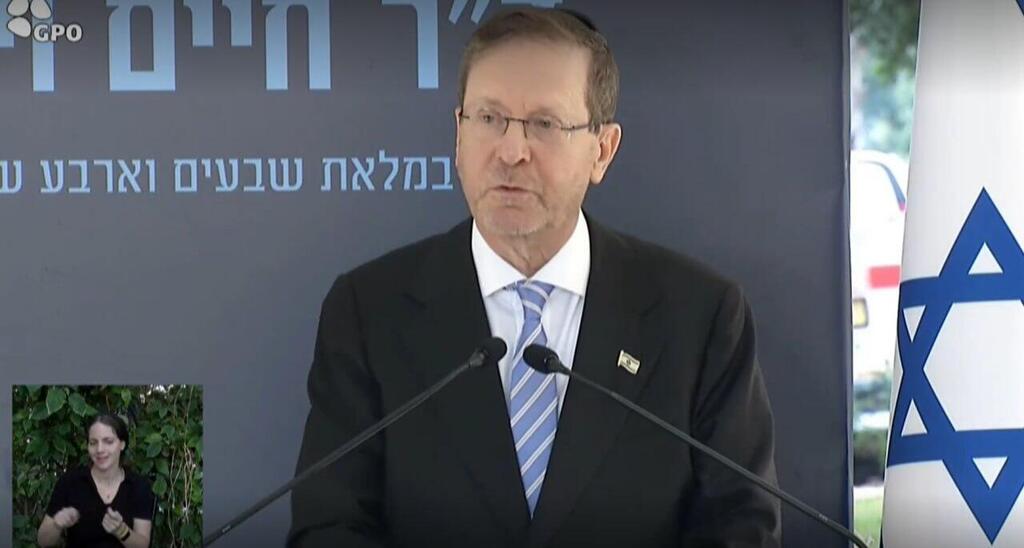
Even before polling stations opened, Herzog repeatedly urged party leaders to put aside their differences and work toward a unity government, including during his appearance at the "People of the State" conference hosted by ynet and Yedioth Ahronoth. He continued making that appeal after the final election results were released, calling on party representatives to come to the consultations with "an open mind and an open heart."
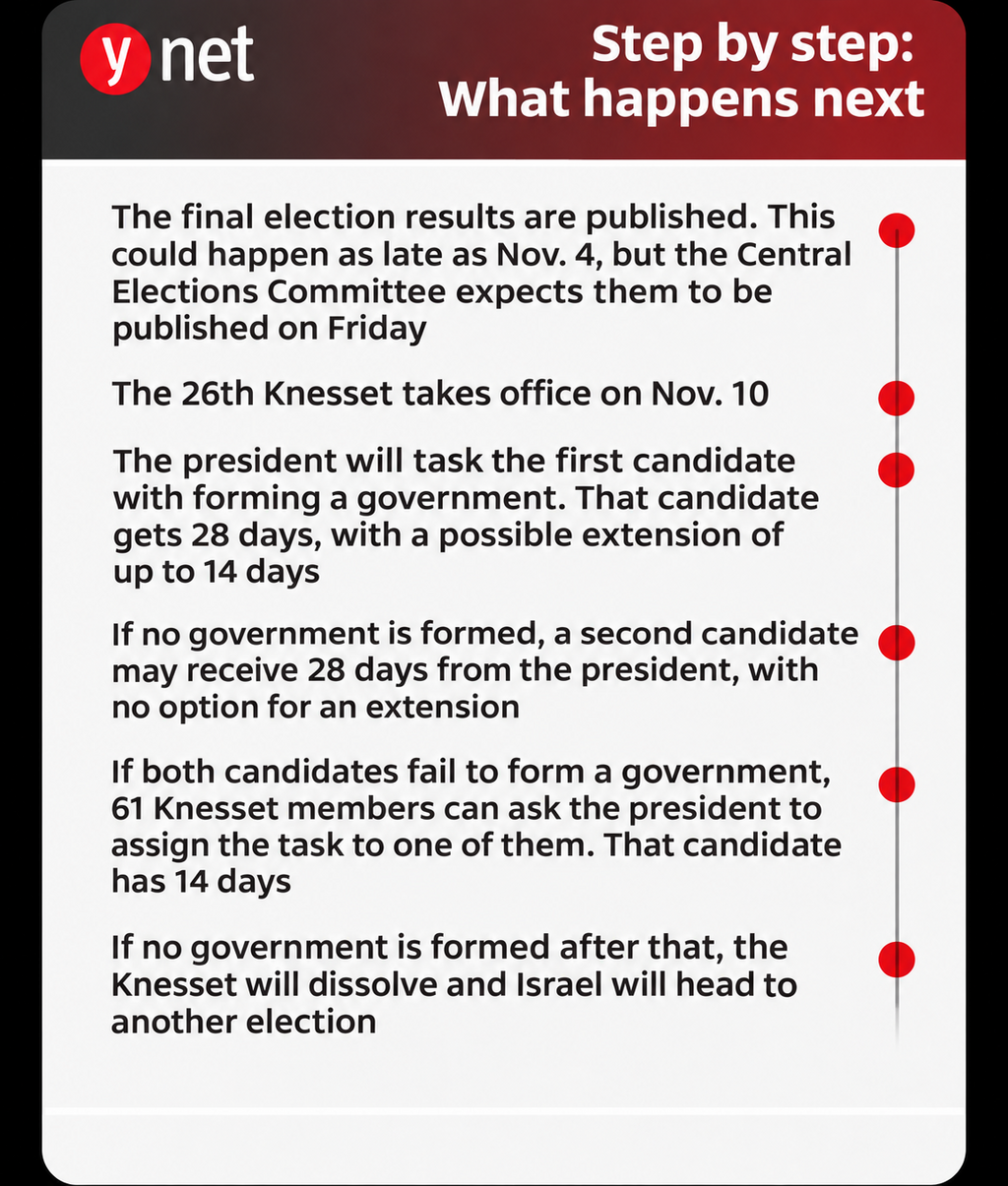
Whoever receives the first mandate will have 28 days to form a government. The president may extend that period by another 14 days. If the candidate fails, the president can choose between two options. The first is to assign the task to another Knesset member, most likely the candidate from the opposing bloc, who would then have 28 days to form a government, without the possibility of an extension.
The second option is for the president to declare that he sees no possibility of forming a government. This would open a 21-day period during which 61 members of the 120-seat Knesset could submit a written request asking the president to assign the task to a candidate of their choosing. That lawmaker would then have 14 days to form a government. If none of these efforts succeeds in producing a government, the Knesset will automatically be dissolved and Israel will head to another election.