


Prime Minister Benjamin Netanyahu is trying to convince coalition lawmakers opposed to the draft exemption bill to support it, hoping to prevent Haredi parties from advancing a bill to dissolve the Knesset
Haredi parties are refusing to support coalition legislation this week, both private members’ bills and government-backed bills, after rejecting Likud’s efforts to fast-track a draft exemption law for yeshiva students.
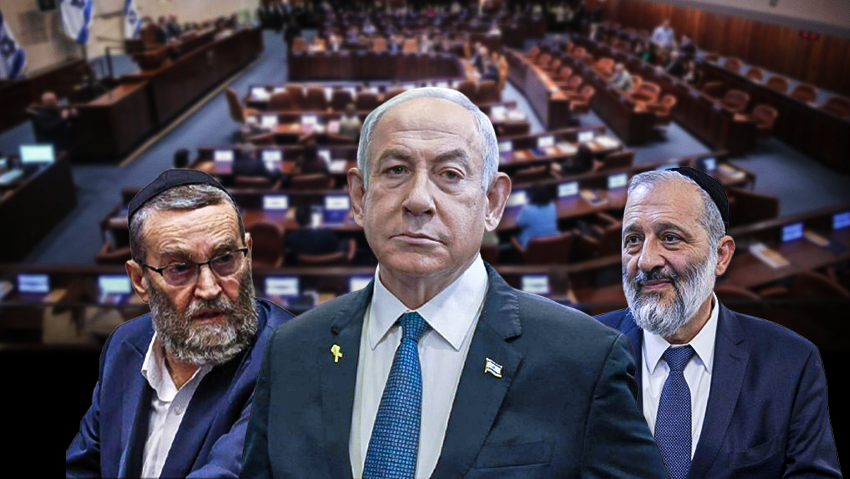
(Photo: Reuven Castro, Amit Shabi, Knesset Spokesperson)
The move comes as a bill to dissolve the Knesset is expected to come up Wednesday for a preliminary reading, further deepening the crisis threatening Prime Minister Benjamin Netanyahu’s coalition.
Netanyahu is continuing efforts to contain the confrontation with the Haredi parties while also trying to persuade coalition lawmakers who oppose the draft exemption bill to back the measure. His goal is to convince the Haredi factions to delay further advancement of the Knesset dissolution bill even if it passes Wednesday’s preliminary vote.
Degel HaTorah has already said it will vote in favor of dissolving the Knesset.
Only Sunday, Haredi factions were informed that the draft exemption bill would be brought up for discussion Monday. Members of the Knesset Foreign Affairs and Defense Committee were told that discussions on the draft exemption bill and the extension of mandatory military service would resume in two days.
But the rupture between the Haredi parties and Likud did not begin because Netanyahu was unwilling to submit the bill. Rather, it came after his aides told Haredi leaders that they would struggle to secure a majority for it in a vote — and there appears to have been no change on that front.
Last Thursday, coalition ministers and lawmakers received calls from Cabinet Secretary Yossi Fuchs and Coalition Chairman Ofir Katz, who asked whether they would support the draft exemption bill. The calls were part of an intensive effort to appease the Haredi parties, who were briefed about the move before the round of calls from the Prime Minister’s Office.
The efforts continued over the weekend as Netanyahu’s circle sought to determine whether there was a majority for the draft bill. The move was also aimed at showing the Haredi parties that Netanyahu is doing everything possible to prevent early elections — or, at the very least, trying to buy time so the dissolution process is delayed.
Netanyahu’s aides are focusing heavily on calming the Haredi parties, especially after remarks by Rabbi Dov Lando, the spiritual leader of Degel HaTorah. Netanyahu fears that United Torah Judaism, and particularly Degel HaTorah chairman Moshe Gafni, are drifting away from the bloc. He sees the crisis as a threat to his long-standing alliance with the Haredi parties.
This is not the first time Haredi parties have refused to support coalition bills, but their current decision marks an escalation because they are also withholding support from government-backed legislation.
Last week, all coalition bills were removed from the Knesset agenda, including a vote on a new appointments bill that would allow any elected government to appoint a long list of senior public officials.
Rabbi Motke Blau, a Degel HaTorah figure, told the ynet studio last week that “the era of the bloc is over for now.”
“A bloc means everyone is for everyone, everyone is committed to everyone,” he said. “Unfortunately, the religious-Zionist camp and parts of Likud are denying that commitment. So if there is no commitment, we part ways. That is all. There does not have to be a bloc.”