


With Israel's vote count officially complete, attention has shifted to the next political battle: forming a government. Political figures in both rival blocs expect Yashar! party leader Gadi Eisenkot to receive the first opportunity to assemble a coalition, but the election results have left him with few realistic options.
The uncertainty has already prompted preliminary contacts and private discussions among party leaders, even as it remains unclear who will ultimately succeed in forming a government. Next week, President Isaac Herzog is expected to summon representatives of the political parties to his official residence for consultations before deciding whom to task with forming a coalition.
Gallery
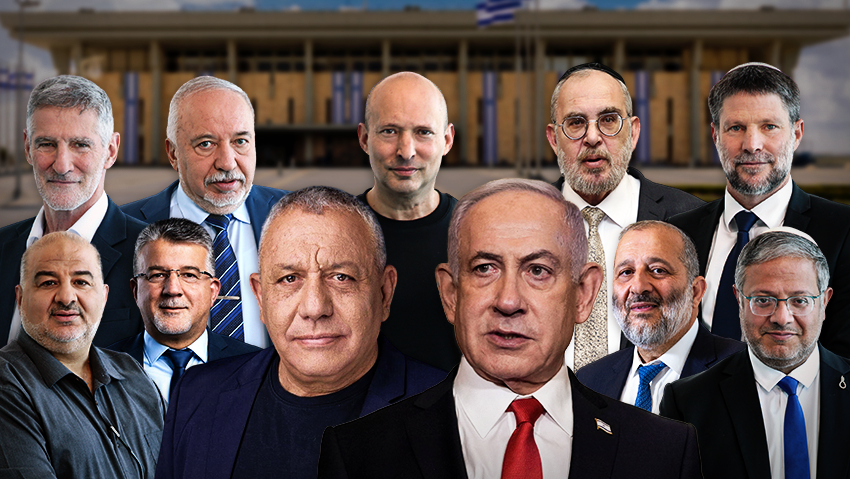
Eisenkot may get first shot at government, but faces major hurdles
(Photo: Shutterstock, Shalev Shalom, Elad Malka, Joint List Spokesperson's Office, Ryan Frois, Alex Kolomoisky, Oliver Contreras/AFP)
In Prime Minister Benjamin Netanyahu's bloc, there has been an unusual silence in the day following the election. Breaking with his usual practice, Netanyahu did not immediately call his political allies after the television exit polls were released, waiting nearly 24 hours before reaching out.
He spoke with Itamar Ben-Gvir and Bezalel Smotrich on Wednesday evening and met Smotrich, chairman of the Religious Zionist Party, in person on Thursday. Netanyahu is also expected to speak with the ultra-Orthodox parties.
Some members of Netanyahu's bloc have questioned his approach, wondering why he has not moved more quickly to consolidate support following the election. Others believe he is concentrating primarily on the results and on efforts to prevent the replacement of the Knesset speaker, a move that could take place in two weeks.
Meanwhile, parties in the bloc seeking to replace Netanyahu are coming to terms with election results that fell somewhat short of their expectations. Eisenkot met Thursday with Yair Golan, leader of The Democrats, and with Naftali Bennett. Golan also met Yair Lapid, although a meeting between Golan and Bennett has yet to be arranged.
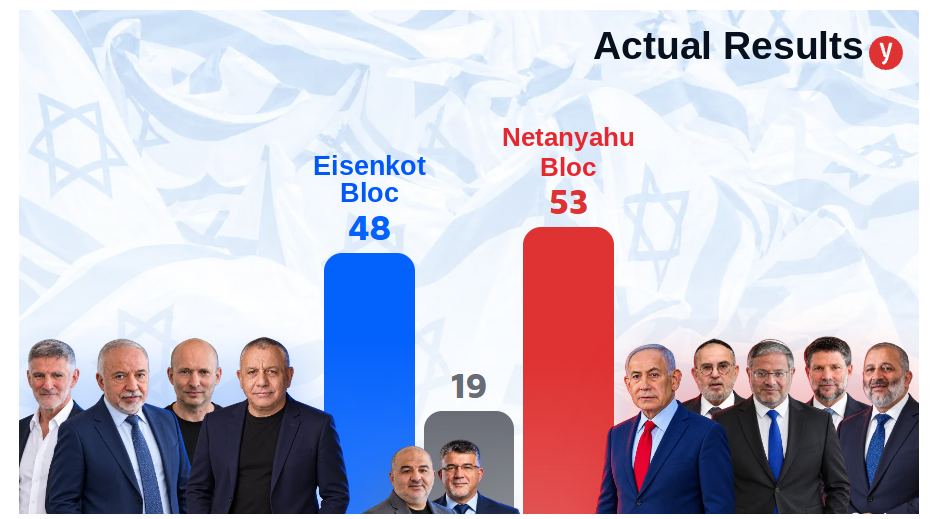
Avigdor Lieberman, chairman of Yisrael Beytenu, is keeping his distance from the political maneuvering for now, waiting for the situation to become clearer before deciding his next steps.
Lieberman told members of his party and local branch leaders Thursday that his campaign commitments not to join a government with ultra-Orthodox or Arab parties remain firmly in place. His position is expected to complicate Eisenkot's efforts to build a governing coalition.
Who will blink first?
Ultra-Orthodox parties signaled Thursday that they would be willing to negotiate joining a government led by Eisenkot. But a major obstacle stands between them: their demand for legislation exempting ultra-Orthodox men from military service.
Such a law would undermine any potential partnership with other members of the anti-Netanyahu bloc, whose parties pledged during the election campaign not to form a government with ultra-Orthodox parties and to address the contentious issue of military conscription.
Despite these difficulties, political figures in both blocs believe Eisenkot will be the first to receive a mandate from the president to try to form a government.
Eisenkot told supporters Thursday that he would work to establish "a new government that is good for Israel," but offered no details about how he intended to accomplish that goal.
He is expected to conduct extensive discussions with leaders across his political bloc, as well as with ultra-Orthodox parties, to determine whether any common ground can be found.
Behind the scenes, figures in both camps have also begun discussing the possibility of a national unity government.
Sources in the bloc seeking to replace Netanyahu say that for such an arrangement to become possible, Netanyahu would need to demonstrate a greater willingness to compromise than he has in the past. They also believe influential figures would have to push the sides toward an agreement.
Among those mentioned are U.S. President Donald Trump and President Herzog, who has repeatedly pledged in recent weeks to do everything possible to prevent Israel from holding another election.
Some politicians in the anti-Netanyahu bloc believe the prime minister has little interest in forming a unity government. In their assessment, Netanyahu would prefer another election rather than make significant concessions or dismantle his traditional political alliance.
Netanyahu, however, has yet to reveal his intentions. He has not discussed the possibility of a unity government with his political partners or close associates within Likud, leaving one of the most consequential questions of the post-election negotiations unanswered.