


Sergeant Nehoray Leizer, 19, from Eilat, a combat soldier in the 601st Combat Engineering Battalion, 401st Brigade, fell in combat in southern Lebanon, the IDF announced on Monday morning. Leizer was killed Sunday during an attack by an explosives-laden drone.
Another soldier was seriously injured in the incident. He was evacuated to receive medical treatment at the hospital, and his family has been notified, according to the IDF.

Hezbollah terrorists launched the drone at around 4 p.m. toward an area where troops from the 401st Brigade, operating under the 146th Division in southern Lebanon, were stationed. Leizer is the 11th soldier killed since the ceasefire in southern Lebanon, and the 23rd since Operation Roaring Lion began.
Over the past week, Hezbollah has stepped up attacks using fiber-optic drones, which are difficult to detect and intercept. On Friday, Staff Sgt. Noam Hamburger, 23, from Atlit, was killed in southern Lebanon when an explosive drone struck an IDF post in Biranit.
IDF Chief of Staff Lt. Gen. Eyal Zamir visited Northern Command on Sunday and approved plans for the continued fighting against Hezbollah, including deep inside Lebanon. However, according to security officials, the plans have not yet been approved by the political echelon, partly because of U.S. President Donald Trump’s decision to advance a diplomatic initiative with Iran.
Israeli assessments hold that understandings between Washington and Tehran also include an effort to stabilize the northern front, and the IDF fears this could limit the military’s freedom of action against Hezbollah in the future.
“The IDF has achieved tremendous military successes in this war,” senior security officials said. “Iran is in a difficult position both militarily and economically, and it must not emerge strengthened.”
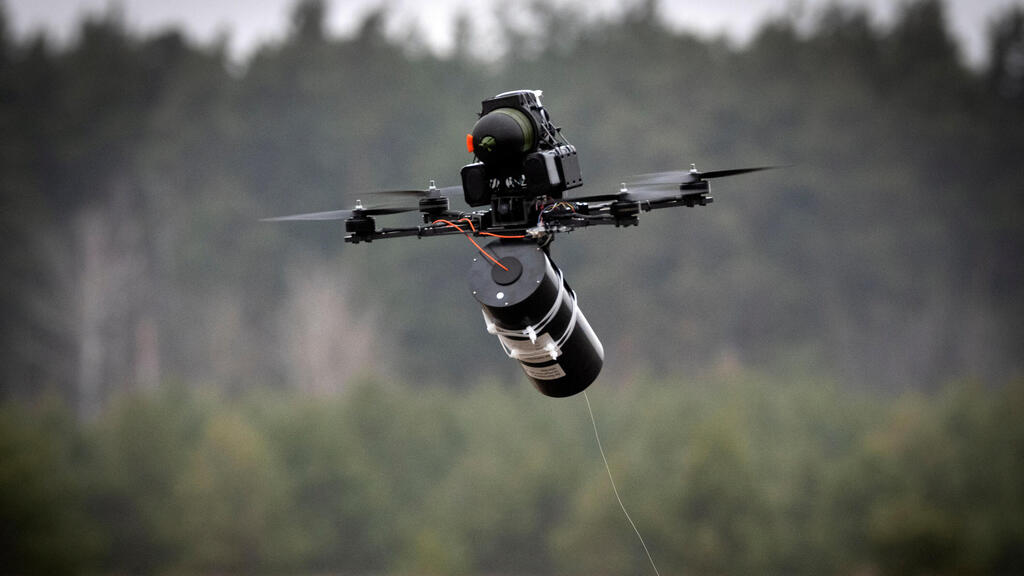
FPV drones have posed a serious challenge for the IDF in recent weeks
(Photo: Efrem Lukatsky, File/AP)
The hours before an official agreement between the United States and Iran — whose terms remain unclear, as does its potential effect on the northern front — are highly tense. The IDF is sharpening procedures both for dealing with explosive drones and for targeting terror infrastructure. On one hand, there is a desire to “fit in” as many operations as possible; on the other, officials understand that Hezbollah may become more daring if it believes everything is nearing an end or a pause. Either way, Northern Command is reorganizing the area ahead of a halt in fighting, the nature and rules of which remain unclear. The outcome, IDF officials say, depends directly on the results of the negotiations.
FPV drones have posed a serious challenge for the IDF in recent weeks. The term FPV refers to their method of operation — “first-person view” through operator goggles. But the truly problematic element is their use of fiber optics, which bypasses the need to transmit signals. The IDF’s detection and jamming systems are helpless against them. Radar systems also struggle to detect them when they fly at treetop height. By the time the drone is spotted, there is no time to scramble a helicopter or fire an Iron Dome interceptor, and the “Iron Beam” laser system remains far away.
Throughout Sunday, sirens sounded across northern Israel because of drone infiltrations. The first alert was activated at 10:09 a.m. in Shomera, followed a minute later by Even Menachem. At 1:13 p.m., sirens sounded in Adamit and Arab al-Aramshe. At 3:34 p.m., an alert was activated in Yir’on, followed a minute later by Avivim. At 4:06 p.m., sirens sounded in Even Menachem, Shomera and Shtula, at 5:31 p.m. in Kiryat Shmona and at 5:43 p.m. in Yiftah.
Following the alert in Kiryat Shmona, an interceptor was launched at a suspicious aerial target with which contact had been lost. The alerts in Yiftah were triggered by a false identification. At 7:13 p.m., sirens sounded in several communities, including Shlomi, Elon, Arab al-Aramshe, Hanita and Ya’ara.