

Opposition leaders on Wednesday accused Prime Minister Benjamin Netanyahu of falsely claiming that Iran had already possessed nuclear bombs, saying he was distorting the facts to justify his policies and alarm the public.
In an interview Tuesday with Channel 14 television, Netanyahu said he had acted twice against Iran "to save us from annihilation by nuclear bombs that were already in their hands."
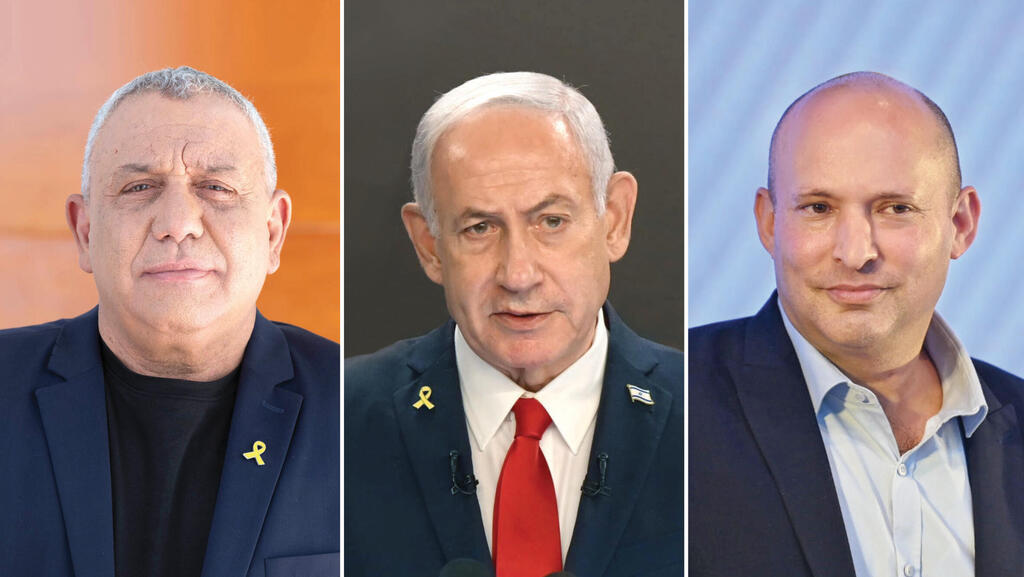
Gadi Eisenkot, Benjamin Netanyahu, Naftali Bennett
(Photo: Yuval Chen, GPO, Yair Sagi)
"You never know who would be here today," he said. "There will be a third time if necessary. As long as I am prime minister, Iran will not have nuclear weapons."
Netanyahu did not elaborate on the claim. Public assessments by Israel, the United States and the International Atomic Energy Agency have long maintained that while Iran has significantly expanded its nuclear program, there is no confirmed evidence that it has produced an operational nuclear weapon.
Gadi Eisenkot, leader of the opposition Yeshar party and a former IDF chief, rejected Netanyahu's remarks during the Herzliya Conference on Wednesday. “Netanyahu made arrogant statements. Iran did not have any nuclear bombs,” Eisenkot said. “He is making up a reality to frighten the Israeli public.”
Former prime minister Naftali Bennett also disputed Netanyahu's account, calling the statement false. “Yesterday it was said that Iran already possessed nuclear bombs. That's a lie. It's an attempt to rewrite history,” Bennett said at the same conference.
Bennett also criticized Netanyahu's handling of Iran's nuclear program during his years in office. “When I entered office, I discovered something unimaginable — there was no plan,” Bennett said. “I kept asking, and I simply never received an answer from Netanyahu. There was no plan.”
He said his transition briefing after succeeding Netanyahu lasted only about 20 minutes.
Bennett argued that after the United States withdrew from the 2015 nuclear agreement with Iran in 2018, Netanyahu failed to rebuild Israel's long-range strike capabilities or allocate funding for weapons that could be used against Iran's nuclear facilities if Tehran decided to pursue a nuclear weapon.
Iran maintains that its nuclear program is for peaceful purposes, although it has enriched uranium to near weapons-grade levels, far beyond what is needed for civilian use. Israel has long viewed Iran's nuclear ambitions as an existential threat and has repeatedly vowed to prevent Tehran from acquiring nuclear weapons.