


At 10 p.m. Tuesday, most polling stations across Israel will close and the country's three main television networks will release their exit polls, offering the first indication of the outcome of the election for the 26th Knesset. But the end of voting will mark only the beginning of a process that could take days to produce definitive results and weeks or even months to determine who will form the next government.
With voter turnout reaching historic levels, hundreds of thousands of special ballots still awaiting separate counting and several smaller parties potentially hovering around the electoral threshold, the results projected on election night may look considerably different from the final distribution of parliamentary seats.
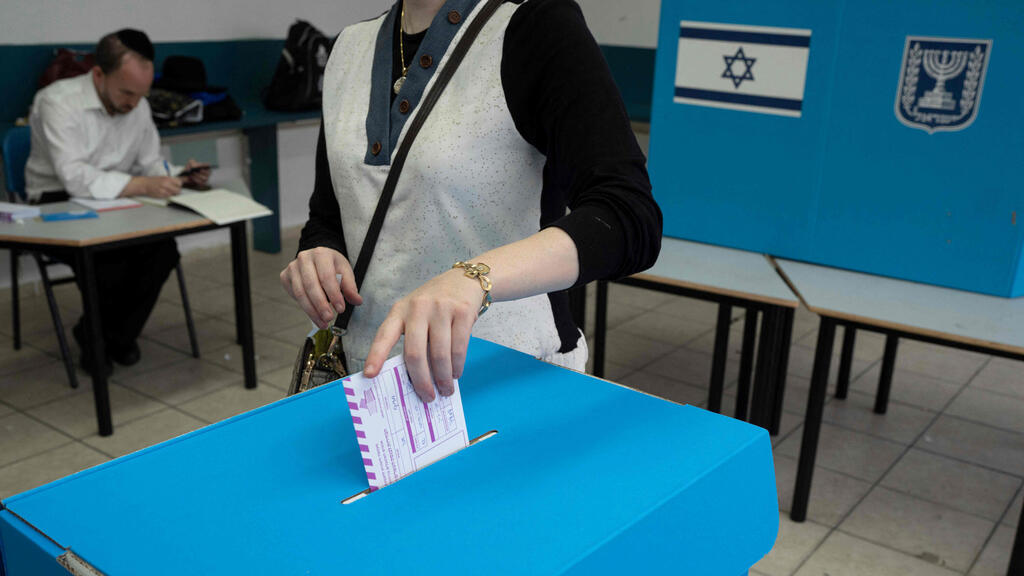
Israel election night: What happens at 10 p.m. and when will the real results arrive?
(Photo: Maya Levin / AFP)
Beyond the count, Israel faces another series of deadlines: the publication of official results, the swearing-in of the new Knesset and the president's decision on which lawmaker will be given the opportunity to assemble a governing coalition.
What happens when polling stations close at 10 p.m.?
At 10 p.m., Israeli television networks Kan 11, Channel 12 and Channel 13 are expected to publish their exit polls, providing the first estimates of how the Knesset's 120 seats will be distributed among the competing parties.
The exit polls are based on surveys of voters and are not official results. While they may indicate which political bloc is ahead, they cannot determine with certainty which parties will enter parliament or who will ultimately become prime minister.
One of the most significant uncertainties concerns parties close to the 3.25% electoral threshold. Parties that fail to reach that percentage of valid votes receive no seats, meaning even a small change in the final count could significantly alter the balance between rival political blocs.
The official counting process will begin as polling stations close, with results gradually transmitted to the Central Elections Committee. The first counted votes are expected to become available during the night, providing a clearer picture as the hours pass.
Although the scheduled closing time is 10 p.m., voters who arrive at a polling station before the deadline will still be allowed to cast their ballots, even if they remain in line afterward.
When will the final election results be known?
The counting process could continue well beyond election night, primarily because of the large number of special double-envelope ballots.
More than 650,000 such ballots are expected from soldiers, diplomats, displaced residents, hospital patients, voters with disabilities and others who cast their votes outside their registered polling stations.
Unlike ordinary ballots, double-envelope votes require an additional verification process to ensure that each voter has cast only one ballot. The identifying outer envelope is checked before the anonymous vote is added to the count.
Central Elections Committee officials had initially hoped to complete the count by Thursday, October 29, but acting Director-General Dean Livne warned that the number of special ballots could be higher than anticipated, potentially delaying the process until Friday morning.
The committee is expected to publish a clearer picture of the election results by Thursday, although the final tally may take longer. Under Israeli law, the official results must be published by November 4.
The distinction is important: even if television exit polls show one political bloc holding a parliamentary majority, the actual allocation of seats could change as the special ballots are counted and parties near the electoral threshold learn whether they have secured representation.
Historic turnout: 74.3% by 8 p.m.
The election has already been marked by unusually high voter participation, with turnout reaching 74.3% by 8 p.m., the highest rate recorded at that hour since 1988.
According to the Central Elections Committee, 5,449,277 Israelis had voted out of 7,331,981 eligible voters, compared with 66.3% at the same hour in the November 2022 election. The increase amounts to eight percentage points, or approximately 12% in relative terms.
The latest figure also surpassed the previous election's final turnout rate of approximately 70.6%, with two hours still remaining before most polling stations were scheduled to close.
Earlier in the day, turnout stood at 66.7% by 6 p.m., compared with 57.7% in 2022. By 4 p.m., it had reached 55.7%, compared with 47.5% four years earlier.
Participation was also particularly high among military personnel. According to the IDF, 68% of eligible service members had voted by 5 p.m., compared with 65% at the same hour during the previous election.
The surge brought long lines to polling stations in several cities, while severe weather and flash floods in southern Israel complicated voting in some communities, particularly in the Arava region, where road closures prevented some residents from reaching their designated polling stations.
Election committee rejects request to extend voting hours
The combination of exceptionally high turnout, lengthy waits and severe weather prompted a political dispute over whether voting should continue beyond 10 p.m.
Prime Minister Benjamin Netanyahu's Likud party submitted a request to extend voting hours. The proposal received support from Shas, led by Aryeh Deri, Otzma Yehudit, led by Itamar Ben-Gvir, and Ofer Winter's Amcha Yisrael party.
Opposition parties, including Gadi Eisenkot's Yashar!, Naftali Bennett's Beyahad and Yair Golan's Democrats, opposed extending voting hours.
Following a discussion, Central Elections Committee Chairman Justice Noam Sohlberg, deputy president of the Supreme Court, decided not to approve the request, leaving the scheduled closing time unchanged.
The committee nevertheless emphasized that voters arriving before 10 p.m. would be allowed to vote even if they remained in line after the deadline.
Violence and confrontations throughout Election Day
Tuesday's voting was also accompanied by several reported incidents of violence, intimidation and confrontations between political activists.
Israeli singer Ofer Levi was questioned by police on suspicion of incitement to violence after a video circulated online allegedly featuring calls to execute left-wing voters. Levi denied making the statements, claimed the video had been manipulated using artificial intelligence and warned that anyone distributing it could face legal action. He was released under restrictive conditions following questioning.
In Rahat, a Bedouin city in southern Israel, a brawl broke out near a polling station following arguments between voters.
In the ultra-Orthodox city of Modi'in Illit, youths burned pictures of Moti Leitner, chairman of the Haredi Public party. Campaign booths belonging to the party were also vandalized in Beitar Illit and Bnei Brak, while activists were reportedly called "traitors."
In Haifa's Bat Galim neighborhood, a confrontation erupted between city council member Yaniv Ben Shoshan, who heads the Likud faction on the council, and activists at a Democrats party campaign booth. The activists alleged that pushing had occurred.
In Bat Yam, Deputy Mayor Kati Piasecki of the Democrats and five other party activists were reportedly assaulted near a school.
Earlier in Tel Aviv, police arrested a man carrying a knife who approached Democrats leader Yair Golan during a tour of the city. Golan's party alleged that the incident was an attempted attack, while police confirmed the arrest but did not characterize it as an attempted stabbing.
The incidents underscored tensions surrounding the election, even as millions of Israelis continued to cast their ballots.
November 10: The new Knesset will be sworn in
Once the official results are published, attention will shift to the composition of the new parliament and the process of forming a government.
The 26th Knesset is scheduled to be sworn in on Tuesday, November 10, exactly two weeks after Election Day. Its 120 elected members will formally take office, even if negotiations over the next government have not been completed.
Unlike in presidential elections, Israelis do not vote directly for a prime minister. They vote for party lists, with parliamentary seats distributed according to each party's share of the valid vote, provided it crosses the electoral threshold.
A party's position as the largest faction in parliament does not automatically entitle its leader to become prime minister. Instead, the president must determine which member of the Knesset has the best prospect of assembling a governing coalition.
To do so, President Isaac Herzog will consult representatives of the parties elected to parliament, with each faction recommending a candidate to form the next government. The candidate selected by Herzog will then be tasked with securing sufficient parliamentary support.
How long does a candidate have to form a government?
The first candidate chosen by the president will have 28 days to form a government. Herzog may extend that period by up to an additional 14 days, allowing a maximum of 42 days for the initial attempt.
If the candidate fails, the president may assign the task to another member of the Knesset. That second candidate would receive 28 days, without the possibility of an extension.
If the president concludes there is no viable candidate, or a second attempt fails, a further 21-day period allows at least 61 members of the Knesset to submit a written request asking the president to assign the task to a particular lawmaker.
Should such a request receive the necessary support, the designated candidate would have 14 days to form a government.
The president's role is therefore central to the post-election process, particularly if the parliamentary balance is divided and no political bloc can immediately secure the support needed to govern.
And if nobody succeeds?
If every attempt to form a government fails, the Knesset would be dissolved and Israel would return to the polls for another election, to be held within 90 days.
Until a new government is sworn in, the outgoing government remains in office in a caretaker capacity.
That means the first exit polls at 10 p.m. may offer only the opening chapter of a political process whose conclusion could remain uncertain for weeks. Even after the official votes are counted and the new Knesset convenes, the question of who will lead Israel may still depend on negotiations between political parties and their ability to assemble a governing majority.