



Voter turnout continues to break records: According to Israel's Central Elections Committee, 55.7% of eligible voters had cast their ballots in the election for the 26th Knesset by 4 p.m. Tuesday. A total of 4,085,075 people had voted out of 7,331,981 eligible voters. So where has turnout been highest so far?
Updated figures show that the highest turnout was recorded in Timorim, near Kiryat Malakhi, where 91.6% of eligible voters had cast their ballots by 4 p.m. The other communities with the highest turnout were Asael (82.3%), Beit Hogla (79.6%), Melilot (79.4%) and Shlomit (78.8%).
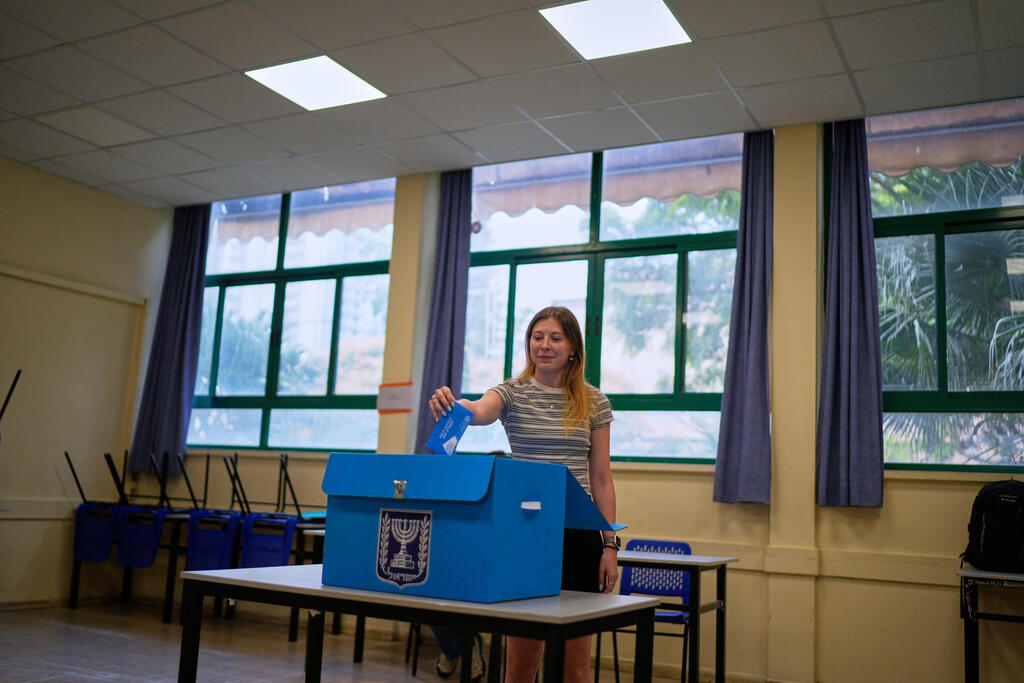
Voters in Tel Aviv
(Photo: AP Photo/David Goldman)
At the other end of the list, the communities with the lowest turnout so far included Sha'ar Menashe (13.2%), Aloney Yitzhak (16.6%), Ghajar (16.7%), Ibim (17.7%), Almon (20.7%) and Yotvata (21.4%).
And what about Israel's major cities? As of 4 p.m., turnout in Rehovot stood at 54% (63,111 voters), followed by Petah Tikva at 52.9% (107,955), Ramat Gan at 52.9% (79,197), Rishon Lezion at 50.9% (113,224), Tel Aviv-Yafo at 50.4% (238,665), Ashdod at 50.4% (94,033), Holon at 48.5% (78,552), Jerusalem at 47.7% (217,449), Be'er Sheva at 46.8% (79,124), Haifa at 46.2% (123,615), Netanya at 41.5% (89,135) and Bat Yam at 40% (51,917).
Tel Aviv-Yafo Municipality issued an unusual statement claiming that voter turnout in the city was higher than the figures published by the Central Elections Committee. According to the municipality, the correct turnout rate as of 4 p.m. was 63.5%.
"The source of the error is that the calculation is based on eligible voters registered in the Population Registry, rather than more up-to-date data from the Central Bureau of Statistics," the municipality said.
The municipality added: "According to the Population Registry, the city currently has 490,900 eligible voters aged 18 and over, while according to the Central Bureau of Statistics, there were only about 365,000 residents aged 18 and over in 2024. Therefore, any calculation of voter turnout should be based on the bureau's figures rather than the Population Registry."
Among Arab cities, Rahat recorded the highest turnout as of 4 p.m., at 60.6%. It was followed by Shefa-Amr at 48.3%, Nazareth at 46.7% and Umm al-Fahm at 41.7%. Among predominantly ultra-Orthodox cities, Elad led with 59%, followed by Modi'in Illit at 58.8%, Bnei Brak at 53.3% and Beitar Illit at 52%.
In the Negev and communities near the Gaza border, the highest turnout so far was recorded in Netivot, at 56%. It was followed by Ofakim at 53.9%, Sderot at 51.6%, Be'eri at 34.6%, Kfar Aza at 29% and Nir Oz at 22.6%.
And what about communities near the Lebanese border? In Shlomi, 52.3% of eligible voters had cast their ballots by 4 p.m., compared with Nahariya at 49.1%, Acre at 43.8%, Kiryat Shmona at 43.2% and Metula at 42.4%.
Using an interactive map created by data expert Nir Smilga, readers can explore figures such as each party's and political bloc's share of the vote, overall turnout rates, socioeconomic rankings and the leading party in each community, as well as compare the figures with results from the elections for the 24th and 25th Knessets.