

Against the backdrop of a sharp rise in violent crime and killings in Israel, along with mounting criticism of the National Security Ministry and police, senior politicians were asked the same question: What needs to change, and how should the police be rebuilt?
The question was put to party leaders and senior figures appearing at ynet and Yedioth Ahronoth’s “Decision Time: Democracy and Society” conference, held in partnership with the Israel Democracy Institute.
Eisenkot: Bring thousands of officers back
Former IDF chief of staff Gadi Eisenkot, leader of the Yashar! party, said that “After the worst minister of public security Israel has ever had, a worthy, professional person needs to be appointed, someone who knows how to deliver rather than just talk,” Eisenkot said.

“The next thing is to direct major budgets to the police and call back hundreds of good police officers, perhaps even thousands, who have left over the past five years.”
Eisenkot said that “A comprehensive plan needs to be prepared, with an understanding that this involves fighting crime, education, leadership and the public sphere, and it needs to be given a very high priority.”
Bennett: ‘Ben-Gvir has to go’
Former prime minister Naftali Bennett said, “We need to reestablish the war-on-crime cabinet that I created as prime minister. Until then, crime had been rising for years, along with the number of murders of Jews and Arabs in Israel. Under my government, we reduced the number of murders by 20%. Then Ben-Gvir and Netanyahu came along. They dismantled the cabinet and the team headed by Yoav Segalovitz, and the number rose from 148 murders a year to 300 in just one year. Since then, it has only continued to rise.”
“The State of Israel has been abandoned,” Bennett said. “Businesses in Hatzor HaGlilit and Be'er Sheva are all paying protection money. It is a disgrace, and this is the biggest failure. Of course Ben-Gvir has to go. He has failed on a historic scale. But in the end, I don’t blame him, I blame the person who appointed him. Netanyahu is simply no longer capable.”
Liberman: Build a comprehensive anti-crime apparatus
“You have to look at the numbers,” Yisrael Beytenu chairman Avigdor Liberman said. “The live-broadcast murder, in the style of the Mexican cartels, that we saw in Caesarea (referring to the killing of a reputed crime boss last month) happened in broad daylight, just three minutes’ drive from the prime minister’s home. A national security headquarters has to be established, because the National Security Ministry is no longer capable of dealing with this phenomenon.”
“It has to be a comprehensive apparatus that also includes the Shin Bet, the Tax Authority, the Justice Ministry and the State Attorney’s Office,” Liberman said. “When we, Yisrael Beytenu, held the public security portfolio, Yitzhak Aharonovich was the public security minister. In all of 2014, there were 61 murders in the Arab sector.”
Liberman has also identified his preferred candidate to replace National Security Minister Itamar Ben-Gvir: Druze lawmaker Hamad Amar. “He will be the next public security minister,” Liberman said.
Smotrich: ‘Draconian legislation’
Finance Minister Bezalel Smotrich was asked specifically about crime in the Arab sector and about rebuilding the police. He said, “The legal framework needs to change. There are a million weapons in the Arab sector in Israel, and this is a national security threat in every sense of the term. This requires legislation that defines it as terrorism and brings in the Shin Bet with all of its capabilities. A law needs to be passed so that if a weapon is found in your home or car, nothing else needs to be proven and you go to prison.”
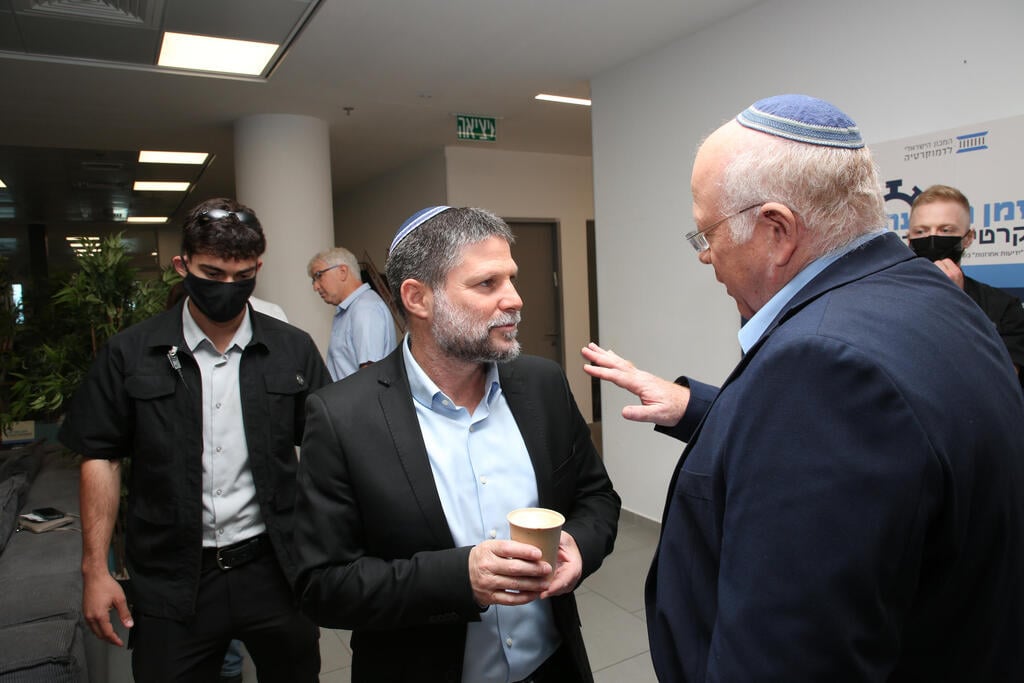
Bezalel Smotrich
(Photo: Ryan Frois)
Smotrich also said penalties for arms trafficking should be increased to 20 years in prison, adding, “If we put people in prison for many years, we will create deterrence and collect those weapons.”
Smotrich added that economic growth and efforts against the illicit economy must also form part of the response, along with his campaign plan to strengthen Jewish settlement in the Negev and Galilee.
“Very, very radical, draconian legislation,” he concluded. “I am convinced it can be done.”
Yair Golan: ‘The police can be rehabilitated’
Democrats chairman Yair Golan said, “I think it is simpler than it seems. We intend to launch a plan that will first establish a government task force, led by a prosecutor, containing representatives from all the relevant government ministries and additional bodies, to coordinate action. The task force should have a budget of at least 1 billion shekels and develop a multidimensional work plan.”
“There are parts of the police that have deteriorated, but it still has many high-quality commanders and many officers who are dedicated to their jobs,” Golan said. “The police can be rehabilitated. Hierarchical organizations are relatively easy to repair. I am not saying it's simple, but it's not like repairing a country. This is one of the main tasks we have set ourselves.”
Golan said his party would also continue what he described as its fight to protect democratic institutions in the National Security, Justice and Education ministries, with both immediate and long-term measures.
Yaakov Asher: Arab community also bears responsibility
United Torah Judaism lawmaker Yaakov Asher said, “I think police officers need to be given support, and we need to make sure that being a police officer in Israel is regarded as something important. “But the Arab community and its leaders also bear considerable responsibility. There is too much tolerance for certain behavior. The police can keep acting, but you rarely hear enough condemnation from community leaders.”
“I remember when I chaired a committee on road safety,” he added. “There were extremely high numbers of people driving there without licenses and without the required documents. I never saw a public representative come out and condemn it or try to change that behavior. Meanwhile, we are the ones constantly being lectured.”
He concluded: “The police need to be strengthened and kept as insulated from politics as possible. That much is clear.”