

U.S. President Donald Trump said Thursday that he does not trust anyone in politics when asked whether he trusts Prime Minister Benjamin Netanyahu, while praising their relationship and saying Israelis want him involved in the country's upcoming election. In a wide-ranging interview with Newsmax, Trump also discussed possible new strikes against Iran, including the use of the powerful non-nuclear weapon known as the "mother of all bombs," and sharply criticized Ukrainian President Volodymyr Zelensky.
In the interview with Newsmax host Rob Finnerty at the White House, Trump was asked directly whether he trusted Netanyahu, with whom he has maintained close political and military ties. "I don't trust anybody, honestly," Trump replied.
Trump discusses Netanyahu during his Newsmax interview
(Video: X)


"I don't trust anybody," he repeated. "In the world of politics, I don't trust anybody."
Trump did not indicate that the remarks reflected any specific disagreement with Netanyahu. Instead, he praised their cooperation, particularly during the war against Iran. "Look, I've had a very good relationship with him. We've had good success together."
The president was also asked whether he intended to become involved in Israel's October 27 election, in which Netanyahu is seeking another term as prime minister.
"Well, they'd like me to be. Yeah, they'd like me to be," Trump said, stopping short of committing to participate in the campaign or endorsing Netanyahu.
He went on to boast about his popularity among Israeli voters, claiming that he would receive overwhelming support if he were eligible to run for prime minister.
"The people of Israel, they say if I ran for prime minister, I'd get 99% of them," Trump said.
The remarks come less than two weeks before Israelis head to the polls, with Netanyahu frequently emphasizing his close relationship with the American president. Trump has so far avoided explicitly endorsing the prime minister ahead of the election. In an interview with Time magazine published October 1, Trump declined to endorse Netanyahu, saying his main priority was helping defend Israel.
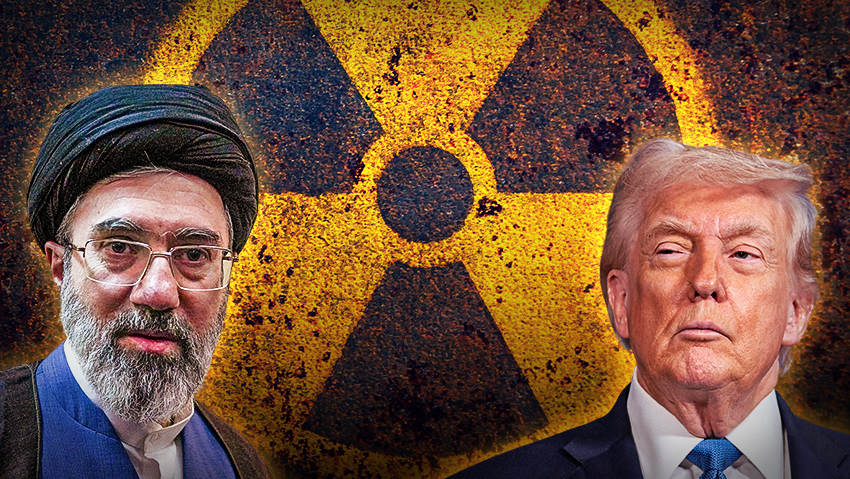
Trump and Iranian Supreme Leader Mojtaba Khamenei. The US president says he will not use nuclear weapons against Iran
(Photo: Hamed Jafarnejad/ISNA/WANA (West Asia News Agency) via REUTERS, REUTERS / Jonathan Ernst, shutterstock)
Trump's comments also came as Washington and Jerusalem continued consultations over Iran, including the possibility of renewed military operations. CNN reported Thursday that the U.S. military had developed new strike plans that could include using the GBU-43/B Massive Ordnance Air Blast Bomb, commonly known as the "mother of all bombs," against Iranian energy infrastructure and nuclear facilities.
Asked about the possibility of deploying the weapon, Trump did not rule it out, but stressed that it was not nuclear.
"Well, the mother of all bombs is not nuclear," Trump said.
"No, it's not nuclear at all. This is just an extremely large bomb," he added. "It's like a tiny nuclear bomb. The mother of all bombs is one big bomb, but it's not nuclear."
The weapon, weighing approximately 21,600 pounds, or 9.8 metric tons, is the largest non-nuclear bomb in the American arsenal. It was used in combat for the first time in 2017, when the U.S. military struck an Islamic State tunnel complex in Afghanistan.
According to CNN, the Pentagon's new plans include possible strikes on a heavily fortified Iranian nuclear site known as Pickaxe Mountain. However, military officials have reportedly raised questions about whether the weapon would be effective against deeply buried installations, since it is designed primarily to produce a massive surface blast rather than penetrate thick layers of rock and reinforced concrete.
Trump separately emphasized that he did not intend to use nuclear weapons against Iran. He also raised the possibility of future nuclear disarmament talks involving Russia and China, predicting that Beijing could catch up with Washington's nuclear capabilities within five years.
Asked why the United States would not simply declare victory and withdraw from Iran after previously claiming that its nuclear program had been destroyed, Trump argued that an early departure could make further military action necessary.
"Well, we could. But if we do that within a year we may have to do it again," he said.
"We want to make it so that they will never have a nuclear weapon, because if they had it, they would use it, in my opinion, instantaneously."
Trump maintained that previous American and Israeli operations had severely damaged Iran's nuclear infrastructure, but suggested that further action could be required against sites believed to remain operational.
"Now, we're looking at Pickaxe Mountain. We may have to go there," he said.
"We'll take a shot at that one. We'll knock it out fast."
Asked whether such an operation could involve deploying American ground troops inside Iran, Trump dismissed the possibility. "No, I don't see that. I don't see that."
He also expressed confidence that the war could end soon through negotiations or further military action. "The Iran war will be over very soon. It's going to end very soon," he said.
Trump claimed that Tehran had asked Washington and Jerusalem to halt their attacks while negotiations continued. "They've asked us to please stop. And we do, because we're negotiating with them," he said.
The president also addressed the continuing war between Russia and Ukraine, directing particularly harsh criticism at Zelensky over Kyiv's renewed attacks on Russian oil refineries.
"Zelensky is not a good guy for us to deal with," Trump said, according to an English-language account of the Newsmax interview published by Anadolu Agency.
"He doesn't want to settle. He says he wants to settle, but he doesn't. No, I'm not a big fan of Zelensky," he added.
Trump accused Ukraine of worsening global energy prices by targeting facilities that produce diesel fuel, which has become particularly expensive amid the broader Middle East conflict.
"I think that's a disgrace. There's plenty of other targets," Trump said.
"When you shoot at diesel refineries where you make, you know, diesel oil and we need that, and the world needs that, then he's not doing a good service for the world," he added.
The comments follow a new dispute between Washington and Kyiv after Trump announced an agreement with Russia intended to increase the availability of diesel on international markets. Zelensky criticized the arrangement and said Ukraine would resume attacks on Russian refineries after accusing Moscow of continuing to strike Ukrainian energy infrastructure despite a proposed pause.
Trump also attributed some of the difficulties in reaching a peace agreement to the personal hostility between Zelensky and Russian President Vladimir Putin, arguing that their mutual animosity made negotiations considerably more difficult.
The American president again raised the issue of holding new elections in Ukraine. Asked about a proposed pause in fighting to allow a vote, he responded: "I think you need an election."
He questioned whether Ukrainian citizens were satisfied with their leadership while Russian missiles continued to strike residential buildings, reinforcing his criticism of Zelensky as the conflict showed little sign of nearing a diplomatic resolution.