

About four years ago, behind the closed doors of the Israel Prison Service medical center, prison guards found Jerusalem cult leader Daniel Ambash unconscious. The man who for years terrorized women and children, dubbed by the media the “sadistic cult leader” and described by Israel’s Supreme Court as running a “regime of fear and terror,” died without great drama, without a final speech and without explanations. An intensive care unit team was called to the scene, doctors attempted resuscitation, but shortly afterward he was pronounced dead.
Ambash was 67 at the time. According to his sentence, he was not supposed to be released until 2037. He died in prison 15 years before his scheduled release date. He left behind six women, dozens of children, countless psychological scars and one criminal case that even veteran prosecutors admitted they had never encountered before.

For attorneys Sagai Ofir and Lizu Wolfus of the Jerusalem District Attorney’s Office, the Ambash case was not just another criminal file. It was something else entirely. “We encountered concentrated evil,” Ofir told ynet in an interview. “I’ve seen murderers, I’ve seen despicable terrorists, I’ve met them — and it doesn’t compare to the feeling of what this man did to his children and to the people who trusted him.”
Starved, imprisoned and sexually humiliated
It all began almost by chance, around 2009-2010. Ofir, then a veteran prosecutor who had already handled countless violent crime cases, received what initially sounded like a routine referral.
“They told me, ‘There’s some incident, a story about a man with several women, look into it,’” he recalled. “It sounded almost banal, almost everyday. But then the investigators sat down with me and started telling me the story. Even before I saw a single piece of paper, before I saw a single video, I understood this was a very, very unusual case.”
Although Ofir immediately realized this was no ordinary case, even he did not initially grasp the full extent of it. Only after testimonies piled up, the children spoke and the women broke down did the scale of the horrors emerge, and prosecutors understood they were facing a case with no precedent in Israel.
Wolfus joined later, after the indictment had already been filed. “It was clear this was an extraordinary indictment in terms of its scale, severity, the volume of investigative material and the number of victims,” she said. “But throughout the management of the case we kept being exposed to more and more things that intensified what we already knew. Each time it only became worse.”

Attorney Lizu Wolfus
(Photo: Yosef Cohen)
When they recall the case, they do not sound like lawyers but more like people returning from a disaster scene. Wolfus describes the case as a “mandala,” a picture that changes each time it is viewed from a different angle.
“It’s not something linear and clear,” she said. “It’s so confusing. When you look closely it appears to be one thing, and when you look from afar it appears to be something else. It’s rare for a legal proceeding to change while it’s being conducted, but here it truly changed. And not for the better.”
The Supreme Court ruling, which unusually opened with the poem “Wanted” by poet Admiel Kosman, described what took place in the Ambash household over more than a decade. The justices wrote that Ambash created for himself “the image of a successor to the grandfather,” a spiritual leader with special powers. Through charisma, fear and threats, the ruling said, he managed to force the women and children to submit completely to his will.
Behind the spiritual image stood a brutal mechanism of abuse: women and children were starved, imprisoned in storage rooms, beaten with electric stun devices, sexually humiliated and forced to carry out degrading “punishments” in front of other family members.
But for Wolfus and Ofir, the greatest shock was not only the acts themselves, but the method behind them.
“One of the moments that broke me,” Ofir said, “was when one of the women described an incident in northern Israel. They took her, stripped her naked, sprayed her with water from a hose when it was close to freezing outside and left her all night in something that looked like a grave. It was a description that reminded me of the Holocaust.”
Then came an even deeper realization. “I understood that part of his method was turning victims into perpetrators,” Ofir said. “He caused them to commit crimes themselves so they would become implicated, so they would be afraid to leave. He wanted that one day, if someone had to answer for this, it wouldn’t be only him.”
Wolfus described how the boundaries in this case became completely blurred. “The victims became perpetrators against their will,” she said. “They were involved in incidents that could have sent them to prison for many years. The more we got to know them, the more the boundaries between victim and suspect kept blurring.”
‘Where exactly were they supposed to go?’
The prosecutors were required not only to manage a criminal case, but also to understand an almost incomprehensible psychological dynamic. Educated, articulate women, some of them highly charismatic, remained by Ambash’s side even after his arrest. Some continued defending him in court. Others cursed the prosecutors in the hallways. Some followed them through the streets.
“People think these are helpless women with no capabilities,” Ofir said. “But these were articulate, elegant, complex women. You look at them and can’t understand how this thing took control of them.”

Attorney Sagai Ofir
One of Wolfus’ breaking points came while listening to phone recordings. The women went out to beg in Jerusalem and Tel Aviv, while Ambash controlled them remotely.
“We heard the yelling and screaming,” she said. “They had to ask permission to go to the bathroom. If someone didn’t bring back enough money, he punished her over the phone. He would tell her: Take off your head covering right now. Don’t eat. Don’t go to the bathroom.”
“And that was only the preview of what would happen when they got home,” Ofir added.
Even from prison, Ambash continued exerting control. “He instructed them to hide witnesses,” Wolfus said. “He sent one of the mothers to get another woman engaged. Everything from prison.”
One of the most jarring moments of the trial came when the defense argued that the door had been open and the women could simply have gotten up and left. Ofir still remembers the anger the argument stirred in him.
“How were they supposed to leave?” he said. “He cut them off from their families, registered one woman’s children under another woman’s name, caused them to commit crimes themselves. Where exactly were they supposed to go?”
As the trial unfolded, the family itself disintegrated before their eyes. Children were sent to boarding schools. Siblings were separated from their mothers. Women gradually began to understand what had happened to them.
“The processes we experienced as prosecutors were only a reflection of what they themselves were going through,” Wolfus said. “For them, the criminal proceeding was only a small point within the complete collapse of their lives.”
Just one more meeting
Aviad Ambash, Daniel’s son, was a child when police raided the home. Today, at 25, he has completed time in a boarding school in southern Israel, a pre-military academy, military service at Havat Hashomer and later in the Golani Brigade. The path he has taken seems almost impossible considering where he came from.
“My first memory of my father is that he kept asking me whether I was Barto or Ambash,” he said, explaining that his father used to “play” with his identity. “He registered me in my ID card as Barto, but Ambash is my real family. He said that if I wasn’t Ambash, then I didn’t really belong to the family.”

Aviad Ambash
(Photo: Marina Cohen )
The confusion accompanied him throughout his childhood. “It hurt me a lot,” he recalled. “I would bang my head against the wall and ask myself whether I really didn’t belong to this family.”
Only years after the affair exploded did he begin to understand that life at home had not been normal. “I was in boarding school, and suddenly you compare stories with other kids,” he said, “and you realize you actually grew up in a crazy place. I left home with a punishment of bread and water, and suddenly everyone’s eating cereal for breakfast. I had to explain to myself why this reality was even considered normal.”
The moment that finally shattered his denial was a phone call from his sister. “She told me about a rape, and that’s when I understood this was no longer part of my life anymore,” he said. “That this story was over.”
But even after the conviction, he remained for years inside what he calls a “mental prison.” “It took me three and a half years to get out of it,” he said. “My father sent letters and messages from prison, and my mother passed them on to me. Physically you can take a person out of prison — the question is whether he leaves the internal prison he’s in.”
Even the news of his father’s death in prison did not bring one clear emotion. “I felt many emotions at once,” he recalled. “On one hand anger and relief, on the other sadness and confusion.”
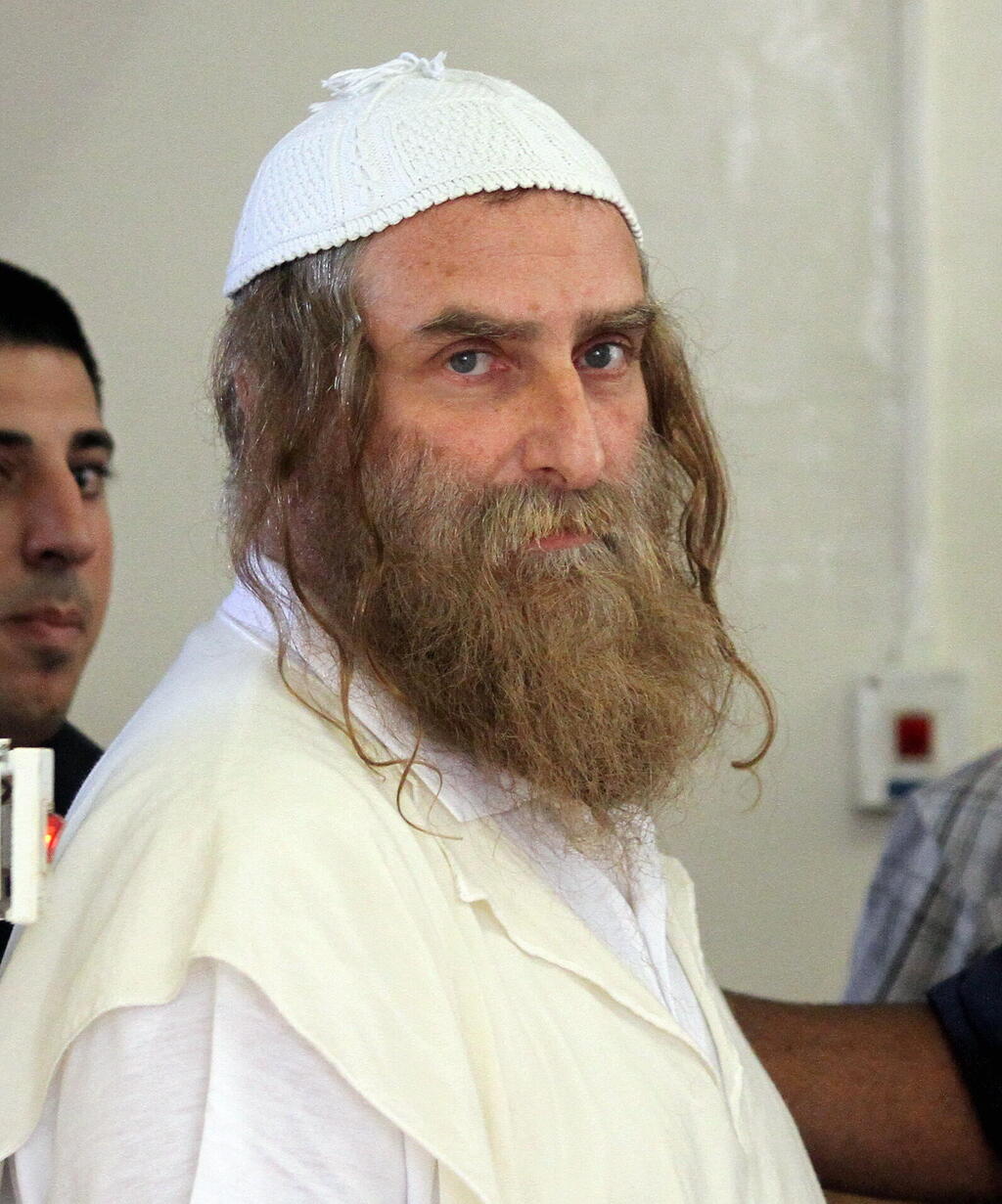
(Photo: Haim Zach)
Aviad admitted he would have wanted one more conversation with his father, “to sit across from him at least one more time with strength, and not as the miserable child he beat up my entire life.”
Today he lectures across Israel about life inside a cult and about children growing up under violence and control. “This is my life’s mission,” he said. “The most important message is social awareness. If just one neighbor had heard the screams and called the police in time, everything could have ended much earlier.”
A trial without rules
That complexity also accompanied the prosecutors themselves. “You don’t talk about these things at home,” Ofir said. “Not with friends, not even with people at the office. You realize you’re alone facing distilled evil.”
At a certain point he realized he could not manage the case alone. “My good fortune was that I had Lizu,” he said. “I needed someone beside me who could look at me and say, ‘Yes, I saw that too.’”
Wolfus laughed when she heard him say that. “And I had him,” she replied.
They said they were not dealing only with Ambash in court. According to them, they also faced an entire network of supporters, five separate proceedings conducted simultaneously, personal attacks online and women following them through the streets of Jerusalem.
“In the regular criminal world there are codes,” Ofir said. “Here there were no boundaries.”
Ultimately, Ambash was sentenced to 26 years in prison. The court wrote that “the family’s final years became a continuing nightmare of imprisonment, beatings, punishments and bizarre penalties.” Even in the sentencing, the judges acknowledged that it was difficult to quantify the scale of the horrors. “The offenses are so numerous that they could amount to hundreds of years in prison,” they wrote.
When Ambash died in prison in 2022, some of the women still insisted on his innocence. Over the years they continued fighting for visitation and conjugal rights. After his death, Adret Ambash accused the Israel Prison Service and said: “They killed our husband. They destroyed our family.”

(Photo: Gil Yohanan)
For the victims themselves, the story is far from over. Even today, years after the case was exposed, many are still trying to understand what their lives actually looked like — how one house in Jerusalem managed to become a private kingdom of fear, silence and total control.
For attorneys Wolfus and Ofir, this is a case they will remember forever. “Each time it shocked us all over again,” Ofir said. “There was never a moment when you told yourself, ‘OK, I’m used to it.’ You don’t get used to something like this.”