

Democratic Sen. Jon Ossoff won reelection in Georgia on Tuesday, defeating Republican Rep. Mike Collins in a closely watched Senate race that tested the political appeal of the 39-year-old Jewish lawmaker, whose increasingly critical stance toward Israel's military operations in Gaza has placed him at the center of a growing debate within the Democratic Party.
Ossoff, Georgia's first Jewish senator and the youngest member of the U.S. Senate, secured a second term in a state President Donald Trump carried in 2024. His victory preserves a crucial seat for Democrats and elevates his standing as a potential national leader ahead of the 2028 presidential election.
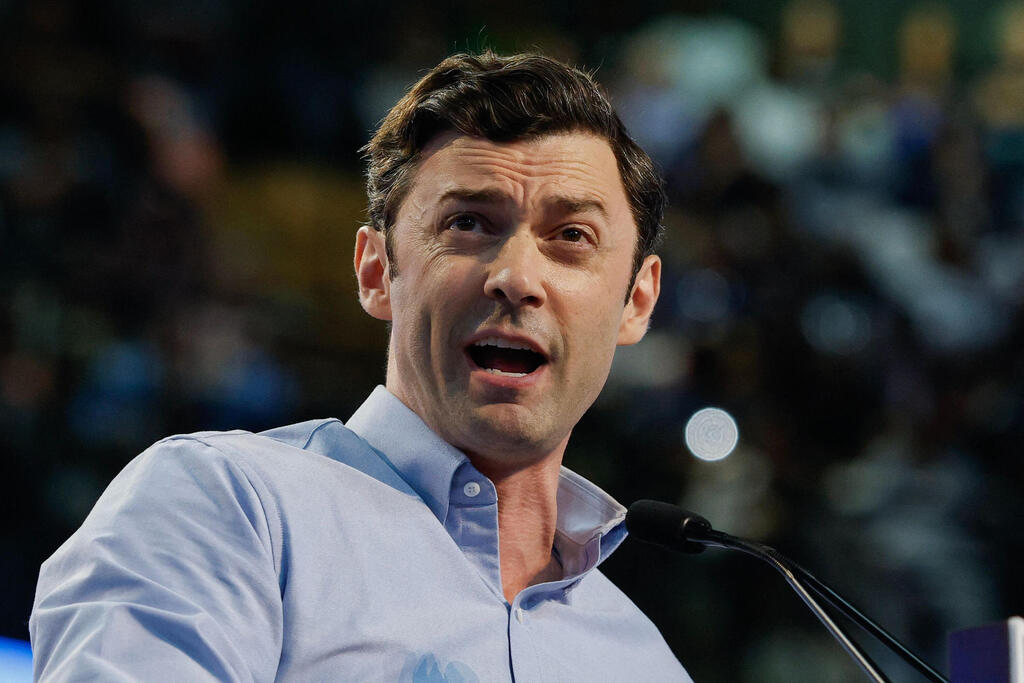
Georgia Sen. Jon Ossoff
(Photo: ERIK S. LESSER / AFP)
The result also represents a setback for Trump, who endorsed Collins in a state central to his false claims that the 2020 presidential election was stolen.
Ossoff entered the race as one of Republicans' leading targets. He was the only Democratic senator seeking reelection in a state Trump had won two years earlier, making his contest a major test of the party's ability to compete in Republican-leaning territory.
But rather than distancing himself from national Democratic politics, Ossoff embraced an aggressive campaign against Trump, delivering blistering attacks on what he called a "failed president" and turning his rallies into widely circulated social media content.
His campaign raised more than $100 million, fueling speculation about a possible presidential bid in 2028.
A Jewish senator navigating growing divisions over Israel
Ossoff's reelection comes as Israel's military operations in Gaza and American support for the Jewish state continue to divide Democrats, particularly between the party's traditional pro-Israel establishment and its increasingly vocal progressive wing.
Throughout the campaign, Ossoff sought to balance his stated commitment to Israel's security with criticism of the Israeli military's conduct in Gaza.
He said he values both Israel's security and "the lives of innocent Palestinians," a formulation reflecting his effort to address competing concerns among Democratic voters.
His voting record has reflected that balancing act. Ossoff supported some U.S. military assistance to Israel while opposing other proposed weapons transfers.
He has accused the Israeli military of violating international standards governing warfare in Gaza, putting him at odds with Israeli officials who maintain that their military operations comply with international law.
However, Ossoff stopped short of accusing Israel of genocide, a charge advanced by some progressive Democrats.
When asked whether Israel's actions amounted to genocide, he said the matter should be determined by the International Criminal Court rather than offering his own judgment.
His approach underscores the political challenges facing Jewish Democrats as their party debates the future of U.S.-Israel relations, military assistance and accountability for Israel's conduct during the war.
Ossoff's victory suggests that his positions on Israel did not prevent him from assembling a winning coalition in Georgia, although the election result alone does not establish how much weight voters placed on the issue.
Trump-backed rival struggles to gain momentum
Collins, a two-term congressman who first won election while echoing Trump's false claims about the 2020 presidential race, struggled to build momentum despite receiving the president's endorsement.
His campaign faced fundraising difficulties, questions about his relationship with Trump and scrutiny over associations with white nationalists, as well as an unresolved House ethics investigation.
Ossoff repeatedly portrayed Collins as politically dependent on the president.
"Whatever Donald Trump says, Mike Collins does," Ossoff said during a debate. "Doesn't matter what it is. Doesn't think for himself."
The senator also accused Collins of bigotry, highlighting past social media posts by the congressman, communications between Collins' former chief of staff and white supremacists, and white nationalist advocacy by Collins' son-in-law.
"If John Lewis were marching today from Selma to Montgomery, Mike Collins would be grabbing a billy club," Ossoff said, invoking the late civil rights leader's participation in the 1965 voting rights marches.
Collins denied the accusations, insisting he had consistently condemned racism and antisemitism.
He sought to portray Ossoff as too liberal for Georgia, accusing him of supporting open borders, allowing transgender athletes to compete in women's sports and consistently voting alongside Vermont Sen. Bernie Sanders, a democratic socialist.
"No one has ever asked or held Jon Ossoff accountable for any of his votes," Collins said.
But the Republican struggled to shift the campaign's focus away from the attacks on his record and political associations.
From Georgia's first Jewish senator to national Democratic star
Ossoff first won election to the Senate in January 2021, defeating Republican incumbent David Perdue in a runoff held the day before Trump supporters stormed the U.S. Capitol in an attempt to prevent Congress from certifying Joe Biden's presidential victory.
His election marked a historic milestone for Georgia, making him the state's first Jewish senator.
In the same election, Democrat Raphael Warnock became Georgia's first Black senator.
Warnock subsequently won reelection in 2022, campaigning largely on his appeal to moderate swing voters.
Ossoff adopted a more confrontational strategy in 2026, betting that direct attacks on Trump would mobilize Democrats without alienating enough independent voters to cost him the election.
His campaign featured carefully staged rallies at which the senator delivered sharp criticism of the president, while aides quickly edited and distributed video clips across social media platforms.
The strategy helped establish Ossoff as one of the Democratic Party's most prominent critics of Trump.
"Corruption in American politics runs a lot deeper than Donald Trump," Ossoff said during the campaign.
"It's not just the money that's corrupted our politics. It is a moral corruption, the cynical indifference of powerful people."
Ossoff also attacked the international business dealings of Trump's family, mocking Donald Trump Jr., Eric Trump and Jared Kushner, the president's son-in-law.
He called for an end to the war with Iran, criticized Trump's tariffs and advocated rolling back many of the president's tax cuts.
The senator also promoted his stalled proposal to prohibit members of Congress from trading individual stocks and called for a constitutional amendment restricting corporate spending in political campaigns.
At the same time, he emphasized his work securing federal resources for Georgia, including hurricane relief, infrastructure investments and other funding.
That record helped him win endorsements from some local Republican officials in the traditionally conservative state, who described him as an effective advocate for his constituents.
A victory with implications beyond Georgia
Ossoff's reelection strengthens his position within a Democratic Party searching for a new generation of leaders capable of challenging Trump and competing in politically divided states.
It also ensures that one of the Senate's most prominent Jewish Democrats will remain an influential voice in debates over American policy toward Israel.
His positions have placed him between Democrats demanding a more forceful response to Israel's actions in Gaza and those who favor maintaining strong military support for the country.
Whether that approach becomes a model for other Democratic candidates remains uncertain, but his victory demonstrates that a senator who has publicly criticized Israel's conduct in Gaza can win reelection in a state that backed Trump in the previous presidential election.
Ossoff closed his campaign by presenting the contest as a choice between competing visions of American identity.
"This is what small men like Donald Trump and Mike Collins will never understand," he said, "that our national greatness flows not through our blood or our genes, but through our ideas and our aspirations and our care for one another."