

Paralympic rowing world champion Moran Samuel has a simple but powerful message: “No matter where you are, what you do in the world, make sure your door is open for everybody.”
Speaking last week on the ILTV Podcast, Samuel explained that just as you would leave the door to your home or building open for guests, you should also leave the door to your heart open.
Samuel, who is paralyzed from the waist down and uses a wheelchair, said not every disability is as visible as hers.
“You cannot always put a ramp to help someone,” she said. “But when you open your heart, your heart is accessible. It’s enough.”
Samuel grew up in Karmiel. As a young woman, she was a basketball star who represented Israel on its youth national teams. Then, at 24, she experienced a rare condition known as a spinal stroke.
“It's like a ticking bomb in your body,” Samuel said. “You do not know it exists. It exploded. I had no oxygen supply to my spinal cord, and just like that, I became paralyzed in the lower part of my body.”
Her life changed instantly. She lay in bed, paralyzed, believing everything she knew and loved was over. But gradually, her perspective shifted. Her body had changed, she realized, but her mind had not.
“The real fight is fighting over that feeling that life is over, and realizing life as I knew it might be over, but I'm still here,” Samuel said. “I realized I have things that I want to do in my life, and if I want to live a meaningful life, I have to get out of bed, literally and mentally.”
She did exactly that. Samuel began playing wheelchair basketball while earning a bachelor’s degree in physiotherapy and a master’s degree in child development. Still, she wanted more. She returned to sports with a new goal, not just to play, but to win, and to reach the highest level: the Paralympic Games.
“It couldn't happen in a team sport,” Samuel told ILTV. “I needed to find a sport where I could do it by myself, be dependent only on me. That’s how I ended up in para rowing.”
Success came quickly. Samuel became a dominant force in the sport, winning medals at international competitions and the Paralympics. Her final gold medal came at the 2024 Paralympic Games in Paris, on a day filled with emotional weight.
“I woke up that morning knowing it's the last time I'm going to compete in the biggest event of sport, because I'm going to retire,” she recalled. “And I was training for the Games with three little children under missile attacks and war and hostages.”
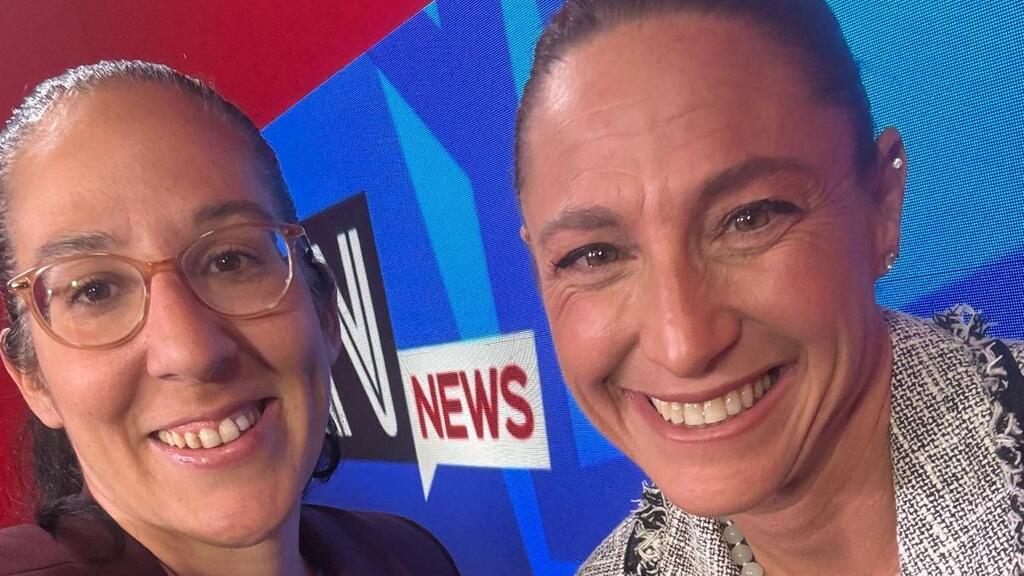
Moran Samuel (left) with the author
(Courtesy of Maayan Hoffman)
That same morning, news broke about the “beautiful six,” the six hostages, including Hersh Goldberg Polin, who were murdered by Hamas in Gaza and returned to Israel.
“I woke up that morning to that news, and I said, ‘how can I separate it?’” Samuel said. “How could I focus? I realized the only thing I can do is transfer pain into power.”
She decided to row in their memory and for her country. Samuel said she knew the one thing she could give Israel that day was a gold medal and the singing of the Israeli national anthem on the Paralympic stage.
“So that’s what I did,” she said. “If you watch the video of me winning the medal, singing the anthem, I could not stop crying.”
For anyone, Samuel said, sport is a way to build self-confidence, and she believes people of all ages should find a sport. More importantly, she said, for people with disabilities, including newly injured soldiers, sport can help shift focus away from disability and restore confidence in both body and mind.
Recently, Samuel joined the board of Beit Issie Shapiro, one of Israel’s leading organizations for disability innovation. She said she connected with the center’s shared philosophy of moving from limitation to capability, and its emphasis on integrating people with and without disabilities.
“Beit Issie Shapiro is getting everybody together in their leadership programs, in kindergarten, in schools, everywhere,” Samuel said. “It's about being together.”
When asked what she wishes people would stop assuming about those with disabilities, her answer was clear: that they need help.
“Don't assume it,” she said, “because we want to do as much as we can by ourselves, be independent, control our lives. If you think we might need help, please ask us first. In general, it respects me as a person.”
Watch the full interview: