

Palestinian Authority Chairman Mahmoud Abbas addressed the United Nations General Assembly by prerecorded video Thursday after the United States denied him a visa to attend the annual gathering in New York for the second consecutive year.
Speaking from his office in Ramallah in the West Bank, Abbas opened his address by criticizing the Trump administration's decision and calling on Washington to reverse its restrictions on Palestinian officials.
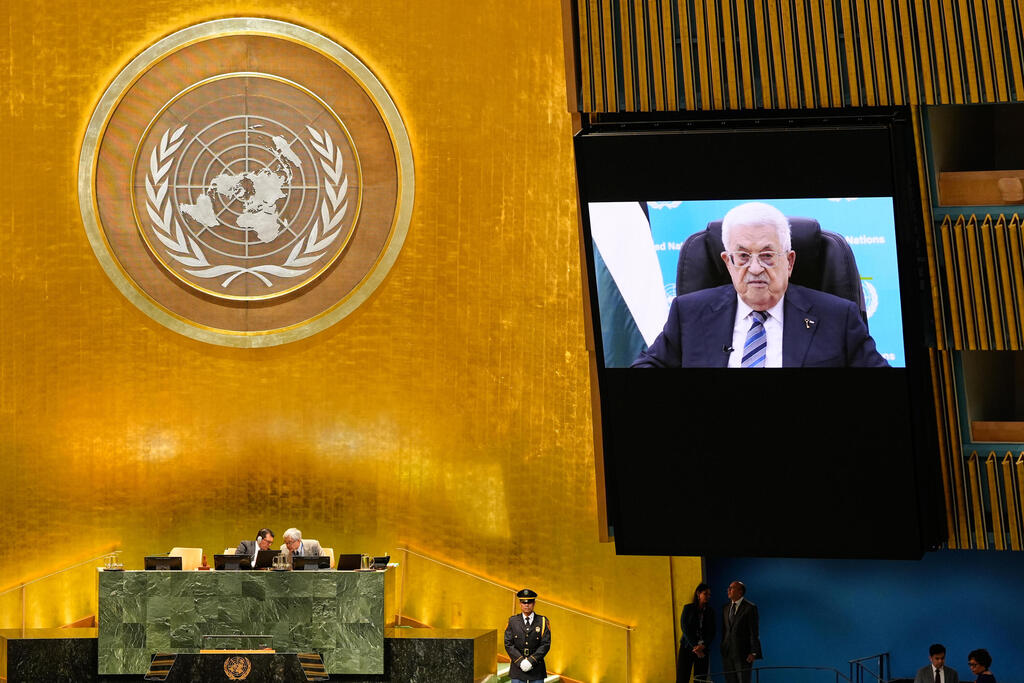
Palestinian Authority Chairman Mahmoud Abbas addressed the United Nations General Assembly via video link
(Photo: AP Photo/Seth Wenig)
“Preventing me from coming to address the General Assembly is a violation of UN procedures,” Abbas said. He called on the United States to “lift the sanctions and return to dialogue and respect” and to discussions aimed at advancing a two-state solution.
The General Assembly voted 152-3, with four abstentions, last week to allow Abbas to address the gathering remotely after he was denied entry. The United States, Israel and Paraguay opposed the measure.
Abbas used much of his speech to sharply condemn Israel's conduct in the Gaza Strip and West Bank.
“In Gaza, the Palestinian people are being subjected to killing, destruction, starvation, attempted displacement and a genocidal war that has created a major humanitarian catastrophe,” Abbas said.
Israel rejects accusations that its military campaign in Gaza constitutes genocide, saying it targets terrorist groups and operates in accordance with international law.
Abbas also accused Israel of accelerating settlement expansion in the West Bank and East Jerusalem, which Palestinians seek as the capital of a future state.
“Israel's policies, in violation of international law, are destroying the two-state solution,” Abbas said. “The danger is growing and threatens the existence of the Palestinian people on their land.”
He characterized Israeli policies in Gaza and the West Bank as a “colonial plot” intended to force Palestinians from their land and warned world leaders against allowing what he described as another Nakba, the Arabic term for “catastrophe” used by Palestinians to describe the mass displacement that accompanied Israel's establishment and the 1948 Arab-Israeli war.
“Do not allow violent gangs, with the approval of the Israeli army, to burn communities,” Abbas said, referring to attacks by extremist Israeli settlers in the West Bank.
Settler violence and settlement expansion have drawn growing international criticism. UN Secretary-General António Guterres said this week that settler violence was rising at an alarming rate and reiterated the UN's position that Israeli settlements in the West Bank violate international law. Israel disputes some international legal characterizations of the territory and says the status of settlements should be resolved through negotiations.
Barred from New York for second year
The U.S. State Department rejected Abbas' visa request for this year's General Assembly after taking the same step in 2025, again forcing the 90-year-old Palestinian leader to participate remotely.
The United States, as host country of the UN headquarters, generally has obligations to facilitate access for foreign delegations attending UN meetings, though Washington retains authority over visas and has imposed restrictions in some cases involving officials with whom it has serious disputes.
The Trump administration has accused the Palestinian Authority and Palestine Liberation Organization of undermining peace efforts, including through attempts to secure international recognition and pursue cases against Israel in international courts. Palestinian officials have rejected the U.S. restrictions.
The visa dispute comes as Abbas faces mounting pressure over the Palestinian Authority's political future and the question of who would govern Gaza under any long-term settlement of the conflict.
The Palestinian Authority exercises limited self-rule in parts of the West Bank under agreements reached with Israel in the 1990s. Hamas seized control of Gaza from Abbas' Fatah movement in 2007.
The Israeli-Palestinian conflict has again emerged as one of the dominant issues at this year's General Assembly, where a series of leaders have criticized Israel over Gaza, West Bank settlements and Palestinian statehood.
Turkish President Recep Tayyip Erdogan used his address to condemn Israel's conduct in Gaza and urge greater international pressure on Israel while calling for broader recognition of a Palestinian state.
Other leaders, including Qatar's emir, Sheikh Tamim bin Hamad Al Thani, have also accused Israel of genocide in Gaza. Israel has repeatedly rejected that charge, saying Hamas' Oct. 7, 2023, attack and subsequent military operations are central to understanding the war and accusing critics of ignoring the threats it faces.
Abbas' address came hours before Prime Minister Benjamin Netanyahu was scheduled to speak before the General Assembly, setting up sharply contrasting presentations of the Israeli-Palestinian conflict from the two leaders.
Netanyahu is expected to defend Israel's conduct and address threats facing the country, including Iran, amid an unusually brief visit to New York and plans for protests surrounding his appearance.