

Russia has become Syria’s primary oil supplier despite the country’s political shift toward the West, highlighting Damascus’ limited economic options after years of war, Reuters reported.
Oil shipments from Russia to Syria have risen about 75% this year to roughly 60,000 barrels per day, according to Reuters calculations based on official data and ship-tracking services including LSEG, MarineTraffic and Shipnext. While modest compared with Russia’s global exports, the volumes make Moscow Syria’s dominant crude supplier following the December 2024 fall of former President Bashar Assad.

Iran, a key ally of Assad during Syria’s 14-year civil war, had previously been the country’s main supplier but halted shipments after his ouster.
Syria’s reliance on Russian oil comes despite lingering distrust of Moscow, which backed Assad militarily. Analysts and Syrian officials cited economic necessity and Moscow’s continued influence, including its maintenance of naval and air bases in the country.
The arrangement risks complicating Syria’s efforts to strengthen ties with the United States and Europe, officials said, speaking on condition of anonymity due to the sensitivity of the issue. Even after Western sanctions were lifted last year, Syria remains only loosely connected to the global financial system.
“If the United States were to fail to reach an agreement or settlement with Russia regarding Ukraine, it wouldn’t be a surprise if it told Syria overnight to stop buying these oil shipments,” Syrian economist Karam Shaar said, warning of potential exposure to renewed sanctions.
Syria has sought alternative suppliers, including talks with Turkey, but has so far been unsuccessful, according to a Syrian Petroleum Company official. Limited purchasing power, financial constraints and the legacy of conflict have restricted access to conventional energy markets.
Russia was the first to resume oil deliveries after Assad’s fall, shipping about 16.8 million barrels in 2025, or roughly 46,000 barrels per day, according to Kpler data and a Syrian official. That figure has since climbed to an estimated 60,000 barrels per day, Reuters reported, with tankers arriving at Syrian ports almost weekly. All identified vessels are under Western sanctions.
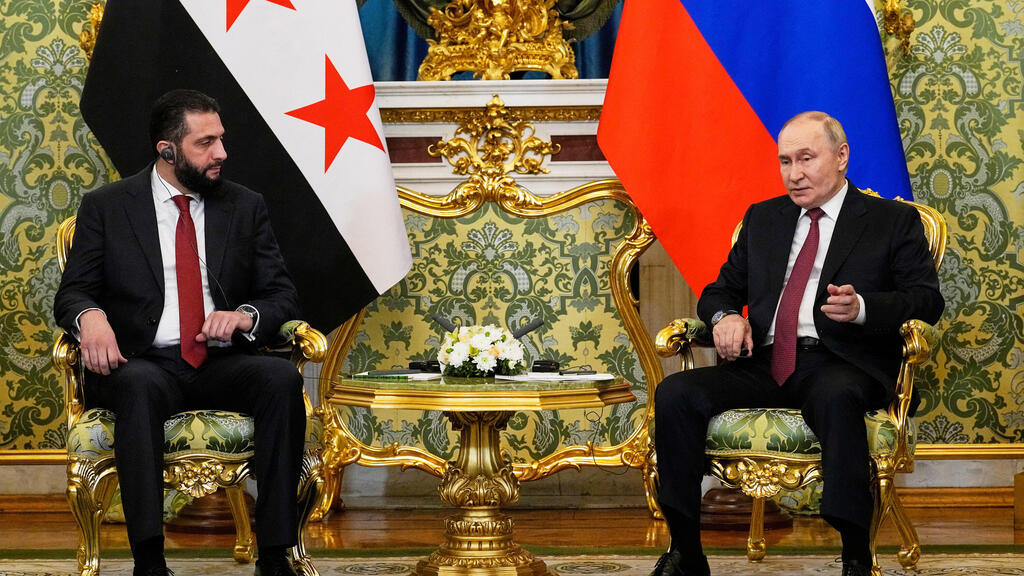
Syrian president Ahmad al-Sharaa meets Putin at Kremlin in Moscow
(Photo: Alexander Zemlianichenko/Pool via REUTERS)
Domestic production remains far below demand. Syria produces about 35,000 barrels per day, compared with prewar levels of 350,000. Its largest oil field, al-Omar in Deir Ezzor province, yields about 5,000 barrels per day. Daily consumption is estimated at 120,000 to 150,000 barrels, leaving a significant shortfall partially filled by Russian imports and smuggling from neighboring Lebanon.
Much of the oil trade relies on sanctioned or high-risk shipping networks. Tankers operate under multiple flags and often conduct ship-to-ship transfers near Greece, Cyprus or Egypt, a practice that can obscure the origin of cargo and reduce sanctions exposure, according to maritime analytics firm SynMax.
“These shipping networks could present reputational challenges for Syria as it seeks to re-establish commercial credibility,” SynMax said, adding that a transition to conventional supply chains is unlikely in the near term.
Some vessels involved have links to Russian and Iranian networks already under U.S. sanctions. Others are connected to companies tied to Russia’s state shipping giant Sovcomflot, according to maritime intelligence firms.
Syrian authorities typically do not disclose the origin of oil shipments in official announcements, likely reflecting domestic sensitivity over ties to Russia. The only publicly identified delivery in recent months came from Saudi Arabia, described as a grant.
The United States has not commented on Syria’s oil trade with Russia. However, the presence of Russian military bases remains a point of contention in discussions with Western governments. U.S. Rep. Joe Wilson, a Republican, said in April that Syria should expel Russian forces.
Analysts say the trade underscores broader concerns about who ultimately benefits.
“The question is who are the sanctioned actors that are actually benefiting from this trade,” said Noam Raydan, an energy and maritime risk analyst at the Washington Institute.