

The Encyclopedia Britannica has removed a map from its Britannica Kids edition that labeled the territory of Israel as “Palestine,” following a complaint by a British pro-Israel legal group and media inquiry by The Telegraph.
The change came after criticism that the educational content effectively erased the State of Israel and promoted a politically charged narrative.
Gallery
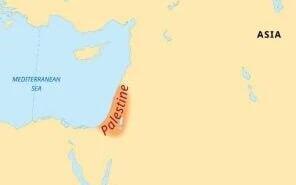
A featured on Britannica labeling Israel as 'Palestine' after backlash
(Illustration: from Telegraph)
The map, published on the Britannica Kids website, showed the entire area between the Jordan River and the Mediterranean Sea as “Palestine,” with no mention of Israel. A caption accompanying the map read: “The name Palestine refers to a region in the Middle East. The region lies between the Jordan River and the Mediterranean Sea.”
The group UK Lawyers for Israel (UKLFI) said the depiction echoed the controversial slogan “From the river to the sea,” widely used by pro-Palestinian activists and militant groups, including Hamas, to describe a future Palestinian state encompassing all of Israel. UKLFI argued that Britannica’s map promoted a modern political agenda and called for urgent corrections.
In its letter to the encyclopedia’s U.S.-based publishers, UKLFI wrote: “These descriptions effectively erase the existence of Israel, which in fact lies between the River Jordan and the Mediterranean sea. By defining Palestine as extending uninterrupted from the river to the sea, the entries closely mirror the language and geographic framing of contemporary activist slogans such as ‘from the river to the sea, Palestine will be free’. This phrase has been widely used as a rallying cry for Palestinian terrorist groups and is contained in the 2017 charter of the Hamas terrorist group, which led the October 7 attacks.”
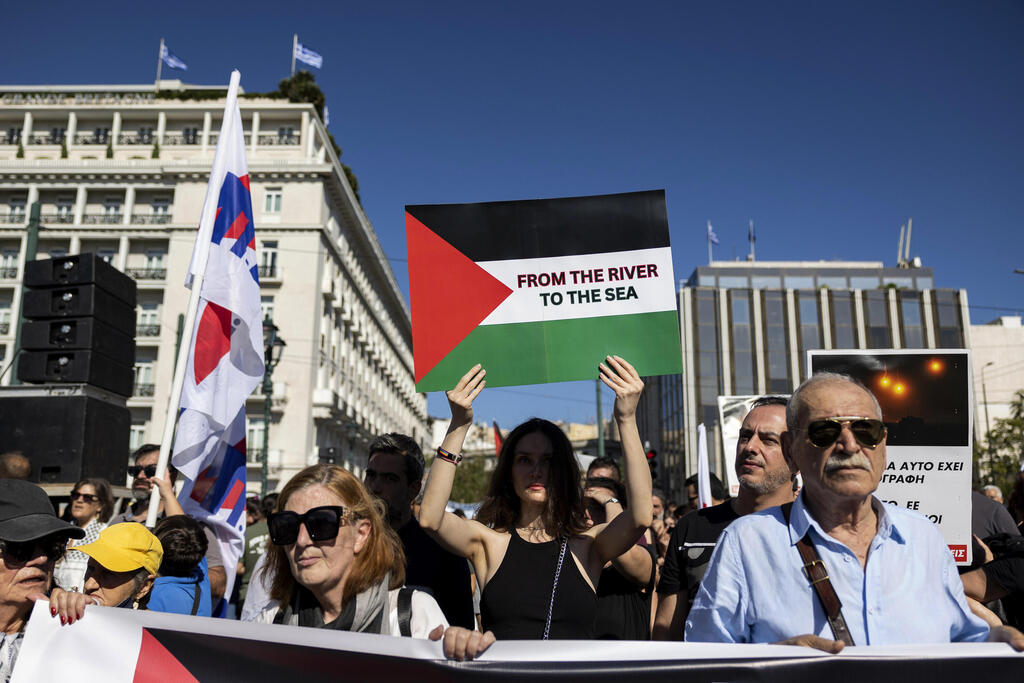
Protester flies a sign bearing the phrase 'from the river to the sea' at a pro-Palestinian deomnstration in Athens, Greece
(Photo: AP / Yorgos Karahalis)
Following a Telegraph inquiry, Britannica removed the map from its site and updated the entry to reflect that “Today the State of Israel, the West Bank, and the Gaza Strip are located within this area.”
The organization’s concerns were first raised in November 2024 by Shari Black, a London-based Jewish children’s book writer with family in Israel. Black contacted Britannica directly and received a response saying the editorial team would review the issue, but she said she was not informed of any resulting changes. “Accuracy is really important when you're writing books for children and I was surprised that such a respected website would publish historic inaccuracies like this,” Black told The Telegraph. “It pushes a certain agenda, an erasure of Israel, a delegitimization of the country—even though it was established by international concensus.”
UKLFI also objected to broader language used in Britannica Kids, which referred to “Palestine” as a historical term dating back thousands of years. Historians cited by The Telegraph questioned this portrayal, noting the term “Palestine” was introduced by the Roman Emperor Hadrian only after the Bar Kokhba revolt in 135 CE to suppress Jewish identity in the region once known as Judea.
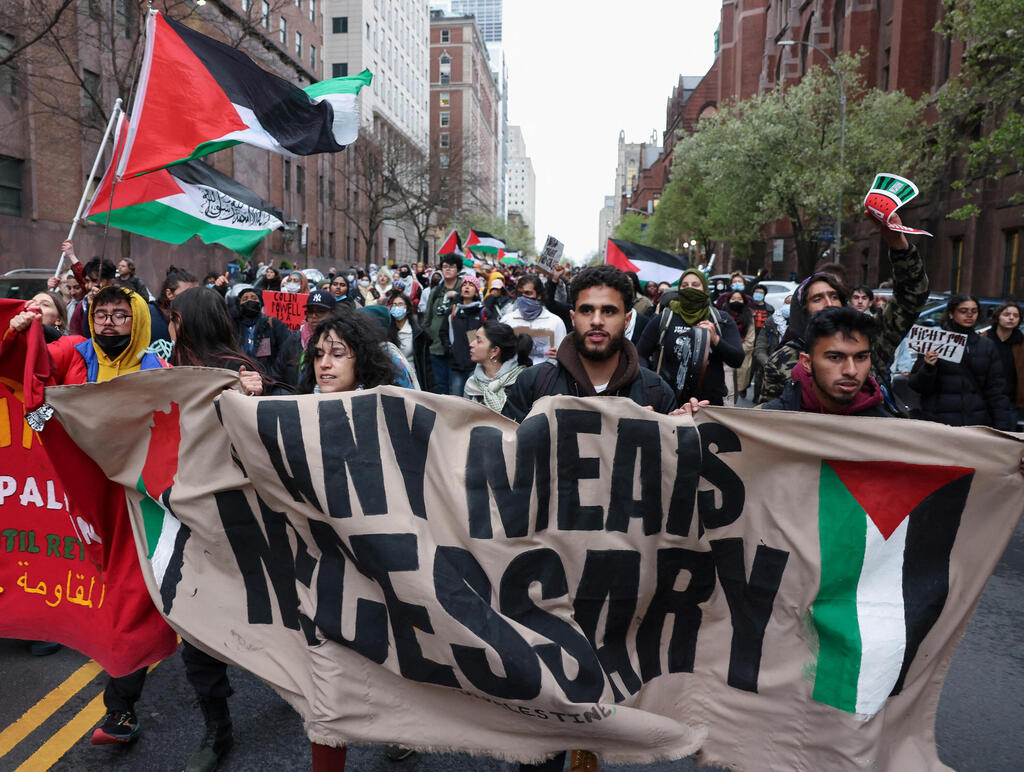
Pro-Palestinian demonstration at Columbia University, New York
(Photo: Reuters)
UKLFI Director Caroline Turner said retroactively applying the label “Palestine” across the region misrepresents historical developments and creates a false impression of continuity.
In response, Britannica’s editor-in-chief, Theodore Pappas, said the company would closely review the concerns. “We will review these claims by the UK Lawyers for Israel and make adjustments to our content, if needed,” Pappas said.