

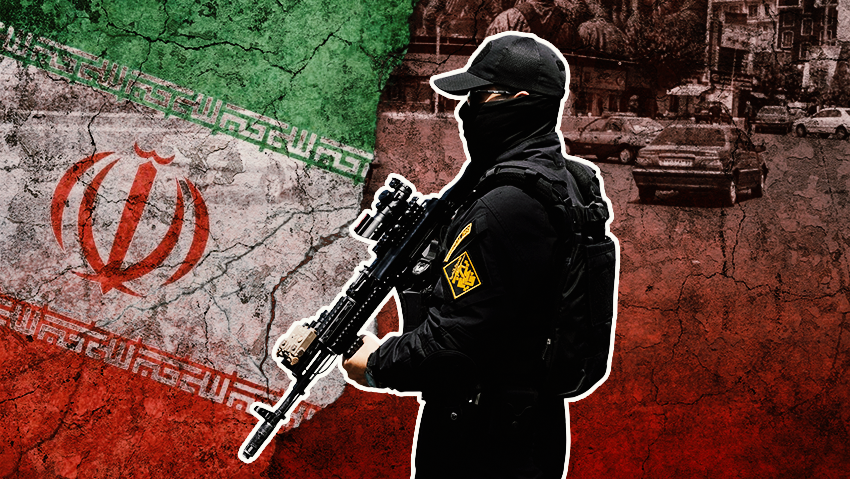
European Union foreign ministers on Thursday agreed to designate Iran’s Islamic Revolutionary Guard Corps as a terrorist organization, marking a significant shift in European policy following Tehran’s violent crackdown on nationwide protests and amid rising tensions in the Middle East.
EU foreign policy chief Kaja Kallas said the decision places the powerful Guard in the same category as groups such as al-Qaida and the Islamic State.
“Repression cannot go unanswered,” Kallas wrote on the social media platform X. “Any regime that kills thousands of its own people is working toward its own demise.”
The move aligns the EU with the United States, Canada and Australia, all of which have previously designated the Revolutionary Guard as a terrorist organization. It comes as Western governments intensify pressure on Iran over its internal repression, ballistic missile and nuclear programs and its growing confrontation with Washington and Israel.
Iranian response and regional tensions
Iran reacted angrily to the decision. Foreign Minister Abbas Araghchi said Europe was making a “major strategic mistake” by labeling what he described as Iran’s “national army” a terrorist organization.
In a post on X, Araghchi accused Europe of “fueling the flames” and warned that the decision would have serious consequences. He also charged European governments with hypocrisy, saying they rushed to defend human rights in Iran while remaining silent, in his words, over Israel’s actions in Gaza.
Iran has not announced specific retaliatory measures, but officials have warned that relations with Europe could deteriorate further.
The designation comes amid heightened military tensions in the region. The United States has significantly expanded its naval presence in the Middle East, sending an additional destroyer — the USS Delbert D. Black — into the region in recent days, according to a U.S. official. That brings the U.S. naval force in the area to six destroyers, an aircraft carrier and several littoral combat ships.
Iran has repeatedly warned it could carry out a preemptive strike or target U.S. military bases and Israel if attacked. Kallas said Thursday that the region “does not need a new war,” even as the EU moved ahead with the designation.
Crackdown drives momentum in Europe
The Revolutionary Guard was created after Iran’s 1979 Islamic Revolution to protect the Shiite clerical system and operates alongside the country’s regular armed forces. Over the decades, it has grown into one of the most powerful institutions in Iran, exerting control over large segments of the military, economy and strategic industries. It is also responsible for Iran’s ballistic missile and nuclear programs.
While some EU member states had long pushed to add the Guard to the terrorist list, others — including France and Italy — had previously resisted, citing fears that such a move could sever diplomatic channels with Tehran and endanger European citizens held in Iran.
That position shifted after Iran’s latest crackdown on protests earlier this month. Human rights groups say thousands of demonstrators were killed as security forces, including the Revolutionary Guard and its Basij volunteer force, were deployed to suppress unrest that began over economic hardship and expanded into a broader challenge to the Islamic Republic.
“It’s important that we send this signal that the bloodshed we’ve seen cannot be tolerated,” Dutch Foreign Minister David van Weel said. France and Italy threw their support behind the move this week.
Kallas said EU officials believe diplomatic channels with Iran can remain open despite the designation.
New sanctions announced
Alongside the designation, the EU adopted a new round of sanctions targeting 15 individuals and six entities deemed responsible for serious human rights violations, according to a statement from the Council of the European Union.
Those sanctioned include Iranian Interior Minister Eskandar Momeni, Prosecutor General Mohammad Movahedi Azad, several senior Revolutionary Guard commanders and high-ranking law enforcement officials. The measures include travel bans within the EU and asset freezes across the bloc’s 27 member states.
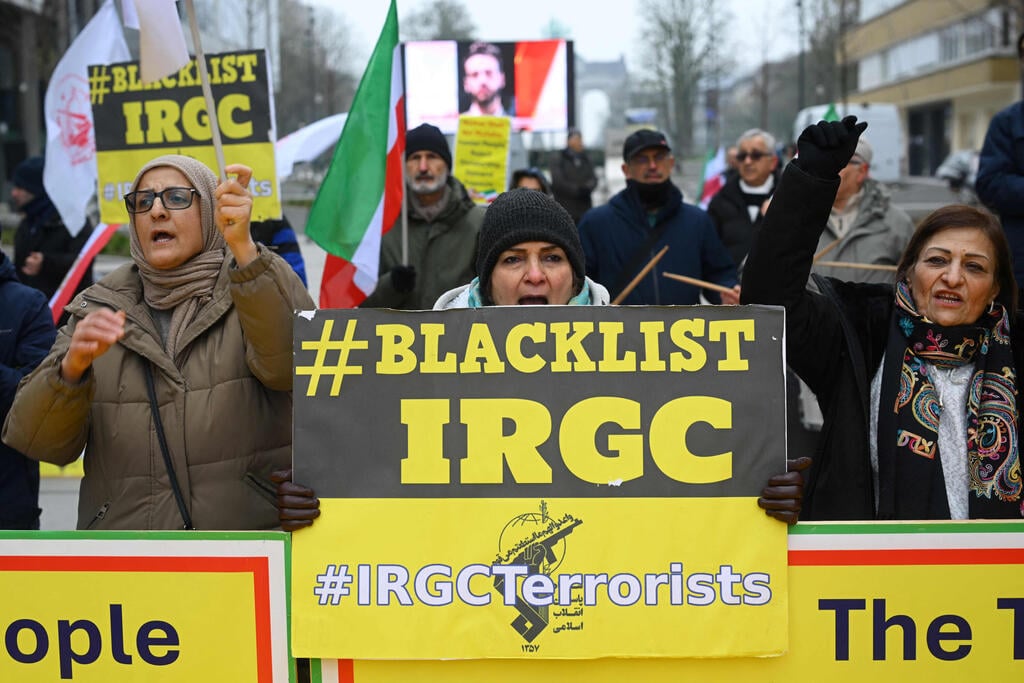
(Photo: Nicolas TUCAT / AFP)
Six Iranian entities were also sanctioned, including the Iranian Audio-Visual Media Regulatory Authority and several software companies. The EU said those bodies were involved in internet censorship, online disinformation campaigns, surveillance and tools used to disrupt access to the internet during the protests.
In addition, the EU imposed sanctions on four individuals and six entities linked to Iran’s drone and missile programs and expanded restrictions on the export of components and technologies used in the development and production of unmanned aerial vehicles and missiles.
Israeli reaction
In Israel, officials welcomed the EU decision. Foreign Minister Gideon Sa'ar described it as a “historic and important step,” saying it dealt a major blow to the legitimacy of Iran’s leadership.
“The designation will criminalize the Revolutionary Guard’s activities in Europe, harm an organization that controls a significant share of Iran’s economy and send a clear message to the Iranian people who are fighting for their freedom,” Sa'ar said.
The EU move further isolates Iran internationally as Western governments escalate pressure following what has become the deadliest period of unrest in the country in decades, drawing comparisons to the turmoil surrounding the 1979 Islamic Revolution.
First published: 17:03, 01.29.26