

With government encouragement, settlers will hold a ceremony Monday evening marking 50 years of settlement in Samaria, as efforts intensify to return to evacuated communities in the region’s north. The moves effectively erase the 2005 disengagement that dismantled four settlements there.
After preventing another evacuation at Homesh, relocating structures to state land and rebuilding the settlement, Samaria settlement leaders are now pressing ahead toward the next target, Sa Nur. Their goal is to establish a Jewish presence there within weeks and to enlist Defense Minister Israel Katz and the Israel Defense Forces in the effort.
A review of the parallel tracks pursued by Samaria Regional Council head Yossi Dagan and allies of Finance Minister and additional Defense Ministry minister Bezalel Smotrich, through the Settlement Administration and the Finance Ministry, shows a coordinated drive to reestablish the northern Samaria settlements. The push extends beyond civilian settlement. Earlier this year, Central Command forces took control of the refugee camps in Jenin, Tulkarm and Nur al Shams and are now deepening their hold on the area.
The momentum was bolstered by a recent Cabinet decision approving 19 new settlements, including Ganim and Kadim, the two other northern Samaria communities evacuated in 2005, alongside Homesh and Sa Nur.
Plans already in place
The Samaria Regional Council has already prepared master plans for Homesh and Sa Nur and plans to do the same soon for Ganim and Kadim. Additional steps include land seizures in the Sebastia nature reserve, expropriation of property from Palestinians, approval of a settlement on Mount Ebal and authorization for excavations at the site identified as the altar of Joshua son of Nun. Together, these measures are creating a continuous settlement space that did not previously exist.
The 50th anniversary ceremony will be held at the Ariel Cultural Center and is expected to draw ministers and members of Knesset. Between 1974 and 1975, the Gush Emunim movement led eight attempts to establish settlements in Samaria. About 150 people took part in the first attempt, and by the second, thousands gathered at the Sebastia train station.
The eighth attempt, during Hanukkah in 1975, succeeded. The army reached a compromise under which the settlers were moved near the village of Qadum to a site that became the settlement of Kedumim. Some members later founded Alon Moreh near Nablus, in line with their original plan. These moves marked the breakthrough for broader settlement in Samaria, which has since undergone many changes.
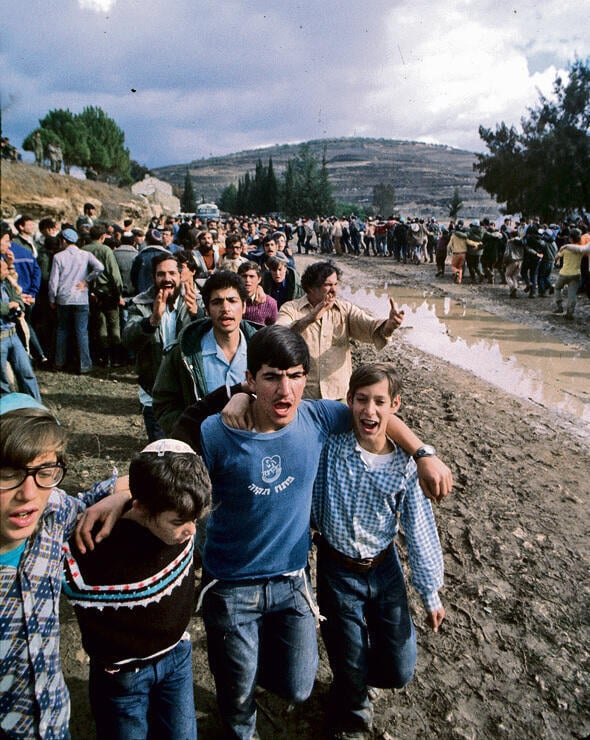
Celebrating in Sebastia after the eighth settlement attempt. Hanukkah, 1975
(Photo: David Rubinger)
A rare letter by Hanan Porat
As part of preparations for the event, a rare letter written by Rabbi Hanan Porat shortly after the first attempt in 1974 was found at the home of his widow, Rachel Porat. In the letter, Porat explains why they chose to go to the land despite government opposition, stressing it was not a media protest but an act of settlement rooted in the belief that “this good mountain” is an inseparable part of the Land of Israel.
He describes the moral affront of a situation in which “in the Land of Israel, in the midst of days of national revival and redemption, Jews are forbidden to settle in the heart of the land,” sharply criticizing laws meant to prevent Jewish settlement and likening them to the White Paper decrees. “I believe with complete faith that soon she will return and arise, ascend and build her home in Samaria,” he wrote, citing the verse, “You shall yet plant vineyards on the mountains of Samaria.”
Dagan said the letter is “a foundational document of renewed Zionism,” expressing deep stateliness, love of the land and a quiet but resolute recognition of “our historical, moral and national right to the Land of Israel.” He said settlement in Samaria grew out of responsibility to the state and an understanding that holding the land strengthens Israel’s security, identity and future. “Fifty years on, we look with reverence at the deeds of that generation and draw strength to keep building, connecting generations and moving forward with faith, responsibility and great hope for the future,” he said.