

Palestine Square in Tehran has in recent years become one of the Iranian regime’s central propaganda stages, both in the capital and across the country. The square regularly featured giant banners threatening Israel, often written in Hebrew. Anti-Israel and anti-American signs, statues and messages were installed there, including a mock hanging of President Donald Trump and a clock counting down to the “destruction of Israel.”
Yet in the midst of the war with Israel and the United States, the square appears to have largely disappeared from Iranian propaganda.
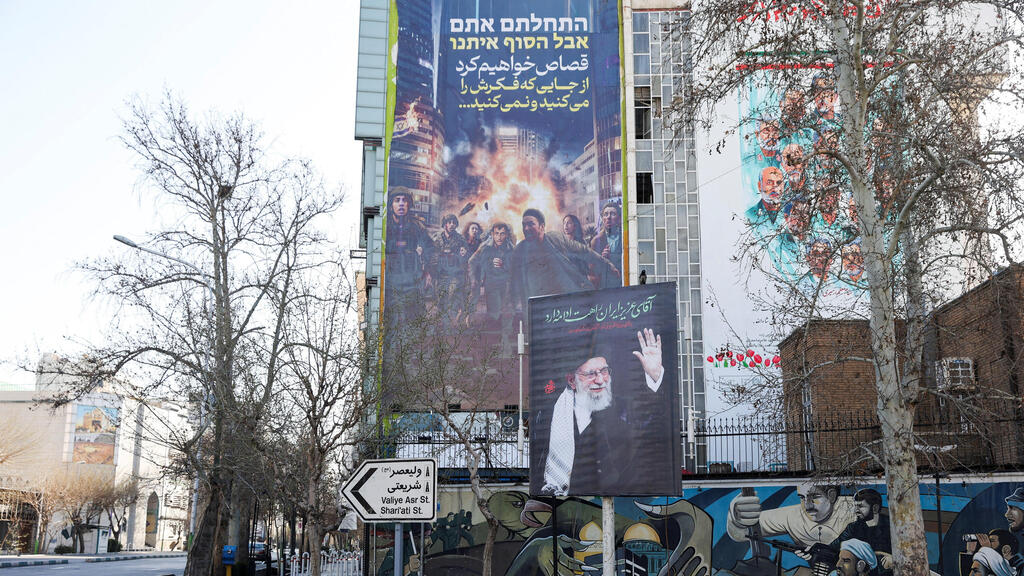
On Feb. 28, the first day of the war, numerous photos and videos from Palestine Square in Tehran were still circulating on social media accounts affiliated with the ayatollahs’ regime. In one video published that day, the clock counting down to Israel’s destruction can clearly be seen — the same clock that had previously been claimed to have been destroyed. In another video, a large building in the square — the structure used to hang propaganda banners against Israel — can still be seen standing.
Reports from Iran suggest the square remains active. It was also part of last Friday’s Iranian “Jerusalem Day” marches. In announcements ahead of the events, it appeared on the list of the “10 routes of the International Quds Day march in Tehran,” alongside major squares such as Valiasr Square, Revolution Square, Khorasan Square and Imam Hossein Square.
However, unlike other Tehran locations such as Valiasr Square and Revolution Square — from which images are frequently published — Palestine Square has largely disappeared from Iranian propaganda coverage, at least during the most recent days of the war.
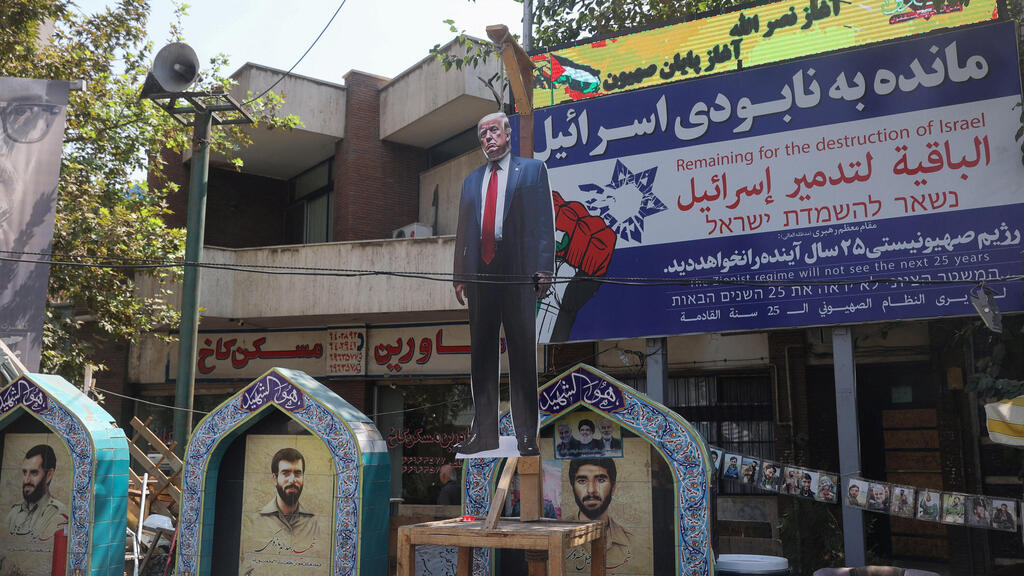
A mock hanging of President Donald Trump in Palestine Square
(Photo: Majid Asgaripour/WANA (West Asia News Agency) via REUTERS)
For example, this morning images circulated on social media accounts affiliated with the regime showing a new sign hung in Valiasr Square, featuring pictures of Iranian missiles accompanied by threatening messages against Israel. By contrast, no new image of the building in Palestine Square that serves as a key propaganda site against Israel has appeared on Iranian networks for an unusually long stretch of days, compared with the frequency with which banners were displayed on the building before the war.
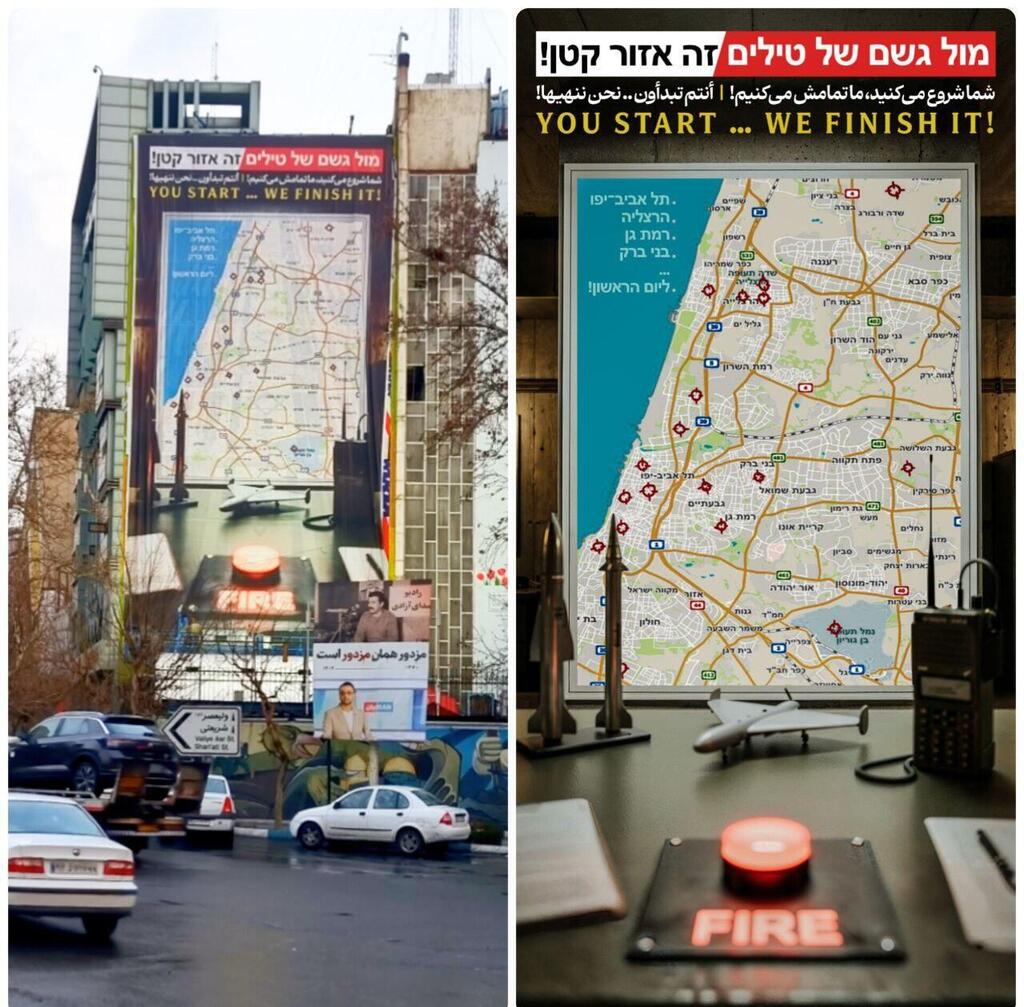
Reuters published a photograph on March 4 purportedly showing the same building, with a banner bearing the Hebrew phrase “You started it, but we will finish it.” The image also shows a small sign with a portrait of Ali Khamenei, Iran’s assassinated supreme leader.
However, a review of earlier material shows that the exact same banner with the Hebrew text appeared on the building in a photograph taken by the same photographer in September 2024.
Despite that isolated publication, Palestine Square appears to have faded somewhat — both from Israel’s targeting and from Iranian propaganda — even though it is normally considered the heart of Iran’s propaganda efforts. It has been difficult to find updated images of the site in recent days.
The square and its symbols appear to remain intact, both because there have been no reports suggesting otherwise and because events there continue to take place. For reasons that are unclear, however, the Iranian regime appears to be shifting attention away from the very site that has long symbolized its hostility.
There have been strikes in the area of the square. The Lebanese outlet UNews, which is affiliated with the Iranian-backed Shiite axis, published a video on Friday — Iran’s Jerusalem Day — that includes an interview with one of the march participants. During the interview, a strike can be heard and the crowd shouts “Allahu akbar.”
The caption alongside the video read: “The reaction of Iranians after a missile fell near the Quds Day march at the intersection of Palestine Square and Revolution Square in Tehran,” although the area itself cannot be clearly seen.
Senior Iranian officials who attended the Jerusalem Day march on Friday passed through the area near the square, and when the strike occurred near the procession, they knew they were surrounded by crowds that were effectively shielding them.
Beni Sabti, an Iran expert at the Institute for National Security Studies, offered a possible explanation for the square’s absence from Iranian propaganda.
“They want to avoid provoking too much and to preserve it. In a way, it’s hiding in the most visible place,” he told Ynet. “I think they are lowering the profile of the site — diverting attention from it and trying to move the fire away. From a Persian strategic perspective, they are shifting the propaganda, the activities and the gatherings to another location. There are many places nearby, since this is the heart of Tehran. The square is like a finger in the eye, and they wanted to reduce the excitement around it and avoid turning it into a target.”