

U.S. President Donald Trump said Monday that Hamas will be given only a short period to disarm, warning that failure to do so would trigger severe consequences, as he strongly backed Israel’s conduct under the Gaza plan and defended Prime Minister Benjamin Netanyahu’s leadership.
“We talked about Hamas and disarmament,” Trump said after meeting Netanyahu. “Hamas will be given a very short period of time to disarm. And if they don’t disarm, there will be hell to pay.”
The joint press conference
(Video: Reuters)


Trump said Hamas had committed to disarm as part of the agreement and stressed that Israel would not be blamed if the process collapses. “You couldn’t blame Israel,” he said, adding that other countries were prepared to act if Hamas reneges. “Those same countries will go and wipe out Hamas. They don’t even need Israel.”
Trump said as many as 59 countries back the enforcement of the agreement, calling it “real peace in the Middle East.”
Asked whether Israel was moving fast enough toward the next phase of the Gaza plan, Trump rejected the premise outright. “I’m not concerned about anything that Israel is doing,” he said. “They’ve lived up to the plan. Israel has lived up to the plan 100%.”
Gallery
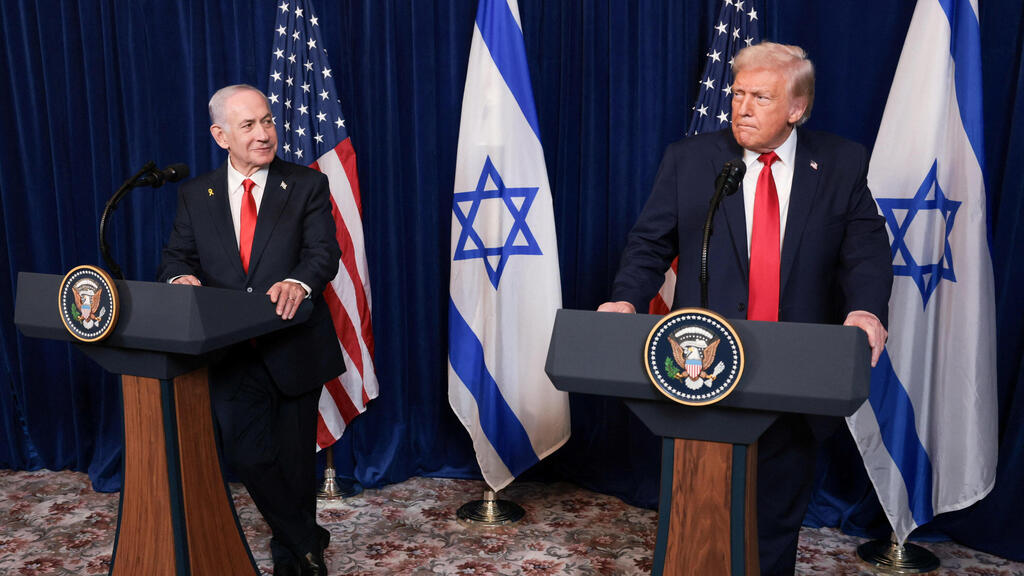
Prime Minister Benjamin Netanyahu and U.S. President Donald Trump
(Photo: Jonathan Ernst/ Reuters)
Trump repeatedly framed Israel as acting in good faith, saying his concerns lay with others. “I’m concerned about what other people are doing or maybe aren’t doing,” he said.
Iran dominated much of Trump’s remarks. He warned that the United States would not allow Tehran to rebuild its nuclear program, even at undisclosed sites. “Iran may be rebuilding its nuclear program in sites other than those U.S. bombed,” he said. “We know exactly where they’re going, what they’re doing.”
“If they build up again, we will eradicate the threat,” Trump said, adding that Iran has already been “greatly reduced in power and prestige.”
At the same time, Trump said he remains open to diplomacy. Asked whether Washington would support talks with Tehran, he replied, “Yeah, I would. Sure.”
Trump linked Iran’s weakening directly to regional normalization. “If we didn’t do what we did to Iran, you wouldn’t have peace in the Middle East,” he said, arguing that Iran’s decline made the Abraham Accords possible.
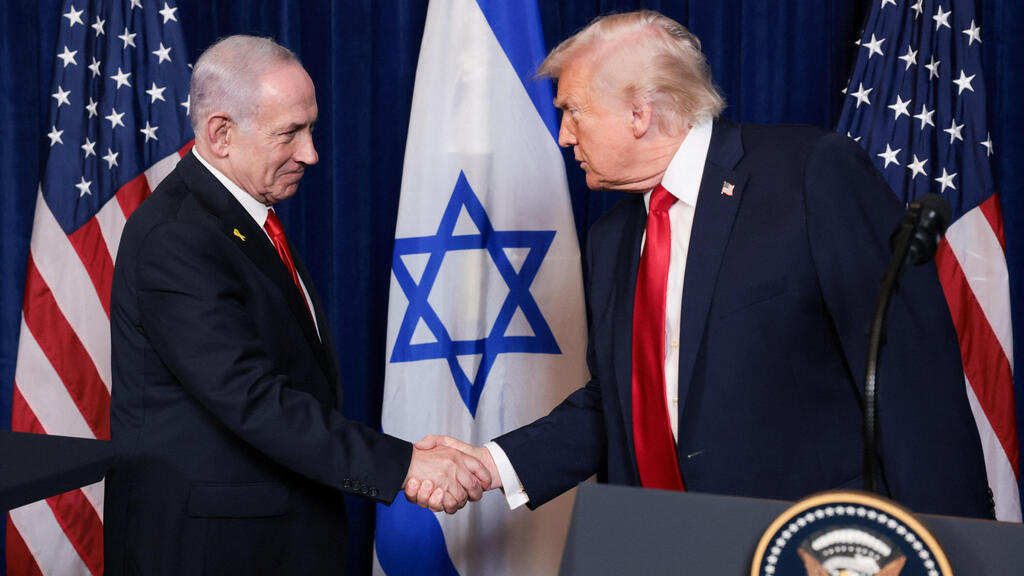
(Photo: Jonathan Ernst/ Reuters)
Trump said the accords would be expanded “fairly quickly,” naming Saudi Arabia as a future signatory. “At some point, they’ll sign the Abraham Accords,” he said.
On Syria, Trump said he and Netanyahu had reached an understanding and pledged to help ease tensions. “We have an understanding regarding Syria,” Trump said. “I will make it so that Israel and Syria’s president get along.”
Netanyahu said Israel’s priority is stability along its northern border. “Our interest is to have a peaceful border with Syria,” he said, adding that Israel seeks to protect minorities, including Druze and Christian communities.
Trump also dismissed concerns about friction between Israel and Turkey, despite harsh rhetoric from Turkish President Recep Tayyip Erdogan. “Netanyahu and Erdogan are not going to have a problem,” Trump said. “Nothing is going to happen.”
Earlier press conference
(Video: Reuters)
On the West Bank, Trump acknowledged differences with Netanyahu over settler violence but said the issue would be resolved later. “We don’t agree on the West Bank 100%,” he said. “That will be announced at an appropriate time.”
Trump offered an unusually expansive defense of Netanyahu personally, calling him a decisive wartime leader. “If you had eight out of 10 prime ministers in his position, you wouldn’t have Israel any longer,” Trump said. “He won.”
The meeting capped a series of high-level discussions during Netanyahu’s visit, with Gaza, Iran and regional security dominating the agenda as Washington signals a harder line on enforcement and a push to expand regional normalization.