


The legal adviser to the Knesset Foreign Affairs and Defense Committee, Miri Frenkel-Shor, told committee members Monday night ahead of Tuesday’s debate on the draft-exemption bill that counting national civil-security service toward draft targets, as proposed in the current version, does not meet security needs and therefore cannot easily be included in the quotas.
“The civil-security service track, which is open only to graduates of Haredi educational institutions, constitutes a violation of equality, since the nature of national-civil service is fundamentally different from military service, even when categorized as civil-security service,” she wrote. “Among other things, it is shorter, voluntary rather than compulsory, and does not include reserve duty.”
She added: “Moreover, even though the civil-security track is closer to the security sphere than standard national-civil service, it does not, at this stage, meet the current security needs, which require increasing the number of combat soldiers and regular IDF personnel.”
Bismuth's draft proposal states that civil service in auxiliary units of the Prime Minister’s Office would be considered service, including the Shin Bet, Mossad, the Israel Prison Service and the police.
Under the bill’s targets, 8,160 young men would be recruited for military and civil service in the first year — defined as roughly 18 months, until June 2027. The numbers would fall to 6,840 in the second year, rise to 7,920 in the third, and reach at least 8,500 in the fourth. From the fifth year onward, 50 percent of each annual cohort of Haredi graduates would be recruited, with civil-service recruits counted toward the total up to a limit of 10 percent.
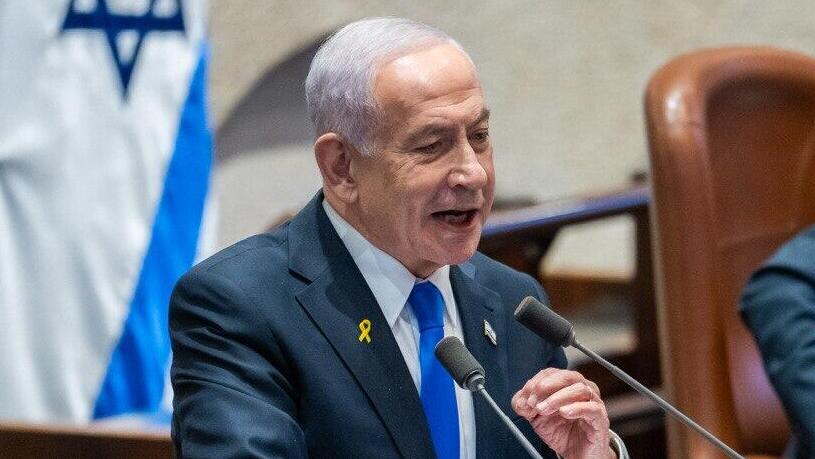
Prime Minister Benjamin Netanyahu
(Photo: Shalev Shalom)
Prime Minister Benjamin Netanyahu on Monday addressed the draft-exemption bill in his own voice for the first time and backed it. Speaking during a Knesset debate held under the “40 signatures” procedure, Netanyahu said, “We placed the draft law on the Knesset table, in the Foreign Affairs and Defense Committee — the beginning of a historic process to integrate the Haredi public into service in the IDF and the security establishment. The law includes significant draft targets, four times higher than before.” He accused the opposition of hypocrisy: “You brought a law of evasion. You do not want conscription. You are interested only in politics.”
The Bismuth bill continues to roil the coalition, with several ministers and lawmakers announcing they will oppose it. Absorption and Immigration Minister Ofir Sofer (Religious Zionism) said he would do so even at the cost of losing his job, and Deputy Foreign Minister Sharren Haskel (New Hope) launched a protest march against the bill. Meanwhile, Shas and Degel HaTorah have demanded that the bill pass a committee vote as a condition for supporting the 2026 budget.
Separately, the Foreign Affairs and Defense Committee on Monday approved Defense Minister Yoav Gallant’s request, in line with a government decision, to extend emergency reserve mobilization under Order 8. Opposition MKs on the committee criticized the move: “There is no limit to the disrespect. They legislate a draft-evasion law over the heads of those who serve and make fateful decisions about their lives in minutes. This is what a government disconnected from reality looks like. It not only fails to respect those in uniform, it exploits them.”