

A week of protests showing no sign of abating, a direct threat from the U.S. president and then the lightning capture of a foreign leader have shaken Iran’s leadership and thrust the Islamic Republic into what senior officials privately describe as “survival mode.”
Officials told The New York Times on Sunday that after U.S. President Donald Trump threatened to intervene in the ongoing unrest in the country if the regime killed peaceful protesters — comments that drew sharp responses from Tehran — Iran’s Supreme National Security Council held a late-night emergency meeting Friday night to discuss how to contain the protests with less violence to avoid fueling public anger.
Ani-government protest in Mashhad, Iran


Three Iranian sources familiar with the discussions said the council, which directs internal and external security policy, also weighed preparations for possible military escalation. Those sources said senior officials have privately acknowledged that Tehran is focusing on regime survival as protests continue.
The Iranian government appears constrained, with few tools to address both a faltering economy and the risk of further confrontation with Israel and the United States. President Masoud Pezeshkian has publicly repeated in recent weeks that he has “no ideas” to solve the country’s deepening crises. In a Thursday speech — his first major address since the protests began — he said, “Any policy in the society that is unjust is doomed to fail. Accept that we must listen to the people.”
Officials involved in internal discussions said there is concern that continued instability could invite fresh Israeli strikes. Statements by Trump and supportive remarks from Israeli leaders, including Cabinet ministers, have heightened that fear.
Last week, Pezeshkian held two emergency economic advisory meetings and sought written talking points in case the crisis deepened. Some aides suggested directing public frustration toward Iran’s power structure centered on Supreme Leader Ayatollah Ali Khamenei, who holds ultimate authority.
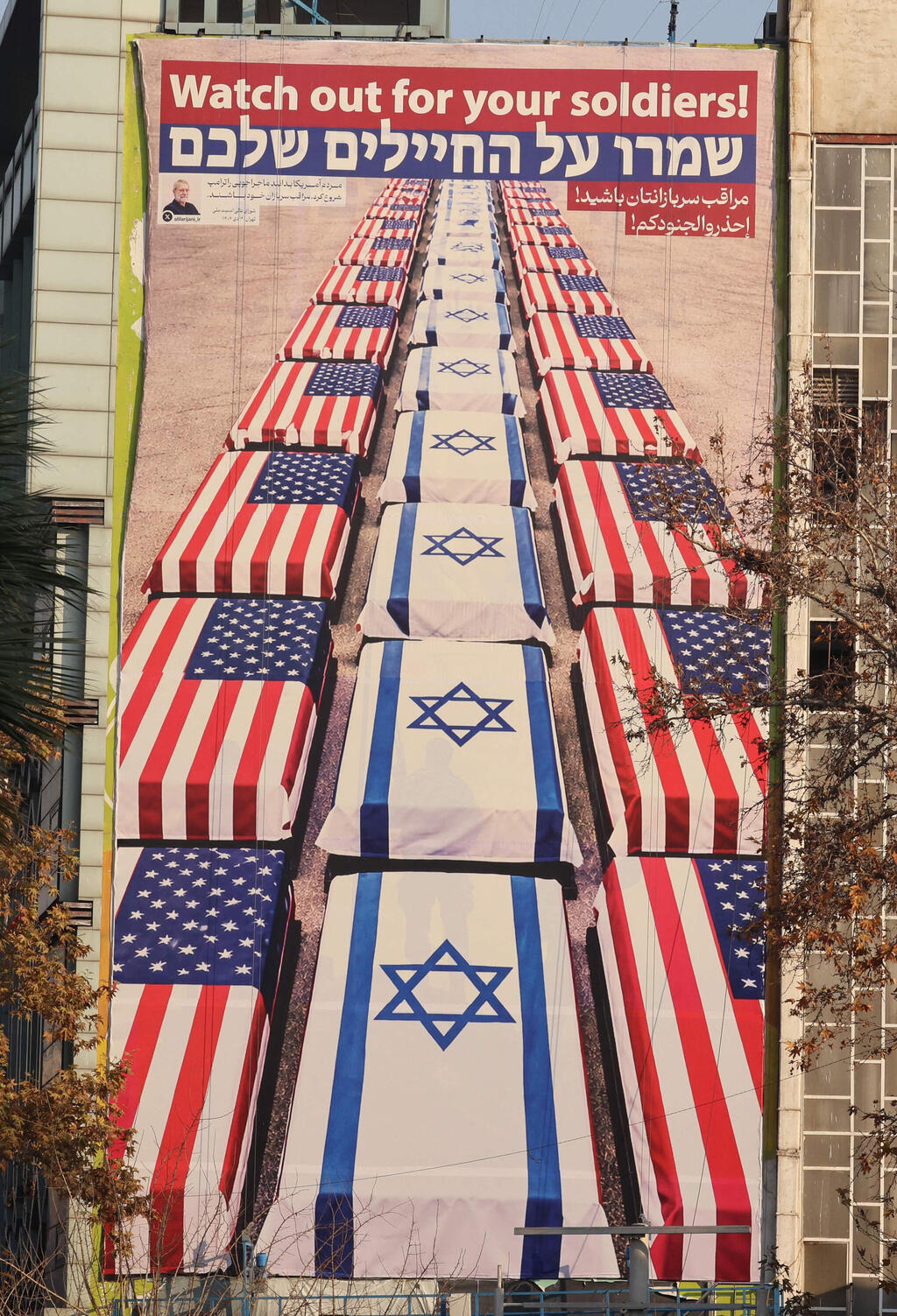
A billboard at Tehran’s Palestine Square showing coffins draped with US and Israeli flags and the words, in Hebrew and English, 'Watch out for your soldiers'
(Photo: ATTA KENARE / AFP)
Khamenei took a harder line Friday, saying at a public speech that “rioters must be put in their place,” blaming “foreign enemies” for the economic woes while acknowledging Tehran merchants’ right to protest price volatility.
The Times also reported that Foreign Minister Abbas Araghchi met secretly Thursday with pro-government media leaders, calling the unrest a “fight for the survival of the Islamic Republic’s rule and for the nation,” and saying negotiations with Washington are not currently possible and beyond his authority.
Today, Iran’s Chief of Staff Gen. Abdolrahim Mousavi accused the United States and Israel of fomenting chaos through “soft war” and economic pressure, claiming trained agents had been sent to exploit the protests.
Meanwhile, state-aligned Iranian social media circulated an image of a new billboard at Tehran’s Palestine Square showing coffins draped with U.S. and Israeli flags and the words, in Hebrew and English, “Watch out for your soldiers,” erected in response to Trump’s threat and a retort from Ali Larijani, secretary of the Supreme National Security Council: “They should worry about their soldiers.”