

Oman identified signs that pilot Hamam al-Hamami was undergoing Islamist radicalization and grounded him. He was reassigned to a desk job at Oman Air but was not dismissed. Flydubai later hired him, after checks that focused on his criminal record but did not uncover his earlier radicalization concerns, and eventually allowed him to fly a sensitive route to Israel.
Israeli authorities, meanwhile, were supposed to identify the security significance of a pilot from a country with which Israel has no diplomatic relations operating a passenger flight into Ben Gurion Airport. That did not happen.
Gallery
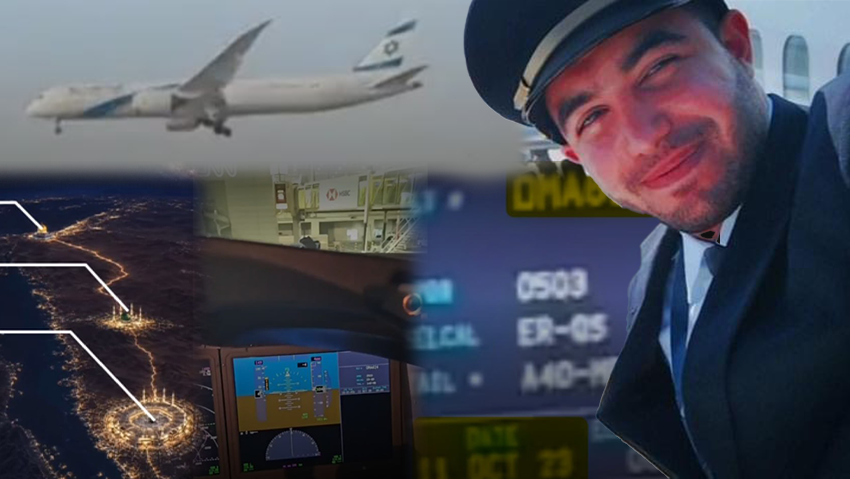
Three countries, multiple failures: How Flydubai pilot reached a Tel Aviv-bound cockpit
(Photo: CNN)
Only the resistance of the Indian captain and the actions of Israeli passengers prevented what investigators now believe could have become a mass-casualty attack. In the aftermath, Israeli oversight bodies have traded blame over who was responsible for detecting the threat.
According to a Wall Street Journal report cited in the investigation, Oman Air had identified al-Hamami’s radicalization, sent him to a deradicalization program and removed him from flying duties. But it did not revoke his international pilot’s license or warn neighboring Gulf states or international aviation authorities that could have prevented him from being hired elsewhere.
When al-Hamami reached Flydubai in 2025, the airline conducted a criminal-background check but did not contact Oman and did not examine whether he had a record of ideological radicalization.
Tribute to al-Qaeda leader: posts by the terrorist pilot
(Video: CNN)


The investigation into al-Hamami in the United Arab Emirates is continuing, including efforts to determine whether he acted alone or under the direction of a state or terrorist organization. At this stage, investigators increasingly believe he attempted to crash Flydubai Flight FZ1023 on his own initiative.
Al-Hamami grew up in Dubai, and investigators are examining a trip he made to Syria as a teenager during the country’s civil war, including whether he became radicalized while staying in the country where his mother was born.
He later obtained a visa for Australia and, according to reports, studied engineering at RMIT University in Melbourne for three years. The university says he did not complete his studies, while a local newspaper reported that his visa had been canceled. Reports also say he later studied for an aeronautical engineering degree through Buckinghamshire New University in England remotely.
Israeli and Emirati investigators are now trying to determine whether early signs of radicalization appeared during his time in Australia. A dedicated Australian team is also examining his contacts and conduct while he lived there, while authorities in Abu Dhabi are investigating Flydubai employees involved in his recruitment.
Suspected plan to crash at Ben Gurion Airport began months earlier
Israeli officials said Sunday that al-Hamami’s interrogation indicated he intended to crash the aircraft at Ben Gurion Airport.
According to the emerging account, he waited until the plane was over Jordan before trying to seize control, intending to continue toward Israel as though the aircraft were making a normal approach before crashing it into the airport and causing mass casualties.
If he could not reach Ben Gurion, investigators believe, al-Hamami planned to crash the aircraft into a U.S. military base in Jordan.
The investigation also indicates that the Omani pilot had considered carrying out the attack as early as July, but postponed it because of a personal connection with one of the crew members aboard the flight, whom he allegedly decided to spare.
Investigators also believe al-Hamami landed in Israel in June and had prepared himself to become a “martyr.”
A major factor in thwarting the alleged plan, alongside the actions of Israeli passengers and the replacement pilots who ultimately stabilized the aircraft, was the struggle put up by Indian captain Smith Machachar.
Investigators say al-Hamami planned to strike Machachar repeatedly with an emergency axe until he lost consciousness, then take control of the aircraft and crash it.
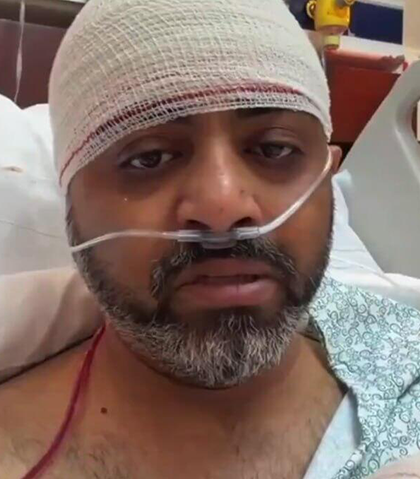
Indian captain Smith Machachar in the hospital. His heroism saved many lives
After al-Hamami was subdued and the plane stabilized, the replacement pilots requested permission to land in Jordan. Jordanian authorities initially refused after learning there was a suspected hijacking aboard the aircraft.
Channel 13 reported that al-Hamami told investigators: “I searched and checked which airline flew to Tel Aviv, and that’s why I chose Flydubai. I tried to get into all the airlines. I planned the operation before I was even hired by the company.”
According to an investigation by the Italian newspaper Corriere della Sera, al-Hamami disconnected the autopilot, seized the controls, shut down the engines in flight and pushed the control column forward with full force.
The aircraft lost 16,000 feet of altitude in less than a minute.
Netanyahu orders review based on recommendation made more than two years ago
Five days after the attempted crash, Prime Minister Benjamin Netanyahu publicly acknowledged for the first time that the incident exposed significant failures and security gaps.
According to his office, Netanyahu instructed National Security Council chief Shmuel Ben Ezra to “appoint an examiner to conduct a thorough review of all aspects of the security of foreign civil aviation to Israel.”
It remains unclear how quickly the review will proceed or whether the security gaps it identifies will be closed promptly.
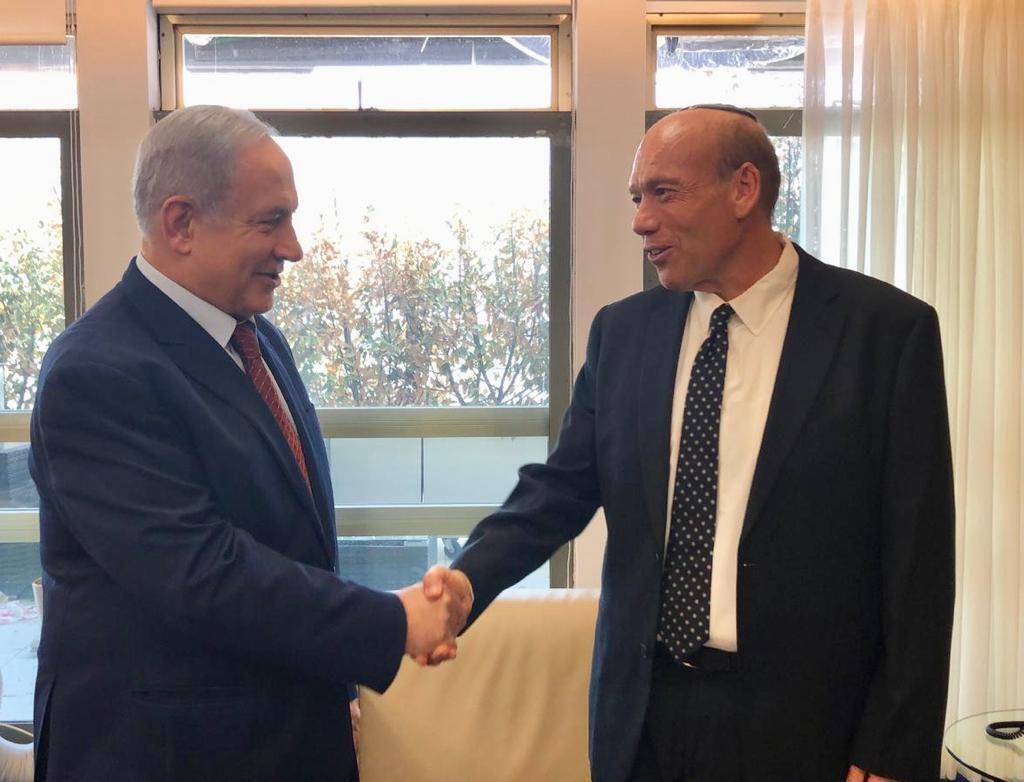
State Comptroller-elect Matanyahu Englman with Prime Minister Benjamin Netanyahu
The review ordered by Netanyahu will be internal, however, and the person heading it will not have investigative or enforcement powers. Ben Ezra’s National Security Council has already been responsible for addressing the issue.
In May 2024, State Comptroller Matanyahu Englman published a report on the security of international civil aviation to and from Israel, identifying serious deficiencies and gaps, including in security arrangements for foreign airlines.
One of its main recommendations was that the National Security Council coordinate work among the Transportation Ministry, Finance Ministry, Israel Airports Authority, Shin Bet domestic security agency and police to formulate a comprehensive new aviation-security policy.
Who is responsible for screening foreign pilots?
On paper, responsibility for foreign flights lies with Israel’s Transportation Ministry.
Its Security, Emergency and Cyber Division, through the Aviation Security Operations Center, is tasked with assessing the security risk posed by foreign flights and issuing security instructions to airlines.
The ministry argues, however, that it is not an intelligence agency and lacks the tools to perform intelligence background checks on crew members and passengers. Its procedures therefore depend partly on security arrangements in the countries of origin and on commitments provided by the airlines themselves.
In the case of the Flydubai flight, it emerged that the Transportation Ministry had never received the crew list.
The Emirati airline had committed to vetting its own crew members and had even told Israel that it had introduced restrictions into its scheduling system designed to prevent pilots from countries without diplomatic relations with Israel from being assigned to Israel-bound flights.
Despite that commitment, al-Hamami, an Omani citizen, was assigned to the flight.
It also emerged that under Israel’s 2023 National Passenger Analysis Center law, the Transportation Ministry’s security division is permitted access to a database containing information on crew members aboard foreign flights. Since the database was created, however, the ministry had not requested such access.
The security division is also facing a significant manpower shortage.
Between 2022 and 2025, eight employees left the division, while its official staffing allocation fell from 21 positions to 19. Six of those positions are part-time jobs intended for students and senior citizens, and at least two senior posts are listed as vacant but unfunded.
In practice, according to published figures, the division operates Israel’s transportation security and emergency apparatus with only about 10 permanent full-time employees.
The proposal to establish a single agency with overall responsibility for aviation security is also far from new.
A proposal to create a national aviation-security authority was submitted to the prime minister as early as 2011. According to the Transportation Ministry, two committees headed by the National Security Council subsequently recommended establishing such a body.
Those recommendations were never implemented.
Following the attempted Flydubai attack, responsibility for addressing the issue has now returned to the National Security Council, this time under Netanyahu’s directive to conduct a “thorough review” of the entire security system.
Danny Shenar, who headed the Transportation Ministry’s security division for 25 years, warned that the risk is not limited to Dubai.
Major airports such as Athens have sophisticated security systems, he said, but smaller airports on islands and in peripheral destinations often have far weaker safeguards, even though flights depart from them directly for Israel.
“That is where the danger lies,” he warned.
Radical posts and a deleted social-media trail
Al-Hamami, an Omani citizen, was born in the United Arab Emirates to an Omani father and Syrian mother and spent part of his life in the UAE.
According to a LinkedIn profile bearing his name that was deleted after the attempted crash, he worked at Oman Air for seven years, until February 2025.
In 2024, while still serving as a first officer at Oman Air, extremist material was reportedly found in his possession. He nevertheless remained employed by the airline in a desk position.
CBS reported a somewhat different account, saying he had worked for Oman’s national airline only “for a short time” and that he was suspended from flying after accessing extremist websites.
According to the same LinkedIn profile, he joined Morocco’s Royal Air Maroc in June 2025 and left six months later, in January 2026. The airline, however, said al-Hamami completed three months of training but was never ultimately employed by the company.
A diplomat from a Gulf state told AP that the pilot underwent standard security checks before he was hired, but that those checks appeared to focus on whether he had a criminal record rather than examining his broader background or possible signs of radicalization.
CNN reported that only two posts appeared on the LinkedIn account associated with al-Hamami, both published on Wednesday, nine hours after the attempted attack.
It was unclear who uploaded them, CNN said, though the network raised the possibility that the posts had been scheduled in advance.
The first contained a series of videos filmed from the cockpit of Boeing 737 MAX aircraft, the same model as the Flydubai jet al-Hamami allegedly tried to crash.
One clip, according to CNN, was filmed at Dubai International Airport and showed the person behind the camera zooming in on an El Al aircraft.
The cockpit screen visible in the footage showed the flight number of an Oman Air flight from Dubai to Muscat on Oct. 11, 2023, several days after the Hamas massacre in southern Israel.
The post included additional videos showing El Al aircraft, as well as one Arkia plane, and ended with footage of al-Qaeda leader Ayman al-Zawahiri, Osama bin Laden’s successor, who was killed in a U.S. strike.
A second post on the deleted LinkedIn account featured an AI-generated image depicting Islam’s three holy cities, Mecca, Medina and Jerusalem, connected by a continuous glowing path. A song heard in the background included statements rejecting “humiliation,” while the speaker said he did not fear death and was defending his honor.
CNN also reported that an account on X bearing the pilot’s name, which has since been deleted, contained extremist religious views.
The network said the account had contained around 3,000 posts. Some described his mother’s difficulty finding him a prospective wife willing, at his insistence, to wear a niqab, the Muslim face covering that leaves only a narrow opening for the eyes.
“They all refused. Then my mother told them, ‘My son is a pilot,’ and suddenly they all agreed,” read one post from February 2022.
Another post, from January 2022, expressed opposition to men and women working together: “How many respectable and religious young women were ruined in mixed workplaces of men and women and manipulated?”
In another post, he wrote: “I don’t know how you have the patience to talk to one girl for four years. Most girls I talk to last two or three days, and I give them 100 tests, including the whore test. Thank God, none survived more than a week with me.”