


The heightened military alert declared by IDF Chief of Staff Lt. Gen. Eyal Zamir roughly a week and a half ago was driven by fears of a dangerous miscalculation involving Iran. His message to Israel's political leadership was clear: The military wants to avoid inflammatory statements and provocative operations that could trigger an Iranian response or convince Tehran that a U.S.-Israeli attack is imminent.
Such a misunderstanding could lead Iran to launch a preemptive strike, even if Israel and the United States had not yet decided to attack.
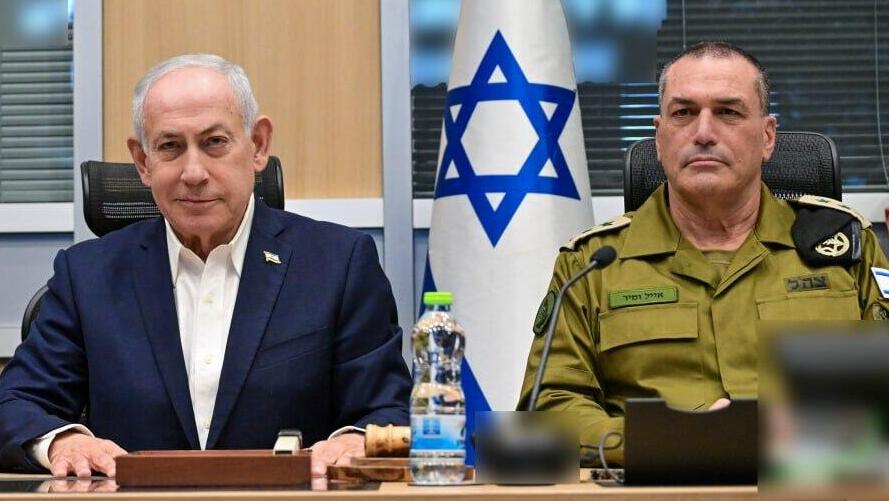
Netanyahu's warnings, Zamir's fears and the Iraq strikes no one has confirmed
(Photo: Kobi Gideon/GPO)
But Prime Minister Benjamin Netanyahu and Defense Minister Israel Katz have continued issuing warnings to Tehran, raising concerns that Iranian leaders could conclude a joint U.S.-Israeli operation is approaching, potentially before the U.S. midterm elections on November 3.
The tensions between Israel's political and military leadership have now surfaced publicly, alongside reports of mysterious attacks on Iranian-supplied military equipment in Iraq.
The reported confrontation between Netanyahu and Zamir
On Sunday, Channel 12 reported details of a serious confrontation between Netanyahu and Zamir over an undisclosed military operation connected to Iran.
According to the report, Zamir recently received instructions from the political leadership but requested an extensive discussion before implementing them. He also sought formal, signed legal authorization from the political echelon for the proposed action.
A security source said the operation could trigger a rapid confrontation with Iran at an exceptionally sensitive moment, potentially resulting in precisely the kind of miscalculation the IDF chief has been seeking to prevent.
Two sources said the atmosphere at a meeting held Sunday at Palmachim Airbase was extremely tense.
Netanyahu denied that any confrontation had occurred.
"There is no clash," he told Channel 14. "Someone is trying to obscure the fact that the chief of staff himself said Iran is trying to interfere in the elections."
The prime minister's remarks referred to warnings by Israeli security officials about possible Iranian attempts to disrupt the Israeli election, scheduled for Tuesday.
The precise nature of the military directive at the center of the reported dispute has not been disclosed.
The mysterious attacks in Iraq
A separate development may help explain the broader strategic tensions surrounding Iran and Israel's military activities.
According to a report published Saturday by the Saudi newspaper Asharq Al-Awsat, Iraqi authorities suspect that two facilities storing air defense systems supplied by Iran to pro-Iranian militias were targeted in airstrikes last week.
The weapons reportedly included portable antiaircraft missile systems intended to provide an additional defensive layer in eastern Iraq.
The militias were apparently preparing to use these systems as a forward line of defense against Israeli Air Force fighter jets and drones in the event of another Israeli attack on Iran.
That would potentially complicate Israeli air operations by placing air defense assets outside Iranian territory, along routes that Israeli aircraft might use in a future operation.
According to the assessment presented here, an Israeli Air Force attack against such targets has already taken place in recent days, possibly using drones or precision-guided weapons launched from a distance.
Reports of the suspected operation appeared in a limited number of Arab media outlets. However, Israel has not officially acknowledged carrying out the strike, and the Iraqi government has neither confirmed nor denied Israeli involvement.
The identity of those responsible and the precise circumstances of the reported attacks therefore remain unconfirmed.
Why Netanyahu and Zamir see the risks differently
Netanyahu has sought to assist Saudi Arabia and Iranian Kurdish groups operating in northern Iraq through operations against the militias threatening them.
Both have come under attack from Iran-aligned armed groups, making the militias a concern not only for Israel but also for other regional actors.
Zamir, however, is understood to believe that Israel has already accomplished enough through previous operations, some conducted in cooperation with the Americans.
His concern is that further operations, or even public reports about them, could put pressure on Tehran to respond.
Iran's leadership may feel compelled to defend the Iraqi Shiite militias that remain loyal to it, particularly given the financial and operational support those groups have received from the Islamic Revolutionary Guard Corps' Quds Force.
Iran has provided money to these militias, including funding that enabled the Quds Force to pay their personnel.
Any Iranian intervention on behalf of the militias could expand an otherwise limited confrontation into a wider conflict.
Iran's strategy after the US withdrawal
The regional situation has become more complicated since U.S. forces completed their withdrawal from Iraq at the end of September.
Iran's Revolutionary Guard Corps is now attempting to exploit the new circumstances by positioning Iraqi Shiite militias as an additional defensive shield for Iran.
This involves developing air defense capabilities on Iraqi soil that could threaten aircraft approaching Iranian airspace.
The militias also serve another strategic purpose for Tehran: They can operate against Saudi Arabia in support of the Iran-backed Houthis in Yemen.
In this way, the Iraqi militias are becoming increasingly important to Iran's regional military posture, both as an additional layer of defense and as a means of applying pressure on neighboring countries.
The Asharq Al-Awsat report suggested that officials in Baghdad were examining intelligence assessments raising an even more consequential possibility: that the U.S.-Israeli war against Iran may already have resumed, not through direct attacks on Iranian territory but through operations targeting Iranian military assets and allied forces inside Iraq.
The October 17 explosion and unanswered questions
One incident being examined took place on October 17, when Iraq's Popular Mobilization Forces, known in Arabic as Hashd al-Shaabi, reported an explosion at an ammunition storage facility at one of its bases in the Baghdad area.
The organization said a fire had broken out following an explosion in an ammunition depot and that its personnel had brought the blaze under control. Five people sustained minor injuries.
The Iran-aligned militia umbrella organization announced that an investigation was underway to determine the circumstances of the incident.
More than a week later, however, no findings had been publicly released.
The Saudi report raised questions about whether the incident could be connected to the suspected attacks on weapons facilities storing Iranian-supplied air defense systems. No confirmed evidence establishing such a connection has been made public.
The uncertainty surrounding the Iraq incidents illustrates the challenge confronting Israel's military and political leadership. Operations intended to weaken Iran's regional defenses may carry limited immediate risks, but the cumulative effect of military action, public threats and Iranian fears of an imminent attack could prove much harder to control.
For Zamir, that possibility appears to be the central concern: An operation intended to strengthen Israel's security could instead produce the rapid escalation that the military is trying to avoid, particularly in the politically sensitive days surrounding Israel's election.