

Western and central Europe continued to struggle Tuesday with a severe heatwave that has brought record temperatures, major disruptions to daily life and a rising death toll.
In France, authorities said at least 40 people had drowned while trying to cool off in lakes and rivers during the extreme heat. The announcement came after the country recorded its hottest June day ever. In Britain, more than 300 schools were closed because of the heat, which could also break the country’s June temperature record and possibly its all-time record. Italy, Spain, Portugal, Switzerland, Germany, Belgium and other countries are also dealing with extreme temperatures.

The heatwave began over the weekend but is expected to worsen in the coming days, with forecasters saying relief is unlikely before Friday. The heat is being driven by a dome of hot air known as an “omega block,” named for an atmospheric pattern shaped like the Greek letter omega, Ω. The system traps hot air in place, allowing temperatures to rise day after day.
British climate scientist Claire Barnes said the hot air originated in North Africa’s Sahara Desert. “This mass is moving very slowly, which means there is almost no wind, not even a light breeze for relief,” she said.
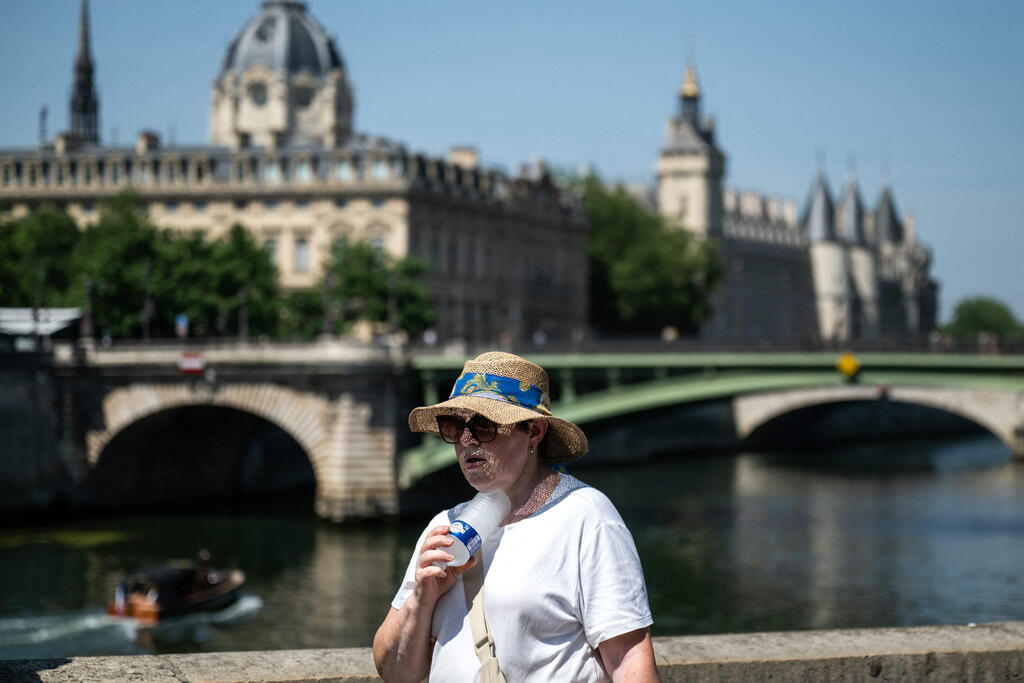
France has been hit hardest so far. On Monday, the country recorded 43.3°C in the village of Châteaumeillant in central France, setting a new national record for June. Overnight temperatures have also offered little relief, especially in a country where most homes do not have air conditioning. France also recorded its hottest night ever between Monday and Tuesday, with an average temperature of 21.6°C.
The French weather service expanded its highest red heat alert from 35 departments to 54, more than half the country, setting another record. Météo-France warned that many areas could approach 40°C by the end of the week. On Tuesday, 43.1°C was recorded in the Vardes area in western France.
“Further record-breaking temperatures are expected, including temperatures that could surpass all previous records at any time of year,” Météo-France warned.
(Photo: ARNAUD FINISTRE / AFP)
The current heatwave is being compared in France to the deadly summer of 2003, when an estimated 15,000 people died from heat-related causes, many of them elderly people living in apartments or nursing homes without air conditioning. Several deaths of elderly people have already been reported in France in recent days. Authorities also said at least 40 people, most of them young, had drowned since Thursday while trying to cool off in rivers or lakes. Among them was a 13-year-old girl who drowned Sunday evening while swimming with her family in the Seine River at Fontaine-le-Port, despite not knowing how to swim, according to reports.
Sports and Youth Minister Marina Ferrari warned the public not to ignore safety instructions and urged people to enter the water only in supervised areas.
The heat has also disrupted public transportation. Some trains in France were canceled, including services on the Paris-Brussels line. Authorities in Paris urged residents to avoid using trains when possible and recommended staying home. Patrick Martin, head of the French employers’ organization MEDEF, told local media that “France is operating at a slower pace,” with businesses implementing worker-protection measures where possible.
The Eiffel Tower closed early Tuesday, at 4 p.m. local time, far earlier than its usual 12:45 a.m. closing time. “We have to adapt to the extreme heat, with the safety of our teams and visitors as the top priority,” the tower’s operating company said. It said the site was also likely to close early on Wednesday. In southwestern France, a nuclear reactor was shut down after the temperature of water from the Garonne River, used to cool the plant, rose above the permitted threshold of 28°C.
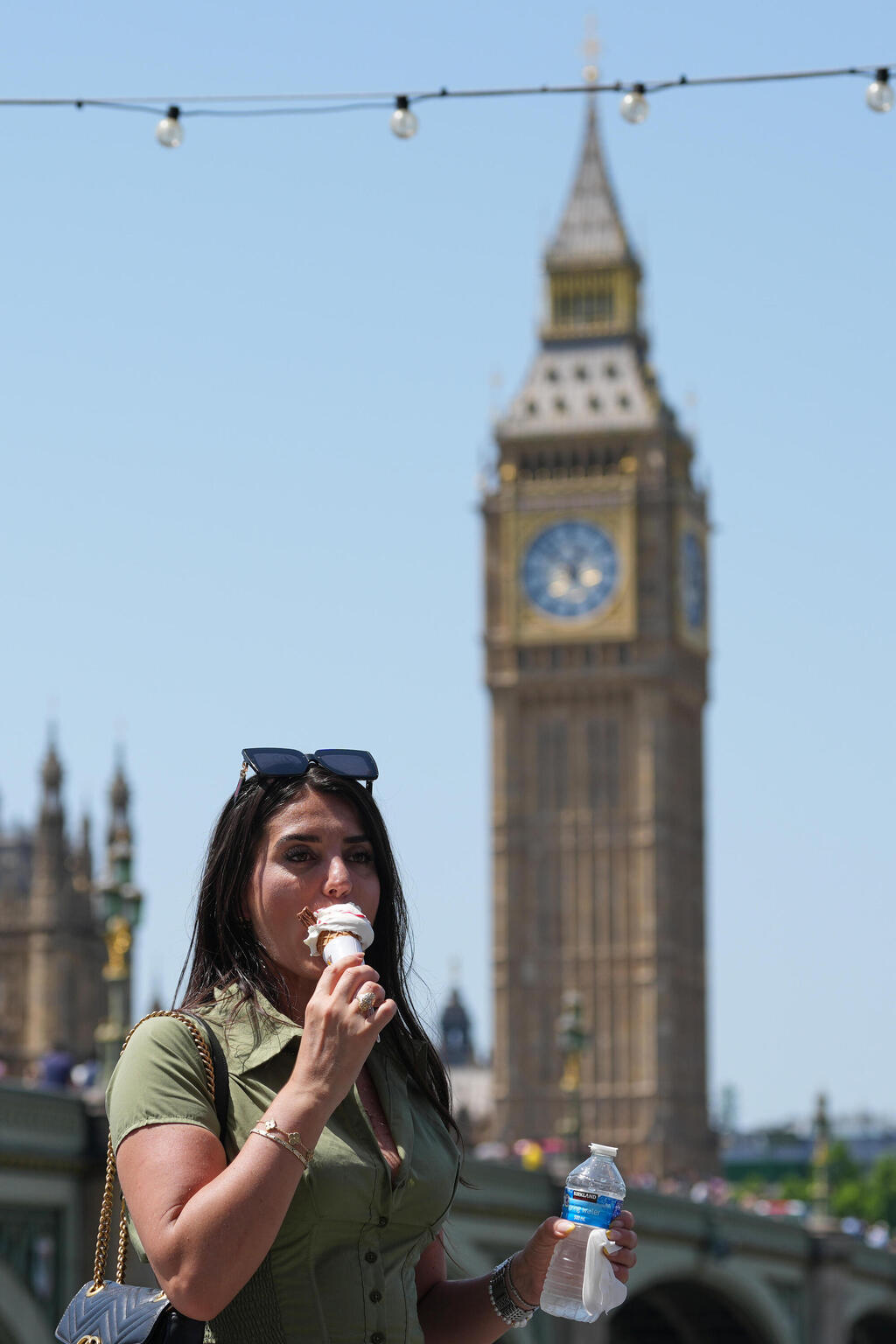
Across the English Channel, Britain is also preparing for possible records. The UK Met Office issued a red heat warning, its highest level, for Wednesday and Thursday across parts of central and southern England, including London and Birmingham, as well as the Cardiff area in Wales. Temperatures in some parts of England could reach 39°C, with 37°C in the shade. The June temperature records for England and Wales, 35.6°C and 33.7°C respectively, are expected to be easily broken.
(Photo: AP Photo/Kirsty Wigglesworth)
The BBC published advice for residents, many of whom also do not have air conditioning at home. It recommended opening windows on opposite sides of homes to create airflow, placing a fan near an open window and putting ice cubes in front of a fan to cool the air.
On Tuesday, classes were fully or partially canceled at 312 schools across Britain, and rail services were also heavily disrupted. National Rail urged people to travel on Wednesday and Thursday only “if absolutely necessary.” Overnight storms also hit parts of England. The Met Office recorded 29,074 lightning strikes in southern Britain, including 3,000 in London in just two hours. According to the Daily Mail, two homes in London caught fire after lightning strikes, while Sky News reported another lightning-related house fire in Bristol. No injuries were reported.
In Spain, temperatures reached up to 44°C in areas such as Córdoba in Andalusia. Tropical nights are also affecting the country, with temperatures remaining above 25°C at about 30 weather stations between Monday and Tuesday. Conditions were especially severe in Almería, where temperatures did not fall below 30°C for three consecutive nights. “Almería does not sleep: a night from hell with temperatures above 30 degrees and highs above 40,” local newspaper La Voz de Almería reported.
Madrid opened “climate shelters” for people especially vulnerable to the heat, including the homeless. Juan Carlos Arellano of the Samur Social welfare organization said the shelters provide air-conditioned spaces, basic food, showers and a place to rest.
In northern Spain, dozens of local authorities banned bonfires planned for the night of San Juan, a holiday marking the birth of John the Baptist. The tradition usually includes large bonfires, jumping over flames and midnight swims.
(Photo: AP Photo/Alessandra Tarantino)
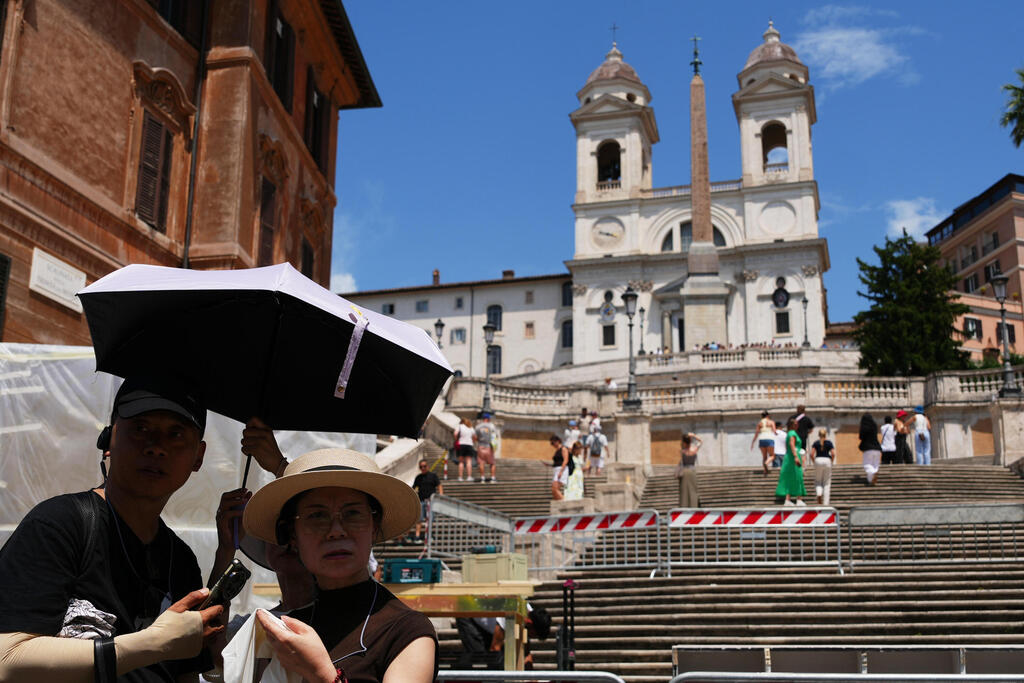
In Italy, red heat alerts, the highest level, were issued in 15 cities, including Rome, Milan, Florence, Turin and Venice. The government introduced emergency guidelines to protect outdoor workers, including agricultural and construction workers, from being required to work during the hottest hours of the day.
Germany is preparing for temperatures of up to 40°C later this week in the west and south of the country. Authorities said six people drowned between Friday and Sunday. In Switzerland, authorities in the northeastern canton of St. Gallen restricted water withdrawals from rivers and lakes, saying surface water and groundwater levels were too low.
As southern and western Europe sweltered, cooler northern destinations drew tourists trying to escape the heat. “We thought about going to Croatia, but we came to Sweden because it is cooler here,” German tourist Katharina Rexing told Reuters in Stockholm’s old city, where the temperature was 22°C compared with 30°C in Zagreb.
Europe has faced repeated heatwaves in recent decades, and scientists say human-caused climate change is making them more frequent and more intense. Burning gasoline, oil and coal, as well as deforestation, wildfires and many industrial activities, releases heat-trapping gases that drive climate change and increase extreme heat and drought events.
According to World Health Organization estimates, more than 200,000 people have died across Europe in the past four years from heat-related causes, most of them preventable. For many in Europe, the current heatwave is already the second since the start of the summer.
The EU’s Copernicus Climate Change Service says Europe is the fastest-warming continent in the world, with temperatures rising at twice the global average since the 1980s. The agency found that 2024 was the hottest year on record both in Europe and globally, and that Europe experienced its second-highest number of heat-stress days ever.
UN Secretary-General António Guterres urged countries Tuesday to intensify action against climate change and cut greenhouse gas emissions. Paraphrasing The Clash’s song “London Calling,” he said: “London is not just calling. It is cooking.”
“The climate crisis is pushing us deeper into higher temperatures and closer to catastrophic tipping points, and the energy crisis exposes the folly of a world addicted to hydrocarbons,” Guterres said. “On the surface, these crises may seem separate, but they share the same destructive source: fossil fuels.”