


Representatives from Israel, the United States and Arab countries, including states that do not maintain diplomatic relations with Israel, gathered in Washington on Tuesday for the fourth MEAD conference, a closely guarded forum focused on regional security and cooperation.
Delegates from 24 countries are taking part in the conference, including representatives from Israel, the U.S. and 12 Middle Eastern states.
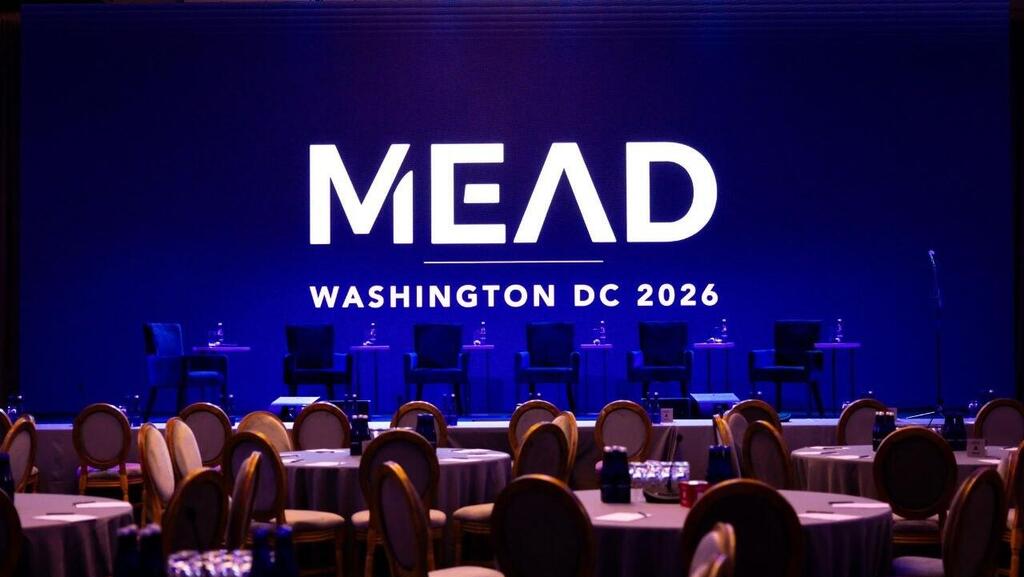
The fourth MEAD conference in Washington, D.C.
(Photo: Itzik Belenitzki)
The gathering comes amid continued uncertainty over the confrontation with Iran and a series of unresolved regional security questions left by the fighting across the Middle East.
Among the issues on the agenda are shipping arrangements through the Strait of Hormuz, the situation in Lebanon, efforts toward an arrangement in Gaza and the future of Iran's nuclear program. Participants are also examining possible new frameworks for regional security cooperation.
The conference is taking place ahead of elections in Israel and the U.S. midterm elections, political contests expected to influence the future of U.S.-Israel relations and Washington's broader policy in the region.
One of the most unusual aspects of the meeting is the participation of representatives from countries that have no formal diplomatic relations with Israel.
As in previous years, Middle Eastern states without official ties to Jerusalem have chosen to send representatives, participation made possible in part by the conference's confidentiality rules.
In recent years, the MEAD conference has developed into a forum for discussions among senior figures from the U.S., Israel and other Middle Eastern countries on regional policy and security.
The event brings together political leaders, senior policymakers and other officials for discussions intended to strengthen alliances, encourage dialogue and develop strategic approaches to regional challenges.
Discussions cover security, intelligence, technology, business, energy, finance and governance, with a broader focus on strengthening U.S. engagement in the Middle East and encouraging greater regional integration.
Energy security and freedom of navigation are also prominent on the agenda, after both shifted over the past year from primarily economic concerns to major security issues.
A central feature of the conference is its use of the Chatham House Rule, which allows participants to use information shared during discussions but bars them from identifying who made particular remarks or revealing their affiliation.
Organizers say the confidentiality is intended to encourage candid discussions, including exchanges involving sensitive information, without participants having to fear immediate public attribution.
That framework is particularly significant because it allows dialogue between representatives of countries that would rarely, if ever, meet openly within formal diplomatic channels.
At a time when almost every public statement in the region is closely scrutinized, the closed-door setting gives participants greater room to discuss areas of disagreement, test possible policy approaches and build trust away from the spotlight.