

“We believe that in addition to nuclear weapons, other types of weapons of mass destruction, such as chemical and biological weapons, pose a serious threat to humanity. The Iranian nation, which has itself been a victim of chemical weapons, feels more than any other nation the danger caused by the production and stockpiling of such weapons, and is ready to use all available means to confront such threats. We consider the use of such weapons to be ‘haram,’ and believe it is the duty of all to work to protect humanity from this great disaster.”
This is the wording of the fatwa, or Islamic ruling, that Iran claims its former supreme leader, Ali Khamenei, issued in the mid-1990s. The ruling was revealed only in 2003, when Iran’s nuclear program first drew international attention, as part of the Islamic Republic’s effort to counter accusations that it was developing nuclear weapons.
Gallery
Khamenei’s son has not stated whether he will adopt his father’s policy, who at least publicly opposed nuclear weapons
(Photo: shuttertsock)
Over the years, Iran has repeatedly relied on this fatwa as supposed proof of its intentions, despite mounting evidence of efforts to develop weapons of mass destruction. Officials in Tehran have consistently repeated the claim that the nuclear program serves only civilian purposes, even as Iran began enriching uranium in the late 2010s to levels as high as 60 percent, close to weapons-grade levels that have no civilian use.
Since Iran’s confrontation with Israel became direct in 2024, and especially since last year’s war in June, voices within the ayatollah regime have increasingly called for reconsidering the public ban on nuclear weapons. Even then, Khamenei insisted, at least publicly, that Iran would never develop such weapons.
Western analysts often viewed this as an attempt to maintain deterrence by keeping Iran as a nuclear threshold state, one that approaches the capability to develop a bomb without actually possessing one.
But in the opening strike of Operation Roaring Lion, Khamenei was killed. His son, Mojtaba Khamenei, who replaced him, has not publicly stated what his policy will be regarding nuclear weapons development, or whether he will adhere to his father’s fatwa.
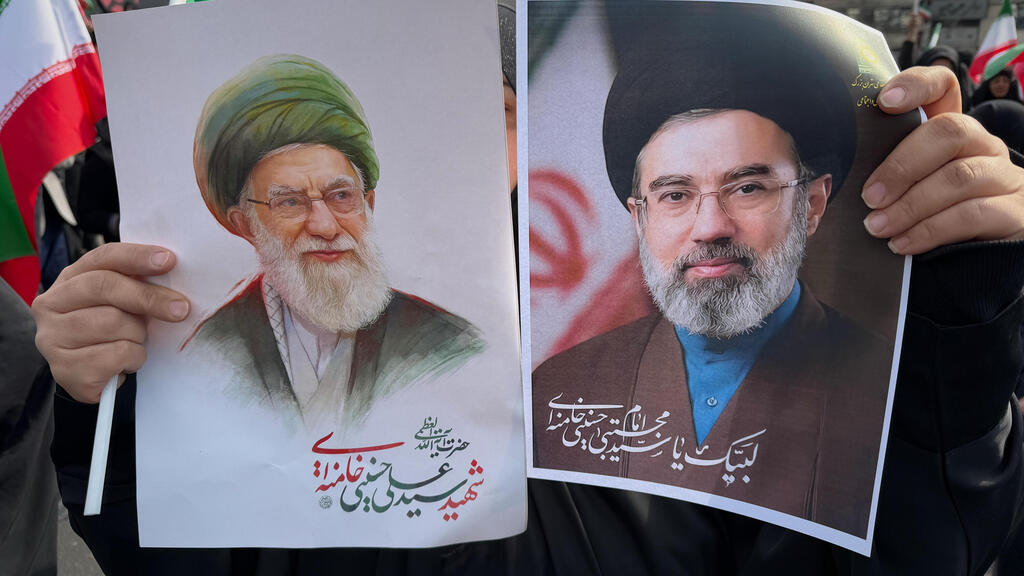
טהרן איראן חגיגות מינוי מוג'תבא חמינאי למנהיג העליון
(Photo: AP/ Vahid Salemi)
Iranian Foreign Minister Abbas Araghchi was asked this month in an interview with Al Jazeera whether the stated ban on nuclear weapons might change. He said he did not know what position the new supreme leader would take.
“My understanding is that it will not be different from our previous policy, but we need to wait until we are aware of his positions,” Araghchi said.
Growing calls to abandon the ban
CNN reported that since the war began, calls within Iran to abandon the fatwa have only intensified, particularly as more extreme elements within the Islamic Revolutionary Guard Corps have expanded their influence following the killing of Khamenei and other senior officials.
“The surviving leadership in Iran faces increasing domestic calls to change nuclear policy. This pressure is intensifying as the Revolutionary Guard consolidates power and appoints retired commanders from the hardline camp to lead a younger, more vengeful generation of fighters,” the network reported.
As an example, CNN cited remarks by Iranian hardline commentator Nasser Torabi, who said in a segment aired this month on Iranian television: “We have entered a new phase. After this war, Iran will be recognized as a global superpower... We must take steps to develop or possess nuclear weapons.”
Sina Azodi, an expert on Iran’s nuclear program at George Washington University, told CNN that hardliners now see an opportunity to shift Iran’s declared doctrine against nuclear weapons.
“One of the reasons they showed nuclear restraint was fear of Israeli and U.S. strikes,” Azodi said. “But at this point, when those strikes have happened anyway, all the cards have been reshuffled. This war has fundamentally changed everything, because Iran has taken many blows.”
Nuclear capability remains
Iran’s nuclear program suffered heavy damage in last year’s war, when Israel and the United States struck its main facilities. President Donald Trump said at the time that the nuclear sites at Fordo, Natanz and Isfahan had been “completely destroyed,” a claim that was questioned even then.
In any case, Iran still retains a large stockpile of enriched uranium. According to the International Atomic Energy Agency, Iran had about 10,000 kilograms of uranium enriched to various levels before the war, mostly low-level, but 440.9 kilograms enriched to 60 percent, a level from which reaching weapons-grade 90 percent enrichment is relatively quick and easy.
That amount is enough for roughly 10 nuclear bombs.
The uranium enriched to 60 percent is believed to be buried beneath the nuclear sites that were attacked, about half of it in Isfahan. The concern is that Iran could retrieve it and enrich it further at hidden facilities with relative ease.

The centrifuges struck in Natanz. Witkoff warned: 'They produce them themselves. They are impossible to stop'
(Photo: AP)
Prime Minister Benjamin Netanyahu said last week that Iran no longer has the capability to enrich uranium, but U.S. envoy Steve Witkoff said earlier this month that the capability remains.
“They produce their own centrifuges for enriching this material, so it is almost impossible to stop them. They have an endless supply,” Witkoff said in an interview with Fox News.
A narrowing window
This concern is why the United States is now considering bold commando operations to extract the buried uranium, though such a mission would be highly risky and it remains unclear whether Trump would approve it. For now, he appears to prefer achieving the same outcome through a diplomatic agreement.
If the Iranian regime survives the war, and the enriched uranium is not removed, Tehran could shorten its path to nuclear capability by developing a “dirty bomb” or a simpler, more primitive nuclear device compared to those held by major powers like the United States and Russia, but one still capable of producing a massive explosion.
Such a weapon might not be mountable on a ballistic missile, but it could still demonstrate nuclear capability as part of efforts to ensure regime survival.
Trump, for his part, has pledged never to allow Iran to develop nuclear weapons and continues to insist on a complete halt to uranium enrichment on Iranian soil, a demand Iran firmly rejects.
“We cannot agree to the emergence of a second North Korea in the Middle East,” Witkoff said over the weekend.