


Even as Iran’s regime negotiated with the United States, its propaganda outlets worked around the clock to fuel a wartime atmosphere and threaten Israel, the United States and their allies. One of those outlets is Iran’s Arabic-language Al-Alam channel, which broadcast explicit threats against American bases across the Middle East that fall within range of Tehran’s ballistic missiles.
Under the headline “American bases under surveillance,” accounts affiliated with the channel published videos presenting bases in Israel and other countries. In one video, released on February 4, Camp Arifjan in Kuwait was featured with the caption: “Arifjan is a main base of the US Army, located about 55 kilometers southeast of Kuwait City. It was established in 1999 as a primary center for logistics, supply and command of US military operations in the Middle East, especially within the area of responsibility of US Central Command.”
On February 5, another video focused on Al Dhafra Air Base in the United Arab Emirates, although it listed an incorrect location. The video described it as a strategic base focused on intelligence gathering and supporting aerial combat operations. According to the clip, the base includes advanced aircraft such as F-22 stealth fighters, surveillance planes, drones and AWACS aircraft. Another site highlighted in the UAE was Jebel Ali Port, described as “one of the most important ports relied upon by the US Navy” and a docking point for aircraft carriers and warships. The video stated that the port’s assistance to the United States placed it on the target list.
Additional numbered propaganda videos targeted Prince Sultan Air Base in Saudi Arabia, Ali Al Salem Air Base in Kuwait, Camp Lemonnier in Djibouti, described as the largest permanent US military facility in Africa, and Sde Teiman base in Israel.
Prince Sultan Air Base
Another video attributed to the channel targeted Hamat Air Base in northern Lebanon, claiming that American transport aircraft land there to transfer logistical aid. The base recently made headlines after a drone flying nearby was shot down, prompting US forces on site to go on alert over security concerns. According to some Lebanese reports, the drone was privately owned and was downed by base security personnel, and US forces later apologized for the panic caused.
Lebanese Defense Minister Michel Menassa issued a statement addressing the reports regarding Hamat. He said some had linked the base to regional developments and movements in neighboring countries, and clarified: “Hamat Air Base is a Lebanese air base belonging to the Lebanese Air Force. All activities and missions at the base are carried out under the supervision, authorization and monitoring of the Lebanese Army Command.
Sde Teiman was also mentioned in the propaganda
“This base, like other military sites, hosts foreign training teams operating under Lebanese Army regulations and instructions for the benefit of various Lebanese Army units,” the statement said. “Hamat Air Base, together with the Beirut Air Base located within the perimeter of the international airport and Rayak Air Base in the Bekaa region, serves as a reception point for assistance to the Lebanese Army, including military equipment, weapons and ammunition delivered via flights from foreign countries as part of cooperation agreements. These flights are conducted with the approval and supervision of all relevant Lebanese authorities.”
Al-Alam published the propaganda alongside other regime-affiliated outlets including Fars, Tasnim, Mehr and Press TV, which operate in multiple languages, including Hebrew, to disseminate Tehran’s messages.
Iran’s missile arsenal
Those same outlets issued threats against US bases within range of Iran’s missiles. Israel and the United States are preparing for interceptions using a coordinated, multilayered air defense array that incorporates lessons from the 12-day war.
For long-range ballistic threats outside the atmosphere, the systems include Arrow 3, Arrow 2, THAAD and SM-3 interceptors launched from US naval vessels. For medium-range missiles and rockets, David’s Sling is deployed. For short-range threats, Iron Dome operates on land, “C-Dome” at sea aboard Sa’ar 6 corvettes and the Barak MX system protects infrastructure and maritime assets.
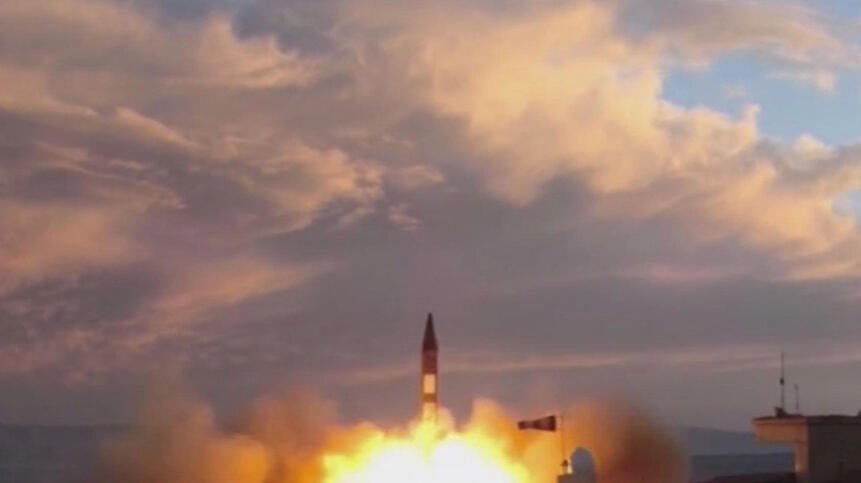
Khorramshahr missile, archive
(Photo: AFP, IRIB TV)
This is reinforced by a significant US military deployment that includes aircraft carriers, destroyers equipped with AEGIS systems, Patriot and THAAD batteries, F-15E and F-35 squadrons, and a new laser layer known as Iron Beam, integrated by Israel for rapid and low-cost interception of rockets, mortars and drones. A broader coalition could also join defensive efforts. In April 2024, the United States, Britain, France and Jordan assisted in interceptions.
“Iran has already developed missiles that can threaten Europe and our bases overseas, and they are working on building missiles that will soon reach the United States of America,” US President Donald Trump said in his State of the Union address.
Amid concerns that Iran may not limit any response to the United States and Israel, the Islamic Republic’s current arsenal includes systems capable of striking targets in parts of Europe and Africa, according to Dr. Yehoshua Kalisky, a senior researcher at the Institute for National Security Studies.
Shahab-3 has a range of between 1,300 and 2,000 kilometers and carries 750 to 1,000 kilograms of explosives. Its accuracy radius is about 1,000 meters.
Kheibar Shekan, reportedly used by Iran in the last war, has a range of 1,450 to 2,000 kilometers and can carry 250 to 1,500 kilograms of explosives. It is liquid-fueled and features maneuverability and thrust vectoring designed to complicate interception.
Haj Qassem has a range of 1,400 to 1,800 kilometers and carries 450 to 600 kilograms of explosives. It uses solid fuel, allowing launch within minutes, and has an impact radius of about 10 meters. The missile is described as hypersonic, reaching up to 15 times the speed of sound. Its destructive power stems not only from its warhead but also from the kinetic force generated by its mass at extreme velocity.
Khorramshahr has a range of 2,000 to 3,000 kilometers and can carry up to 1,800 kilograms of explosives. It maneuvers and reaches up to 12 times the speed of sound, approximately 14,200 kilometers per hour.
Emad has a range of 1,700 to 2,500 kilometers and carries up to 750 kilograms of explosives, with an accuracy of about 50 meters.
Sejjil has a range of 2,000 to 2,400 kilometers, carries up to 750 kilograms of explosives and is solid-fueled. It is relatively simple to operate, reaches about 13 times the speed of sound and features internal navigation and GPS guidance based on acceleration and angle calculations.
Fattah 1 and 2 have a range of about 2,000 kilometers and are described as hypersonic missiles with maneuvering capability and thrust vectoring.
Despite technological and military disadvantages, Kalisky said, Iran remains a global missile power. Although the Israel Defense Forces have struck launchers and damaged parts of its arsenal, “it still has a significant number.” According to Kalisky, the most dangerous missile currently in Iran’s possession is the Khorramshahr. “It is long range, maneuverable and uses a new type of fuel, likely hypergolic, which probably gives it the greatest acceleration. Its accuracy is about 30 meters, which is fairly precise. It is hypersonic and carries a warhead. But Kheibar Shekan is not far behind,” he said.