

Taiwan, the democratic island of about 23 million people, is an isolated technological powerhouse living under the shadow of its giant neighbor. China views Taiwan as a breakaway province and openly declares its intention to bring it under Beijing’s control, by force if necessary. In Taipei, officials understand that time may be running out, and the island has shifted into a mode of preparation: civilian, military and economic.
That complex diplomatic reality is felt daily inside Taiwan’s Foreign Ministry. Deputy foreign ministers Chen Ming-chi and François Chih-chung Wu describe a troubling picture of quiet warfare, one aimed at isolating Taiwan and weakening it from within.
“Beijing uses every possible tool to isolate Taiwan. We are their number one target,” Chen said. “In the past year alone, we identified 45,000 official Chinese accounts that spread some three million false posts against Taiwan.”
According to the officials, the campaign is not being waged only from afar. China, they said, exploits Taiwan’s internal political divisions to recruit messengers inside the island. “They have proxies, companies and private individuals who receive funding from Beijing and spread narratives such as, ‘Our democracy is flawed,’ ‘We cannot win,’ or ‘It is better to surrender,’” they said.
One reason the world is so closely watching the confrontation is Taiwan’s role in the most sensitive industry of the 21st century. The island produces about 80% of the world’s semiconductor industry, making any crisis in the Taiwan Strait a global economic and strategic emergency.
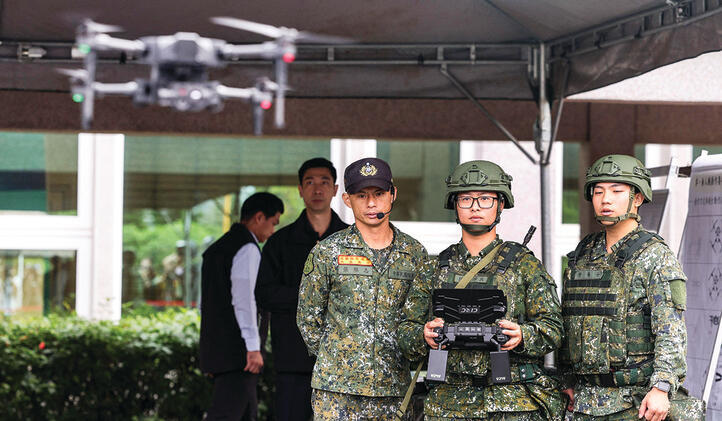
The lessons of the war in Ukraine have resonated strongly in Taipei. Ukraine showed that inexpensive drones and unmanned naval vessels can play a decisive role in slowing or stopping an invasion by a much larger army. Taiwan is studying that model closely.
In the city of Taichung, Thunder Tiger, once known for manufacturing toy cars and boats, has transformed itself into a producer of unmanned systems for military use. One of the company’s key developments is a drone guided by a fiber-optic cable. “Since it is physically connected by a wire, it cannot be jammed electronically,” said Allan Chi of Thunder Tiger.
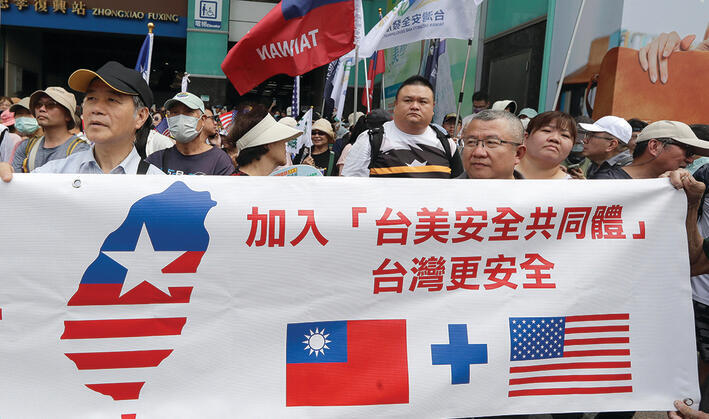
Pro-Taiwan rally
(Photo: Chiang Ying-ying, AP Photo/Chiang Ying-ying)
The struggle is also being fought on the civilian front. Taiwan’s national resilience effort is led in part by Kuma Academy, a civil defense organization that has already trained more than 100,000 citizens for a possible invasion scenario.
“About 90% of Taiwan’s population does not serve actively in the military,” said Kuma Academy CEO Fuming Chu. “Our role is to prepare them for emergencies without making them paranoid. We teach first aid, rescue, logistics and, critically, how to identify disinformation.”
Graduates of the academy are meant to form part of the backbone of Taiwan’s home front. In a crisis, they are expected to help prevent social collapse, maintain routine and counter the panic that China seeks to generate through psychological warfare. In Taiwan, where the law prohibits carrying personal firearms, civilian resilience has become a central weapon against Chinese propaganda.
Throughout the visit to the island, held at the invitation of Taiwan’s Foreign Ministry, Israel came up repeatedly as a point of deep identification and a source of operational lessons. Taiwanese officials and analysts see Israel as another small democracy surrounded by threats.
“The military and diplomatic support you receive from the United States and the Western world is far beyond what Taiwan receives,” said a representative of the Straits Exchange Foundation, the body responsible for economic relations with China. “Israel does excellent work in gathering intelligence and fighting the infiltration of spies. That is something we must improve. But beyond that, we see the determination of your people. We need to learn from you how to put disagreements aside.”
Taipei’s daily routine still projects business as usual. Streets remain crowded, nightlife continues and markets draw large numbers of visitors. But beneath that surface, a vast engine of preparation is running.
Taiwan is not seeking confrontation, but it is no longer willing to see itself as a victim. Faced with Beijing’s growing pressure, the island understands that the future of democracy in East Asia may depend on its willingness and its ability to defend itself.