


U.S. President Donald Trump’s announcement that he had canceled another large-scale strike on Iran after the outlines of a possible agreement were reached caught Israelis at the height of the summer travel season, when airports, vacations and overseas flights are at their busiest.
Yet while the Israeli public continues to endure daily uncertainty over whether the country could be drawn deeper into the confrontation with Iran, the government has again remained silent, apparently wary of being portrayed internationally as the side pushing for war.
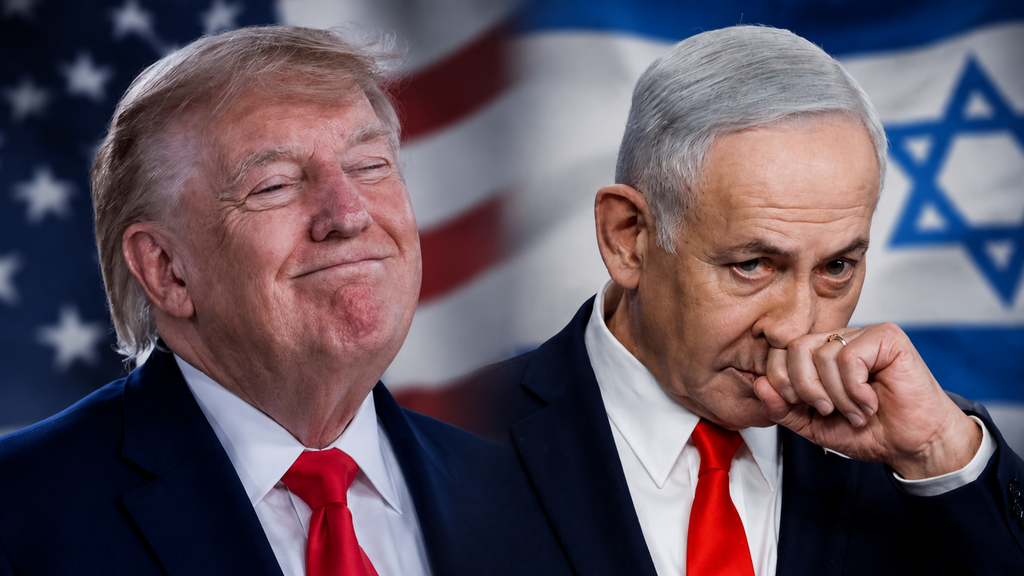
Donald Trump and Benjamin Netanyahu
(Photo: REUTERS/Evelyn Hockstein)
The silence continued even after Trump said Israel had joined his commitment to refrain from military action.
“The country of Israel joins me in this commitment,” Trump wrote on Truth Social after announcing that he had agreed to cancel the planned attack, provided that a deal could be reached quickly.
There was no immediate public confirmation from Jerusalem.
Trump’s decision marked the latest sharp shift in a policy that has veered for nearly four months between threats of overwhelming military force and efforts to cool the confrontation.
Iranian officials were quick to mock the reversal.
“Trump retreated again,” Mohammad Marandi, a senior Iranian figure associated with the regime’s negotiating delegation, wrote on X shortly after the announcement.
The central issue driving the latest escalation, freedom of navigation through the Strait of Hormuz, remains unresolved.
Iran continues to oppose unrestricted passage through the strategic waterway without its approval, and no clear solution appears imminent. The strait is a critical energy route through which a significant share of Gulf oil and gas exports reaches global markets.
Weeks of U.S. strikes against Iranian military targets have failed to restore secure maritime traffic. The campaign against Iran has now entered its sixth month, leaving Israel and the wider region in prolonged uncertainty.
Only days earlier, Trump had said from Camp David that the United States was still considering further military action and warned that Washington could “hit them very hard.”
It remained unclear what would ultimately determine whether he ordered another attack.
The heightened tension prompted the U.S. State Department to issue security warnings Saturday. American embassies in 11 countries across the region, including Israel, urged U.S. citizens to consider leaving or prepare for a rapid departure in the event of escalation.
Trump said Sunday morning that Iran and other Middle Eastern countries had asked Washington to refrain from attacking.
“The U.S.A. is locked and loaded and ready to go against the Islamic Republic of Iran, at levels of Military Terror, Strength, and Power not seen since World War II,” he wrote.
“Despite this, we have just been asked by Iran, and other Middle Eastern Countries, to hold off any attack in that the perimeters of a deal has been agreed to.”
Trump said the emerging understandings would include the “immediate, complete, and total opening” of the Strait of Hormuz and an end to the Iranian nuclear threat.
“Based on this request, I have agreed, for the future benefit of the world and, likewise, the survival of a successful and prosperous Iran, to cancel the attack, subject to being able to rapidly make a deal,” he wrote.
“Get to work, everybody, and get it done.”
No additional details have been released on the terms under discussion, the timetable for negotiations or the concessions expected from either Washington or Tehran.
The announcement came after reports that Trump was seriously considering broad strikes against Iranian energy facilities and infrastructure.
U.S. officials had said no final order had been issued, but the option was under active consideration following an Iranian attempt to strike an American base in Jordan and continued disruption to shipping in the Strait of Hormuz.
Saudi Crown Prince Mohammed bin Salman reportedly played a central role behind the scenes in trying to prevent the attack.
According to reports, he warned Trump that U.S. strikes on Iranian energy infrastructure could trigger retaliation against oil and gas facilities in Saudi Arabia and other Gulf states.
Qatar, the United Arab Emirates, Turkey and Pakistan also worked in recent days to promote de-escalation and revive negotiations.
Iran, meanwhile, warned that any new American or Israeli attack would draw a forceful response.
Iranian Foreign Minister Abbas Araghchi threatened that Tehran could target energy facilities and infrastructure in Israel, Saudi Arabia, the United Arab Emirates and Qatar.
Those threats intensified fears that another strike would not remain confined to Iran but could ignite a much broader regional confrontation.
Senior Iranian officials told The New York Times that Tehran had used the ceasefire to prepare a plan for activating its proxies and intensifying attacks on U.S. allies, with the aim of imposing the heaviest possible military and economic cost on Trump.
Elements of that strategy appeared to have surfaced last week, when two liquefied natural gas storage tankers, including one under American ownership, caught fire after a drone attack near the Suez Canal.
Saudi Arabia later joined the United States in airstrikes against pro-Iranian militias in Iraq, which were suspected of attacking Saudi oil installations.
The latest uncertainty has immediate consequences for ordinary Israelis.
Families waiting in lines at Ben Gurion Airport, planning summer vacations or simply trying to get through the school break now face the constant possibility that flights could be canceled, Israeli airspace could close or a broader war could erupt.
The repeated policy reversals in Washington have turned that uncertainty into a logistical nightmare.
For now, Israelis are again left learning about the “outlines of a deal” from the U.S. president while wondering how stable those understandings are, whether Iran will reopen the Strait of Hormuz and what Trump’s latest reversal will ultimately mean for Israel’s security.